COVID Thoughts

Coronavirus (Fusion Medical)

What is next with the COVID-19 story? Most of the world is still unvaccinated, but progress is being made. 41% of the world has received at least one dose, but only 1.9% of people in low-income countries have received at least one dose. It is in unvaccinated regions where the variants to the virus develop, whether it be Tanzania, Columbia, or Northern Idaho.  Will a virus that is immune to the vaccines and deliver a deadly dose develop?  It is possible.  That is why, I believe getting the vaccine to everyone as quickly as possible is very important.  We need to stop this virus before it mutates into something worse. (The delta variant is already worse than the original virus.  What is next?)

Right now the COVID’s fourth wave has hit America hard, but things are different for this wave because many of us are vaccinated and that is making a difference. However the difference is not big enough because we do not have enough vaccinated people for herd immunity.  The risk is lower for me since I have been vaccinated.  The people I hang around with are vaccinated too, but we still need to be careful not to spread it.  Unfortunately, the unvaccinated are catching the COVID virus and hospitals are filling up.  What does America need to do?  Is mask wearing needed?  Is a lockdown needed?  Mandatory vaccinations? Right now it is mostly up to the individual, to companies, or to the local governments.  I do not have the answers.

People have different comfort levels.  Some feel the need to wear face masks and others don’t. (And there are a few, mostly elderly, where a face mask makes it more difficult for them to breathe.)  I am comfortable without a mask, but I respect those who differ and I am willing to wear a mask if it makes the individual comfortable.  I am also willing to wear masks if the store or the local government requires it.  It is a small price to pay to keep the peace and maintain relationships.  And I believe that masks do make a difference.  There are many studies that show face masks do help reduce the risk of infection.

There are conspiracy theories out there that are convincing people that the vaccines are bad for them. Yes, I consider these stories to be conspiracy theories.  The evidence is missing, and the story requires large numbers of knowledgeable people to be lying. I cannot believe that a falsehood requiring so many knowledgeable people to lie can continue without being fully exposed.  Here is an article debunking many of the myths.  I ask you to look around and ask yourself, “How many people who I know have had lasting ill effects from the vaccine?”  For me it is zero.  The vaccine does not harm people. It is a very rare case when it causes problems.  

The vaccine is effective at protecting you from the virus. If you are vaccinated there is a one in 5,000 chance per day of becoming infected, and it may actually be a one in 10,000 chance per day.  Unvaccinated people are about five times more likely to become infected with the delta variant of the COVID virus than vaccinated people.  They are now ten times more likely to be hospitalized, and 11 times more likely to die of COVID than those vaccinated.  The vaccine works. One alternative treatment touted by conspiracy theories is a potential antiviral drug, ivermectin.  Current results from the studies show that ivermectin is not effective against COVID-19. (There are some more studies in progress.)  Those considering ivermectin should be very careful, because ivermectin is dangerous to take, especially in large doses.

Should we be getting  a third shot, a “booster shot”, when many in the rest of the world do not have their first shot?  The head of the World Health Organization says, we should wait, and there appears to be a question of whether the third dose is really needed.  The rich countries have promised 1 billion doses to the poor countries, but only 15% of the promised amount has been delivered.  Should we focus on helping poor countries get vaccinated? It would help prevent new strains of the virus from developing. Or should we first protect America’s vulnerable with a third shot? I am not certain if it is an “either/or” question.  I think both can happen.  I believe that we need to get the world vaccinated, the faster the better.  The vaccines need to get to poor countries quickly, but only if the logistics are in place to get the people vaccinated.  Logistics can be a problem.  And I think third shots can happen too, but they should be the extra doses that are not going to be used by those getting their first and second doses.

With all that is happening, as Christians, we can be rest assured that our God is good and loving and in control.  We need not fear.  In the end, heaven awaits, where everything will be made right for us.

Self Destruction

I believe we are all engaged in self destruction, everyone of us, though most of us would deny it. We all are doing and thinking in ways that harm ourselves, and there are deadly consequences to our thoughts and actions.  I am talking about sin, that is the wrongdoing and wrong-thinking that we do. We are all guilty of doing it, and it is not healthy.

I know that it is not popular to talk about this today.  Sin is a countercultural topic. People for 50+ years have been saying “I’m okay and you’re okay”.  Most would say that they are, by and large, good people.  And they would say that of others too so as to at least not damage their self esteem. (It is easier to see the faults of others than to see faults in ourselves.)  Reality is we are all damaged goods. We are not okay.  We are broken and not good at all.  Problems in the world are not just out there.  The problems in the world start inside each one of us.  It is ultimately an internal problem, our own sin. 

What does sin look like?  The list of the “Seven Deadly Sins” is a good way to categorize various sins.  They are lust, gluttony, greed, sloth, wrath, envy, and pride.  Pride is considered to be the original and most serious of the sins.  It is where ego and self are directly opposed to God. It is where you say “I can do better than God”, or “I know better than God”.  It is you being self centered. According to a Vatican study, the sin that men were most likely to confess was lust,  while for women it was pride.  What is the sin category you struggle most with?

How does one fall into sin? Father Maximos of Mount Athos says the “holy elders” have described five stages of temptation to sin as: 

  1. Assault: The tempting or evil thought first attacks a person’s mind.
  2. Interaction: A person opens up a dialogue with the tempting thought.
  3. Consent: A person consents to what the tempting thought urges them to do.
  4. Captivity: A person becomes a hostage to the tempting thought, finding it more difficult to resist each time one falls.
  5. Passion or obsession: The tempting thought becomes an entrenched reality within the person’s mind.

Sin is habit forming. What can you do with that sinful habit of yours?  It is not easy to deal with, but with the Holy Spirit’s help you can nip the tempting thought in the bud.  At stage one, you ignore the tempting thought and put it out of your mind.  That is easier said than done, but it is possible. It is especially difficult if you have fallen many times to that same temptation. The sin can become second nature to you.  To help, there are a variety of 12 step recovery groups around to help and support you in your struggle.  Celebrate Recovery is a Christian 12 step recovery program that covers all you may be struggling with.  It does not matter what your addiction or sinful habit is, whether it be drugs, porn, or gossip.  Celebrate Recovery can help.  They are nationwide with groups all over the USA.

The reality of sin is depressing and very self esteem crushing, but there is good news. Each and every one of us is fully loved by God, despite our sin.  Jesus Christ came into this world to deal with sin and to restore us to God.  Because of him we can have an abundant life in him and ultimately will become free from our sin.  In Christ, we can face the brokenness of the world and of ourselves. Also because of him we have become forgiven children of God. Our sins will no longer define us. God will restore us from our self destruction and we will be made whole.

It is our 264th Monthiversary!

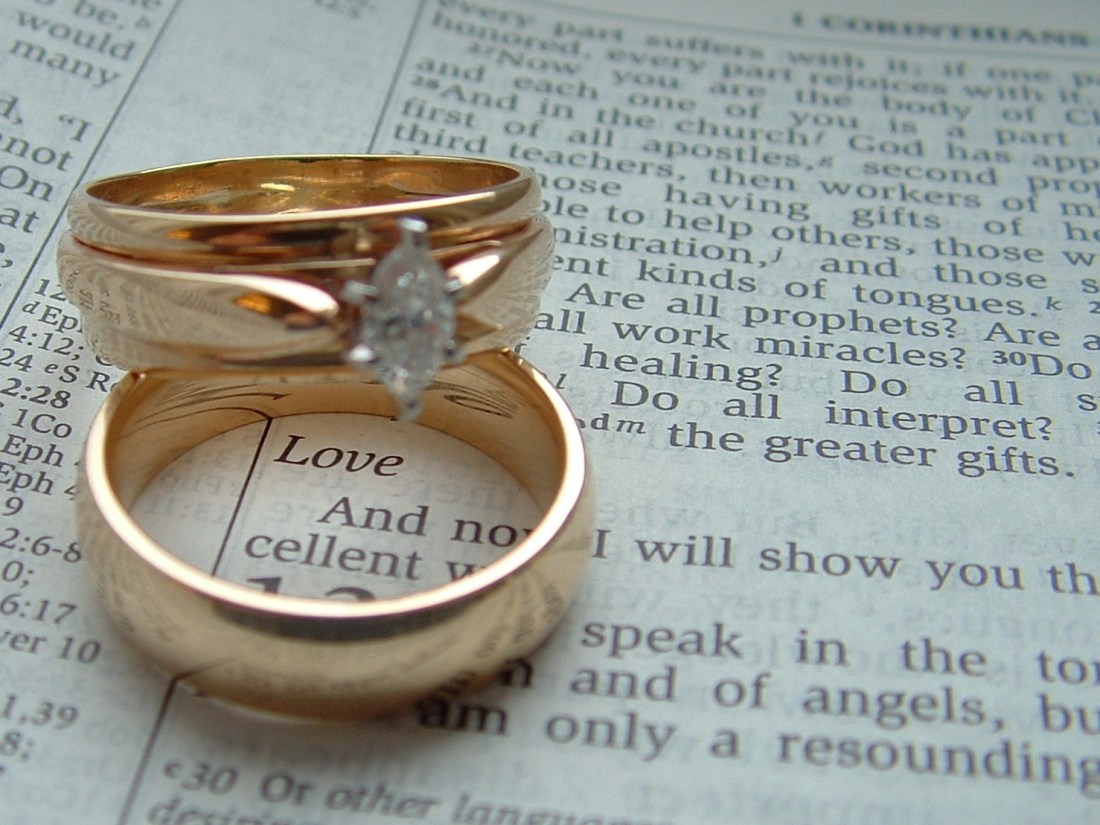
Marriage Rings Photo by Mike Goodwin

22 years ago on Sunday August 15, 1999, I married Gail Halstead. As I recounted in last year’s blog post, my life plans had not worked out as I had planned.  Instead God’s plans were better.  It was an unusual courtship back then with Gail in Oregon and me in Colorado.  Because of that distance, we did a lot of emailing. Our six month engagement turned out to be unusual too.

Two months into our engagement, I became deathly ill with Guillain Barre syndrome.  Nerves disconnected and I was paralyzed from the rib cage down with other parts of my body slightly less affected.  I could not close my eyes, or pucker my lips.  My hands were pretty useless.   I spent 2 weeks in the ICU with a total of 6 weeks in the hospital.  I then spent 7 weeks recovering in a nursing home, doing physical therapy and learning to walk again.  After that, I continued my recovery at home. I ended up missing six months of work.  My goal was to be able to walk with one cane down the aisle to get married.  That I did, however I went back to two canes after the wedding for a period of time.

In many ways, this was not totally a negative experience.  It gave Gail a chance to ask if she could love a man who might remain bedridden.  Yes, she decided she could.  She was able to get off work and fly out to visit me more often than she would have.  It was very nice to see her even though I was in bed.  I had to trust her with my finances and the selling of my townhouse. It was a bonding experience for us.  And it was a faith growing experience for me.  I grew more aware of God’s grace and goodness during this illness.

When we became engaged, Gail started reading several books on marriage and gave me three books to read.  We wanted our marriage to be successful, because it is a vow, a commitment, we make for life to each other and to God.   What I learned is that marriage takes work.  I also learned that Gail’s love language was very different from mine.  Over the years, we have taken several marriage courses to keep our marriage going strong, and of course we were always reminded that communication is very important. About a year ago, we took another marriage course, Marriage in Christ.  It is a good course and we are planning on offering it at our church. You can also take the course online.

Our marriage has turned out great.  I am very happily married to Gail.  Marriage does take work and commitment.  You can not and should not take the other person for granted. And you need to be intentional in your marriage.  They are your partner in life and with some work you can have a wonderful marriage.

Distrust!

Newspaper Boxes (photo by David Resseguie)

It seems like there is a lot of distrust in America these days. In my conversations, I have been surprised at how much distrust there is.  There is a lot of distrust on both sides of the political divide, and I believe distrust is tearing the country apart.  From my perspective, there are a lot of reasons to trust societal authorities, the government, police, journalists, etc.  So my default mode is to trust, not distrust, the authorities. This post is about why I trust, and not distrust, societal authorities even though they all have their problems. 

I believe behind much of this distrust is today’s Postmodern culture.  The culture makes us suspicious of the facts because we recognize that there is always a bias (no matter how small) in how the facts are presented.  Unfortunately, we have a tendency to believe only the stories that we want to agree with. We are not properly discerning the facts and are falling prey to the spin that promotes our preferred perspective on how things are.  There is no self correction, because we, as autonomous individuals, make ourselves out to be the only authority.  We alone can discern the truth.  All other authorities are suspect, spinning the facts to put their perspective out front. (And today’s culture also allows us to spin the facts the way we want.)

Is it true that the government, police, journalists, churches, etc. put a spin on the facts?  Yes, everyone has a bias.  That includes you and me, but I believe that American society has built in safeguards to hold people accountable for falsehoods.  It does not always work but in general I believe we can trust the societal authorities.  There  is no need for the institutional disrespect we see today.  Yes, we need to hold people and institutions accountable, and there may be biases that need to be dealt with, but in general I believe we should trust our societal institutions.

Let us first take a look at  journalists.  Their job is to report the news.  I believe conspiracy theories are due to not trusting the journalists and the news sources.  A  journalist would win a Pulitzer Prize if they could prove one of the conspiracy theories to be true.  It is that motivation and competition that keeps the journalists honest.  So whether the conspiracy theory is one of the 9/11 conspiracy theories or the “Stop the Steal” conspiracy theory or a different conspiracy theory, the likelihood that the theory is true is very unlikely.  The “what if” possibilities in the conspiracy theories are not evidence of facts.  You may want it to be true but it does not make it so.  I believe it is the distrust of societal institutions and the journalists reporting that allows these conspiracy theories to flourish.  Journalists and the institutions supplying them with information are not perfect, but in America the journalists do a pretty good job.  There are biases of varying degrees, but you need to discern those biases.  I  find the Reuters news service to be pretty unbiased.

(Yes, many of you believe the “Stop the Steal” story, but why were almost all the lawsuits dismissed and why did the Attorney General William Barr say “To date, we have not seen fraud on a scale that could have affected a different outcome in the election” if the “Stop the Steal” story is true? Maybe you want it to be true, but I believe it is not.)

Many people distrust the police.  Some would want to ban police departments, or cut the funding for the police way back.  I believe that the vast majority of police officers are good and honest.  There are few bad apples that need to be removed, and some department policies need to be reworked so that accountability can be enforced, but in general the American police are in good shape.  What happens if there are no police?  We have an example from Seattle, WA, June 2020, where for 23 days protestors occupied a few blocks in the Capitol Hill neighborhood of Seattle.  The police vacated the area, leaving their precinct station.  The protestors started with high hopes.  It was to be a police-free, self-governing utopia. Seattle’s mayor Jenny Durkan said the zone could herald a “summer of love”. Unfortunately, it turned out not to be an utopia, and after 23 days and two deaths later, Seattle’s mayor called in the police to end this utopian experiment.  The problem as I see it is that we all are sinners and we need the police to enforce some boundaries (i.e. laws) for our good.  The police are a necessary part of society. We need them but we also must hold them accountable.

There is a lot of distrust of the government, whether it be federal, state or local.  Again, like the police, I believe the vast majority of them are good honest officials, and worthy of our trust, even if we disagree with their policies.  Again there are just a few that are “bad apples”.  We need to find and remove those.  Those who distrust the government, many times say that the deep state or civil servants are hindering government change.  Both Trump and Obama supporters have been concerned about deep state interference.  My take is the federal government is a huge organization and I see making change to be like trying to quickly turn a massive oil tanker.  It will take time.

And today, churches tend to be ignored more than being distrusted.  However the sexual abuse scandals have affected the trust in churches. Again I believe the vast majority of clergy and church workers are good and honest, but churches are human institutions, and all humans are sinful so it is no surprise that scandals also are found in churches.  And yet we can put our trust in God.  He is the trustworthy one, a solid rock that can not be moved, and his love is amazing!

These societal institutions are not perfect, but in America I believe they are worthy of our trust.  They do need to be held accountable for their failings.  In America, one should default to trusting the authorities.  That is where I stand.  As a Christian, I take comfort that God has all this in his control.  Bad things may happen because of our sin but in the end God will fix all the brokenness.

Blazing Hot!

Weather vane

An extraordinary weather event occurred in the Pacific Northwest (NW) on June 26-28, 2021.  An Omega Block High set up over the British Columbia (BC) and the NW creating a heat wave.  There is nothing extraordinary about that, except for the fact this one was extremely strong.  What surprised me was the extremely high temperatures that it created. Portland, Oregon now has a higher record high temperature (116°F) than all of Colorado (115°F), and almost as high as Las Vegas, Nevada’s record (117°F).  The old records were exceeded by several degrees. Portland’s prior record was 107°F so the record was broken by 9 degrees!  It was broken for each of the three days with 116°F happening on the last day (June 28).  Seattle, Washington had only reached 100°F or more on three separate days in the past, but under this heat wave Seattle also broke 100°F for 3 days in a row (June 26-28).  But the biggest record breaker was Lytton, BC which had a record high temperature of 121.3°F. That shattered the Canadian record and it is higher than or equal to all but 4 state records in the USA.  Unfortunately for Lytton, soon after the record, a wildfire started and destroyed much of the town. For a retired meteorologist like me this heat wave was exciting, but also kind of scary.  (Note the heat in the West continues in July.)

So was this heat wave a rare event? And will it still be that rare in the future? Yes, I believe it was a very rare event.  But the second question is much harder to answer.  It depends how much climate change/global warming affects the weather in the NW.  I believe in human-caused global warming, so I am not a denier, but I am not an alarmist either.  I believe the world is warming and I believe it is at least partially due to humankind.

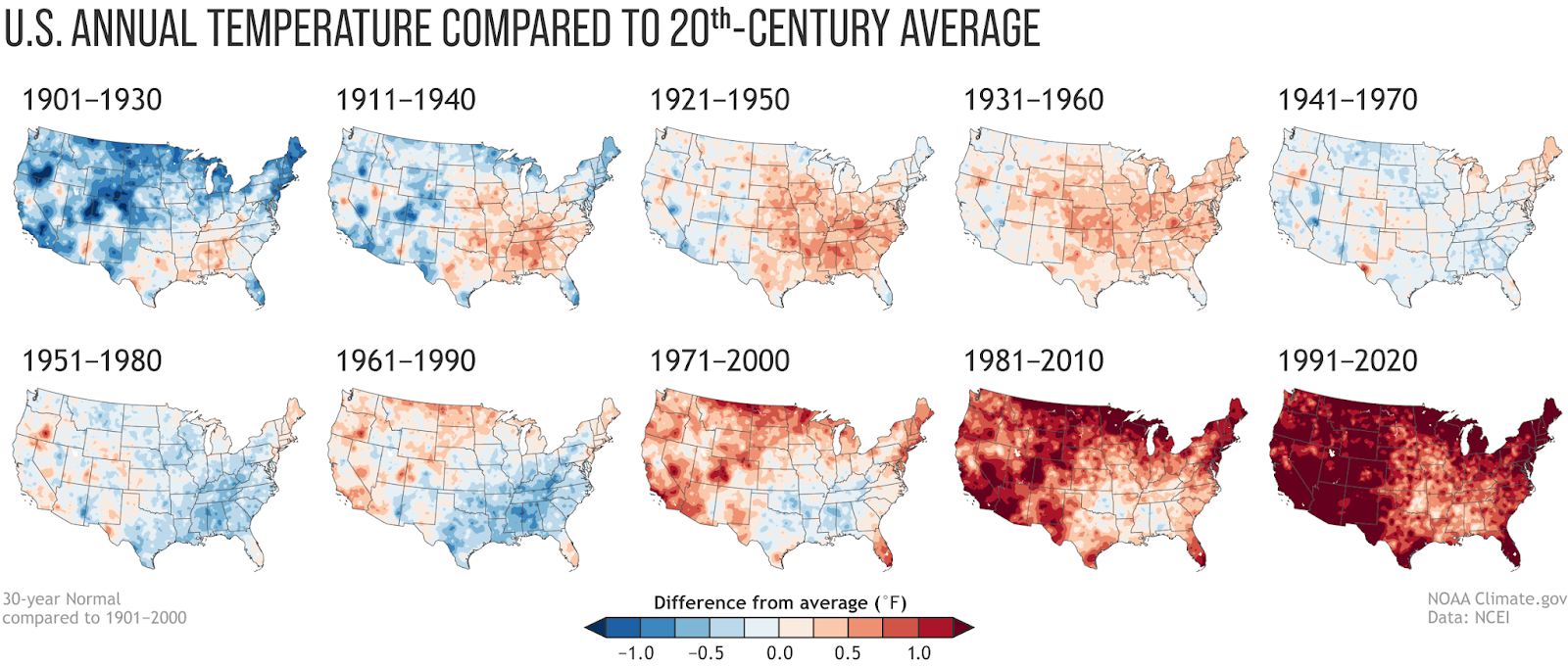
The earth is warming.  The image below shows the change in 30 year normals.

Professor Cliff Mass, University of Washington says that the heat wave was natural variability and was not really affected by climate change.  (Note Cliff Mass believes in climate change.)  However the Oregon State Climatologist is quoted saying,

High-pressure systems like the one driving the Pacific Northwest heat wave are “something like three times more likely to occur when we have a tropical cyclone out in the Pacific,” he [Larry O’Neill, Oregon’s state climatologist] said. “So climate change is impacting tropical cyclone activity through modulation of sea surface temperatures, and also things like wind shear.”

And there was a tropical cyclone that could have been indirectly strengthening the high pressure ridge. Similarly there is the climate change weak lazy jet stream theory which allows for big ridges of high pressure.  That theory is still being debated with pros and cons.  And there is World Weather Attribution, which is a European effort that calculates probabilities, and they have said this heat wave “was virtually impossible without human-caused climate change” for the extreme temperatures to have occurred. 

What do I think? If I had to make a choice, I think, except for the 2°F warming from climate change that has already occurred, the heat wave was not directly affected by climate change and it was mostly just a very extreme case of natural variability (like what Professor Cliff Mass said), but I am not certain.  Indirectly, it is possible that the tropical cyclone in the Pacific could have strengthened the Omega Block High with that tropical cyclone being more likely to form in warmer ocean temperatures due to climate change.  And is it “virtually impossible without human-caused climate change” as stated by the World Weather Attribution people?  Maybe, but I would need to better understand more how they determined the probabilities. 

Does that mean that events like this will be more common?  Maybe, I really do not know.  I personally would rather not label individual events as “caused by climate change”, though it is possible they may be strongly influenced by climate change.  Global warming is a long term happening, and it does affect individual weather events, but I believe the effects tend to be indirect (e.g. warmer temperatures, increased available energy, etc.), so therefore I would not like to declare a weather event to be caused by global warming rather I would say individual weather events are influenced by climate change.  It may just be wording, but I like the word “influenced” better.  

However note that I believe climate change does make a difference.  I do not feel confident in saying how much, but this is how I see it.  Today it is like jumping off a 6 foot high diving board.  50 years ago the diving board was 1 foot high and 50 years from now it may be a 20 foot diving board.  Jumping off (the weather event), is the same no matter what the height of the board is but the splash will be bigger jumping off the higher board.  The height does influence the splash.  Climate change does make a difference.  To sum up where I stand, I do believe that the earth is warming and human-caused climate change is real.  We need to be concerned, because doing nothing will make it harder on future generations. 

Open Source Software and Linux

A Linux Logo

I am a fan of open source software and particularly Linux.  Open source software is computer software, where the owner “grants users the rights to use, study, change, and distribute the software and its source code to anyone and for any purpose”.  Linux or the Linux kernel is probably the most well known example of open source software.  Linux is the software that makes a foundation or the kernel of an operating system.  A Linux distribution, of which there are many, is what most people would consider the operating system.  A Linux distribution is a full operating system,  like Windows 10 or Mac OS X.

Linux was started 30 years ago by Linus Tovalds.  The internet was just getting going from being a research project to what it is today.  It was perfect timing for this hobby project to take off and become more than a hobby.  I remember reading the initial announcement of the Linux kernel.  There was immediately tremendous interest in Linux, and it quickly became a group project that programmers from all over the world were writing code for.

Soon after that, Microsoft realized Linux’s potential and a potential impact on Microsoft’s bottom line, so  Microsoft began to actively discourage the use of Linux.  Microsoft used fear, uncertainty, and doubt (FUD) to discourage its use.  Linux was even called a “cancer” in 2001 by then Microsoft CEO Steve Ballmer.  

Move forward 20 years and in a completely different sense Linux has spread like a cancer.  I just installed the “Windows Subsystem Linux (version 2)” on my Windows 10 Home laptop.  This program is a Microsoft developed and approved piece of software.  I am running the Linux kernel and operating system inside Microsoft’s Windows 10 Home with Microsoft’s blessing.  What happened and why is Microsoft now supporting Linux?

It turns out that using the collaborative methods of making open source software produces software better than the proprietary methods (in most cases).  Using collaborative open source methods means that people from all over the world are working on improving the software and correcting any bugs in that software.  There tend to be more people working on open source software than if it were proprietary software.  

My experience with open source software illustrates the point in a small way.  Some of the weather radar processing software that we used was very old.  A friend wrote a program to easily view weather radar files.   He built it on top of some other open source code.  I wanted to have some editing capabilities so I added that capability.  My editing code barely worked.  Another friend added some stuff he wanted in it.  Then someone from Europe, who no one knew, saw the code on Github and he cleaned up the code, made it faster, and he added more capabilities to the code.  Now the program works great and is being used by many people.  The open source code made collaboration easy and improved the software.

Microsoft learned that lesson and decided to give its users/developers what they wanted. Microsoft went into open source software in a big way. Microsoft has open sourced a lot of their software, and Microsoft bought Github, the main collaborative open source software website.   (However their crown jewels, Windows and Office, remain closed source.)  Microsoft has changed from 20 years ago.

Was Microsoft right to be concerned 20+ years ago? Yes, they were, but Microsoft should have embraced the change sooner, instead of fighting it for many years.  Today most web servers, all the top 500 supercomputers, and all non-Apple (android) smartphones run on Linux.  Linux is everywhere, and because of android phones Linux is the number one operating system kernel in the world.  Only on the desktop is Linux missing a significant presence with about a 4.7% presence.  (About half of that 4.7% is Chrome OS (Chromebooks) which has Linux underneath.)   This is the case even though many Linux distributions (e.g. Ubuntu Linux) are as easy to use as Windows or Mac OS X.  Several years ago, after our Windows XP laptop got infected twice, I put Linux on it and for the next several years Gail and I used that Linux laptop to surf the web and do our various computer tasks until we got a Windows 10 laptop.  It was as easy to use as Windows and much more secure than Windows XP.

Open source software is what runs the Internet, and underneath this web page is open source software, the very popular WordPress and the operating system Linux.  Even your web browser is mostly open source. (The Firefox browser is 100% open source.)  Open source software has revolutionized the software industry and it is here to stay.  And I think Linux is the best example of the potential of open source software.

Forgiveness versus Justice?

Gavel Photo by Jason Morrison

Is forgiveness a bad thing? Does it hinder justice?  Some activists would say, “yes, forgiveness is a bad thing”.  My Christian faith would say the opposite.  I read a very interesting essay by Timothy Keller on the current state of forgiveness in America.   In today’s individualistic culture, where Critical Race Theory and the Cancel Culture are major influences,  there is very little room for forgiveness.

Back in 2015, racist Dylann Roof entered a Charleston church and shot and killed nine African-Americans.  (Three others survived.)  Soon after the relatives forgave Dylann Roof for the killing.  Some activists opposed the forgiveness, because “The supposed moral obligation of forgiveness was seen as an instrument by which those in power maintained their position.”  They consider forgiveness as giving support to the enemy. In this case, the enemy was white racism.  “They argued that forgiveness is a form of ‘self-renunciation,’ giving up your perfect right to pay back to the person what they did to you.”  That is true but without forgiveness there is little, if any, hope of healing and reconciliation. As Martin Luther King Jr. wrote, “He who is devoid of the power to forgive is devoid of the power of love. . . .We can never say, ‘I will forgive you, but I won’t have anything further to do with you.’ Forgiveness means reconciliation, and coming together again.”  

That is what the Christian Faith is all about.  God forgave us so that we might be reconciled to him.  It did not mean that justice was not served.  Jesus paid the price for our sin.  There was a cost. Justice was not forgotten.  We need to forgive in a way that honors justice.

Since God forgives us yet in a way that honours justice, so we should also forgive in a way that honours justice. As Don Carson once wrote, “Christians are called to abandon bitterness, to be forbearing, to have a forgiving stance even where the repentance of the offending party is conspicuous by its absence; on the other hand, their God-centered passion for justice, their concern for God’s glory, ensure that the awful odium of sin is not glossed over.”

An example of this on the national scale is the nation of Germany.  After World War I, justice was served and Germany suffered the cost of making war reparations. I believe because of the heavy cost of justice Hitler rose to power and World War II happened.  After World War II, Germany was a part of the Marshall Plan and received assistance in recovering from the war.  That was forgiveness in action.  There was a cost borne by the USA, but that is a part of the forgiveness, and today Germany is reconciled to the allies.  But note there was still justice.  Its leaders were tried and prosecuted for the horrible things done, and still today German school children learn of the wrongs their nation did.  Forgiveness with justice happened. (Marshall Plan motivation was not about Christian love, but I believe it is still a good example of forgiveness on a national scale.)

Another example of forgiveness on a national scale happened in South Africa, where Desmond Tutu set up the Truth and Reconciliation Commission, which offered amnesty and forgiveness to any person guilty of violence who came forward and publicly confessed what they had done.  This allowed for reconciliation between the former white oppressors and the black majority. Civil war was avoided.

Today forgiveness is countercultural.  Today’s individualistic culture “stresses looking inward to forge one’s own identity based on our desires, and then moving outward to demand that society honour our individual identity and interests.”  That does not allow for the cost of “self-renunciation”, only the exaltation of oneself.  The starting point of the Christian Faith is that we all are broken sinners.  No one is exalted above another. No one is superior. At the same time, as Christians our identity is secure.  We are children of God, and no matter what happens that is who we are.  This is what makes forgiveness possible.

There are three aspects to forgiveness.  We, first, need to embrace the free forgiveness that God has given us.  We can forgive because we have been forgiven due to the costly sacrifice of Jesus Christ.  Then we can give up the desire to get even.  We forgive them inwardly, so that we do not dwell on it. It does cost us to give up what is due us.  And thirdly, we seek repentance and reconciliation from the offender.  The goal is to reconcile with each other.

Through the years, Christianity has changed the world for the better.  Forgiveness has played a big part in that change and it will again in the future.


PS All quotes (in italics) were from the essay.  The essay is insightful and is worth a read.

Is the Bible Wicked?

Bible with heart shadow

I have become aware that many people consider the Bible to be an evil or wicked book.  There are more than just a few with that opinion.  I like to believe that is because there is a lot of ignorance of the Bible behind many of those opinions, and maybe it is also in part due to our Postmodern culture where you choose what you want to believe.  Part of the issue is there are some Bible passages that can sound horrible if we do not put those passages in proper context.  The Bible is not a wicked book.

My awareness peaked this last January when a commenter said this on Joe Biden’s inauguration:

“Out of all the books your choose, the bible must be one of the worst examples of a text on which you swear an oauth. Can anyone think of another collection of stories that demonstrates worse morals, ethics and which lacks any basis for system of right and wrong that could be used by a just society?” (slashdot)

Because there is so much wrong with that comment, I am not going to discuss it since it would require me to spend the entire blog post on that comment. (Okay, the most obvious rebuttal is “the Ten Commandments are from the Bible”.)  But that comment started quite the discussion between a variety of people, and I learned that a lot of people believe that the Bible promotes horrible morals..  I also learned that there is a website called www.evilbible.com,  which uses Bible passages to show how evil God is. The website takes some misunderstood or hard to understand passages as well as some completely misinterpreted passages and puts the worst possible spin on God. This website expresses the horrible morals of God. Fortunately for us, the website has it all wrong. 

Note you can put the same spin on the movie “Mary Poppins”.  You think “Mary Poppins” is a sweet family friendly movie. Well with the right clips from the movie you end up with “Scary Mary”. So instead of the family friendly movie, you have a horror short.  I think that is what the evil Bible website is doing.

Providentially, also in January, my adult Sunday school class started going through the book “How (Not) to Read the Bible’‘ by Dan Kimball, in which the book addresses many of these misunderstood passages and gives four helpful facts for reading the Bible. You have to admit there are some passages in the Bible that from today’s viewpoint suggest that the Bible is anti-women, anti-science, pro-violence, and pro-slavery, as well as being intolerant.  These are the hard to understand passages.  I will focus on the four helpful facts that will allow you to navigate these tough Scripture passages.

The Bible is a library not a book. The Bible was written over about 1500 years by many authors in three languages.  There are 66 books in two volumes, the Old Testament and the New Testament.  These  books have several different literary styles.  The Bible consists of letters, history, poetry, law, apocalyptic literature, and prophecy.  So you must take those differences into account.  You do not read a chapter in 1 Kings the same way you would read a Psalm.

The Bible was written for us, but not to us.  Each book of the Bible was written to a particular people in a particular situation. This truth can be clearly seen in Paul’s letters.  Most of the time he dealt with real problems the local Christians were having at that time, in that culture, and at that location.  Things today have changed.  The culture is different, and yet God’s truths are still found in those letters.  We need to take into account those cultural differences to understand what is being conveyed.  Many times the meaning is clear, but with some of those harder to understand passages you need to look at what the passage meant to those in that time and place and culture.  Ask yourself what is the purpose of the passage? Is it dealing with a problem?  Is there a cultural issue?  What is the principle that the passage is trying to convey? Does your interpretation agree with the rest of Scripture? It is important to note that God works within the culture, so for an example the Old Testament laws concerning slavery does not mean God approved of slavery, rather the laws were there to lessen the bad effects of slavery and to provide some protection to those enslaved.

Never read only a Bible verse.  Read the verse in context.  Look at the Bible verse in context with the surrounding verses.  Zoom out some more and ask yourself what is the verse in context to the Bible book.  And then look at the verse in context of the overarching story of the entire Bible. Your interpretation of the verse should fit in each one of those contexts.  If it does not then you are missing something.  To help you with getting the context, the Bible Project has great overviews of each book of the Bible.

All the Bible points to Jesus.  When we read the Bible we should always keep Jesus in mind, because Jesus is at the center of that overarching story of the Bible. His story is what is really important. There are six acts to the big story.

  1. God created the universe and was in relationship with Adam and Eve. (Genesis 1-2)
  2. Adam and Eve rebelled and due to disobedience the relationship was broken. (Genesis 3-11)
  3. Redemption was initiated. (Genesis 12 – Malachi)
    1. God chose Abraham/Israel to bless the nations.
    2. Israel failed.
    3. Israel was exiled and then restored. Hope remains.
  4. Redemption has been provided through Jesus. (Matthew – John)
  5. We are sent to all nations. (Acts – Revelation 21)
  6. Restoration will be completed. (Revelation 22)

Jesus also believed that his teaching of love and forgiveness was consistent with the stories and teaching of the Old Testament.  If he believed that, then one should be able to reconcile those hard to understand passages. The God of the Old Testament is the same God of the New Testament.  He is not a mean evil god, rather he is loving and good as Jesus shows us. That should be our starting point when encountering these hard to understand passages.

To summarize, context is very important.  For a Bible passage one needs to consider the literary context, the historical context, the cultural context, and the Biblical context with a focus on Jesus.  Doing so will help you gain some understanding of these tough passages.  

There are many resources available to counter the evil Bible meme and the misrepresentation of the hard to understand Bible passages.  I will suggest a few resources. The book I read, “How (Not) to Read the Bible’‘ by Dan Kimball, is one good resource. The book “Is God a Moral Monster?” by Paul Copan is a more complete resource that is widely recommended.  On the web, you need to be careful of the resources you use.  They can and do vary a lot in quality.  However, www.gotquestions.org seems to be a good resource.  Another good resource is the  “What Would You Say?” video series from the Colson Center.  (An example from that series is  “Is the Bible Sexist?”.  Note the importance of context in the video.)   Unfortunately you may find on the web several different answers for these hard to understand passages. So you will have to evaluate the answers, but remember it is ultimately about Jesus and what he did for us.

Connection Makers

Bible with heart shadow

One of my favorite passages in the Bible is 1 Peter 2:9-10.  It says

But you are a chosen race, a royal priesthood, a holy nation, a people for his own possession, that you may proclaim the excellencies of him who called you out of darkness into his marvelous light.  Once you were not a people, but now you are God’s people; once you had not received mercy, but now you have received mercy.  (1 Peter 2:9-10)

This passage tells me my identity.  I am chosen.  God has made me holy..  He has made me royalty.  I am his.  And my favorite description is that I am his priest.

What is a priest?  In the Old Testament, they represented the people before God and they represented God before the people.  They were the connection between God and us.  They assisted Israel in the worship of God and they were messengers of God, teaching the people (Malachi 2:7).  They were connection makers.  They were from the tribe of Levi, specifically descended from the family of Aaron, but God did not consider them to be the only priests.  In fact, God called all of Israel to be priests right before he gave the Ten Commandments.

Now therefore, if you will indeed obey my voice and keep my covenant, you shall be my treasured possession among all peoples, for all the earth is mine; and you shall be to me a kingdom of priests and a holy nation.’ These are the words that you shall speak to the people of Israel.” (Exodus 19:5-6)

Here we see another example of how our Christian calling is not different from Israel’s calling. The 1 Peter 2:9-10 passage echoes the Exodus 19:5-6 passage.  The people of Israel were called to be  “a kingdom of priests”. I believe, to be “a kingdom of priests” means as Israel was to be a witness to the surrounding nations.  They were to connect the surrounding peoples to God, just as we, Christians, are to do so today by proclaiming “the excellencies of him who called you out of darkness into his marvelous light”. 

Note that every descriptive term in 1 Peter 2:9-10 describes a group of people.  If we step back a few verses, we see in 1 Peter 2:4-5 that we, individually, are part of a bigger structure, a spiritual house.

As you come to him, a living stone rejected by men but in the sight of God chosen and precious, you yourselves like living stones are being built up as a spiritual house, to be a holy priesthood, to offer spiritual sacrifices acceptable to God through Jesus Christ. (1 Peter 2:4-5)

So Christians are to act together to be a holy priesthood.  That is why we meet together.  Each congregation works together to connect people with God.  It is not a purely individual effort.  One may individually share the faith, but eventually that person needs to be connected to other Christians as well as to God, to fully participate and grow.

So because of our identity as Christians, we have been given a special task.  We are connection makers.  In sharing God’s love and the Good News about Jesus, we assist in connecting people to God.  Or in other words, we connect people to God because that is what priests do.

My Broken Story

Photo of crepuscular rays by Peter Hostermann

When I look back at my life I see various events that help define me.  Many of the events were part of my brokenness.  I can let those events define my future, or I can define my life backwards.  As a child of God, I know who I am and whose I am.  I know my future is determined.  I will spend eternity with God.  If that is the case, I should define my future in light of that eternal perspective.  My life is not just a cause and effect life, defined by the past, broken as it may be, but instead I can define my life based on its outcome, eternity with God.

Let me give an example from my life. I am a strong introvert. I really did not learn to chit chat until I was in college. The church I attended during my college years was an outreach to college students. I would after church stand around, sipping punch and eating a cookie waiting for someone to come up and talk to me. Conversations were happening all around me but not with me. I was somewhat of a wallflower. After quite a long while, I decided I have had enough of this and I attempted to take part in the conversations. It worked sometimes and not so well other times. Eventually, I learned to chit chat. Still today, others tend to be better at it than me, but I can do it. Because of this broken part of my life story, today, when I see a person alone at church, I will usually approach them and try to strike up a conversation. I want them to feel welcomed and not the loneliness that I felt. God has rewritten that part of my broken story and turned it into a good thing. My life has been redefined by that eternal perspective, and not by the brokenness of the past.

How do we define our lives? We seem to define ourselves by doing.  We respond to the question “Who are you?” by giving our occupation.  Doing seems to define us, but should it?  We might better be defined by our inner self, our “being”.  It is out of our thought life flows all our doings. Unfortunately, this also includes our fears, our struggles, our broken relationships, and our selfishness.  We are broken deep down inside.  But as Christians, we have hope.  God is for us, and he has made us his own.  We can be defined by our identity as a child of God. We are not defined by our broken doings.

With the enabling help of the Holy Spirit, we can begin to repair our brokenness and turn it into a blessing. Too many times we conform to the brokenness around us, to the culture of the world. We may say we are Christian, but many times we act like we are an atheist, thinking only of temporal desires and ignoring God and his wisdom. We need to be transformed and our minds renewed.

I appeal to you therefore, brothers, by the mercies of God, to present your bodies as a living sacrifice, holy and acceptable to God, which is your spiritual worship.  Do not be conformed to this world, but be transformed by the renewal of your mind, that by testing you may discern what is the will of God, what is good and acceptable and perfect. (Romans 12:1-2)

That Romans passage tells us to submit ourselves to God, because of what God has done. We are not to be influenced by the broken world around us, rather we need to be transformed and renewed. This means we need to be intentional and disciplined in dealing with our inner self.  We should not become distracted by the many temporal things around us, rather we need to look to our eternal relationship with God and strengthen that intimate relationship. By focusing on God, and not on the events of the past, we will find wisdom and fulfillment.  (Daily reading of the Bible helps you grow in that relationship.  The S.O.A.P. method is one way of many ways to study Scripture.)

A good start is to note who we are, and whose we are. That definition of “being” is important and it sets the focus. We are God’s own, his children, saved for a life of good works which he has prepared for us to do (Ephesians 2:10). We need to recognize that our story is a part of God’s big story of salvation, and he wants to use us. With the enabling help of the Holy Spirit, we can renew our minds and “take every thought captive to obey Christ” (2 Corinthians 10:5).

This post was inspired by Ken Boa’s book, “Rewriting Your Broken Story”.