Are You Okay?

I remember the phrase “I’m okay, you’re okay”.  It was a popular phrase in the 1970’s and 80’s.  It originates with a 1967 self-help book.  The phrase took on a life of its own, and has been used to promote self-esteem, especially in children.  I think the phrase is still in use today to promote self-esteem, but for many people, in practice, I think it has become “I’m okay but you are not okay”.  People today seem to feel that they are pretty good and have it together most of the time, but those they disagree with are not okay.  Those disagreeable people have been misled and/or have serious issues.  They must not be okay. I think that is a common way of thinking today.

People today look around and blame today’s problems and the problems we experience on cultural influences and other people with serious problems.  These are problem people, who we believe by our own definition, do not want to do things the way we want them done. Today’s “enlightened” people believe it is wrong thinking and wrong societal ideas that are creating the problems, which can be found in societal structures of domination and oppression (Critical Theory).  It can not be our fault because we are okay, relatively good, so we look outside ourselves to locate the problems.  Even though there are cultural influences and other people creating problems, the real core problem is inside each and every one of us.

Here is the reality.  Each and every one of us is not okay. We all have our problems.  We all are broken. Some people want us to embrace our brokenness and say that is just who we are.  I do not think it is a good idea to deny or embrace self destructive behavior.  I believe our brokenness is self destructive and it is also not good for others.  The fact is I am not okay.  I am not good or good enough.  I have my problems.  I have my issues. My brokenness is not healthy for me and for others.  And since it is true of everyone, that is why the world is as messed up as it is.

If you pull back the curtain and look deep inside you, you will find that you are a self centered selfish person whose ego is focused on yourself.  Whether you are feeling good about yourself or despairing, the focus is on you.  Even when you try to be generous and giving, that self centeredness is still there. That self centeredness corrupts everything.  That is the core problem with you and the world. Christians have a name for that condition and for all the wrong doing and wrong thinking.  It is called sin.  We are left in a pretty hopeless situation.

But there is hope.  Though we can not solve the problem, God, the Creator of the universe and of us, can.  Because he loves each and every one of us, he has sent Jesus to us as the solution.  Jesus came to Earth and was born.  He grew up and lived a perfect life.  He died on a cross as a payment for our sin, and then he rose again so that we may have a full life in him.  That full life in Jesus empowers Christians, those who have received Jesus as Lord and Savior, to work for a better life for all, and one day we, Christians, will live eternally with him in a world without sin.  Today it is clear that we are not okay, but God still fully and completely loves each and every one of us, so it is okay.

That is what the Bible says. Below is from the Apostle Paul in his letter to the Romans.

  1. Everyone is a sinner and needs God’s salvation. “for all have sinned and fall short of the glory of God(Romans 3:23)
  2. The consequence of sin is death, but God offers salvation for free. “For the wages of sin is death, but the free gift of God is eternal life in Christ Jesus our Lord.” (Romans 6:23)
  3. In love, Jesus Christ took our place and died for our sins.  He paid the price for us. “but God shows his love for us in that while we were still sinners, Christ died for us.” (Romans 5:8)
  4. It is through faith that we receive salvation and eternal life. “because, if you confess with your mouth that Jesus is Lord and believe in your heart that God raised him from the dead, you will be saved.  For with the heart one believes and is justified, and with the mouth one confesses and is saved.” (Romans 10:9-10)
  5. Because of Jesus Christ, our relationship with God has been restored.  We are no longer condemned by our sin. “Therefore, since we have been justified by faith, we have peace with God through our Lord Jesus Christ.” (Romans 5:1) and “There is therefore now no condemnation for those who are in Christ Jesus.” (Romans 8:1)

Father God,  Thank you for saving me because of all that Jesus has done.  I am yours.  Forgive me, cleanse me, and restore me for I am broken, a sinner in need of your forgiveness.  Thank you for that forgiveness and for your love, mercy, and grace.  Let your Holy Spirit enable me to live a full life dedicated to you.  I ask this because of Jesus’ life, death, and resurrection. He is Lord and Savior!  Amen! 

Is Love Love?

love you

How would you define the word love?  English has a very broad definition of love. In honor of Valentine’s Day, I am going to focus on the interpersonal love found in marriage between a husband and wife.  The ancient Greeks had many words for love.  Wikipedia puts the count at 6 different words, but I have seen lists vary between 3 and 8 different words. I will look at what I consider to be the 3 main Greek words for love and how they relate in marriage.

Today’s romantic love focus seems to be on the passion for one another with an emphasis on the sexual attraction and action.  That sort of love is the Greek word eros, from which we get the term erotic.  I believe eros love includes passion, affection, and delight in one another, which does not have to be sexual in nature.  Eros love produces strong feelings that are powerful.  However, those feelings will wax and wane over time.  The media emphasizes eros love because it is flashy and easy to express.  Some people will equate eros love with lust.  They say it is all about our own sexual desires and the fulfillment of those desires.  I believe that eros love is more than the lust of sexual attraction.  Eros love creates an unstable foundation for marriage, especially if it is focused only on sexual attraction.

Philia is the Greek love word that denotes friendship.  It is a love word where you enjoy one’s company, talking with each other, and doing stuff together. It is the love of friends.  Many times it is described as “brotherly love”. Friendship in marriage is important.  You want to know your spouse and share life together with them.  Philia love is all about sharing life together.

Agape love is the main love that you find in the Bible.  It is an unconditional love that embodies self-sacrifice and commitment.  It is a love that causes you to act in your spouse’s best interest and not your own.  Agape love first looks to others and not to yourself. It is the main love God has for us.  Agape love allows for true intimacy to occur.  The commitment to each other allows for one to be vulnerable to each other.  That is what intimacy is all about.  Because of that intimacy, agape love strengthens the friendship of philia love and increases the passion of eros love. It makes marriage a safe place to express oneself, to share concerns, and to work through issues.  It is a love that binds us together. Agape love is the stable foundation from which the other loves should flow from.  Agape love is described well in this Bible passage.

Love is patient and kind; love does not envy or boast; it is not arrogant or rude. It does not insist on its own way; it is not irritable or resentful;  it does not rejoice at wrongdoing, but rejoices with the truth.  Love bears all things, believes all things, hopes all things, endures all things. Love never ends. (1 Corinthians 13:4-8a)

How does your love fit this description?  My love does not always fit well to the description, but it is something I desire to do better at and in doing so it will strengthen my marriage. Agape love makes for a stable foundation for one’s marriage.  God’s agape love does fit this description.  Replace the word ‘love’ (and ‘it’) with God or Jesus and see how God loves you.

God has many times in the Bible expressed his love for us in terms of marriage.  We, the people of God, are the bride and God is the bridegroom or husband.  God passionately pursues us (eros).  He seeks to restore that personal friendship that was lost in Eden (philia).  And he loved us so much that he died for us, so that we can be united to him (agape). (Note, only the Greek love words philia and agape appear in the Bible.)

A closing thought:

 Beloved, let us love one another, for love is from God, and whoever loves has been born of God and knows God. Anyone who does not love does not know God, because God is love. In this the love of God was made manifest among us, that God sent his only Son into the world, so that we might live through him. In this is love, not that we have loved God but that he loved us and sent his Son to be the propitiation for our sins. Beloved, if God so loved us, we also ought to love one another. No one has ever seen God; if we love one another, God abides in us and his love is perfected in us. (1 John 4:7-12; agape love)

P.S. This post was inspired by a session from the Marriage in Christ Seminar.

The Trinity (Part 2)

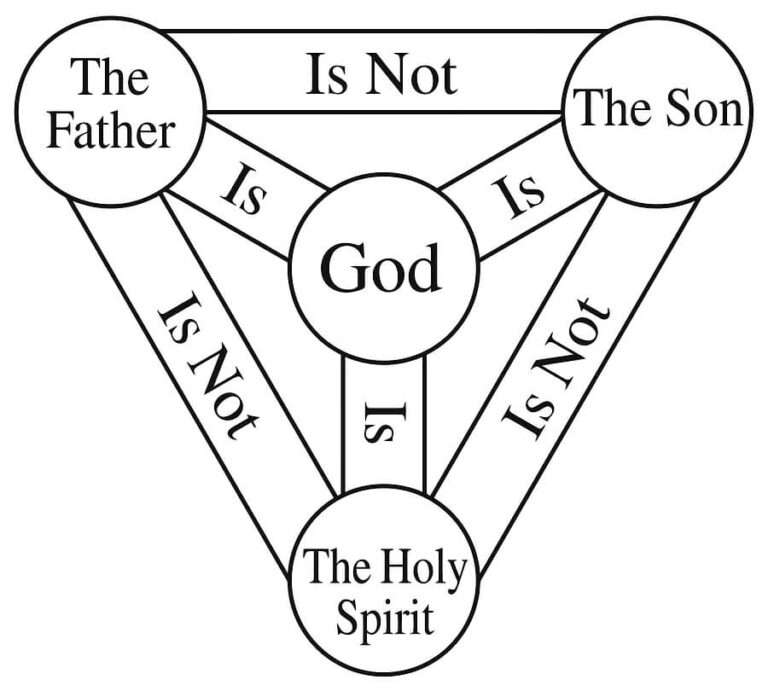
Trinity Shield from symbolsage.com

In the last post, it was pointed out that the Bible teaches there is only one God, and yet there are three persons in that one God.  This post will look at each person of the Trinity, and will take a look at some alternative views and provide some scripture against those views.

God the Father

Jesus referred to the God of the Old Testament as his Father.  He had a good reason since he was the Son of God.  He also encourages us to call him Father too. (There are also passages in the Old Testament, where God is referred to as Father.)  God the Father is considered to be the Creator of the world, but the Son and Holy Spirit also have roles in the creation of the world.   It is the Father that sent Jesus to be born as a human.  And from the Father (and the Son) proceeds the Holy Spirit.  If the word ‘God’ is mentioned, my first assumption is to assume that the passage is referring to God the Father (e.g. 2 Corinthians 13:14).  I believe that most of the time that assumption is correct.

Jesus Not Created

Jesus was born of the Virgin Mary, and yet the Bible makes it clear that he existed from eternity.  Some claim that Jesus was God’s first creation.  They use Colossians 1:15b, “the firstborn of all creation”, as proof of God’s first created being.  The word firstborn does not have to refer to being born first.  The firstborn son had special privileges and so the word firstborn can also refer to one with the special privileges of a firstborn son without being firstborn.  Moses was told to tell Pharaoh that “Thus says the Lord, Israel is my firstborn son” (Exodus 4:22b).  That verse as well as the Colossians verse the word ‘firstborn’ can not be taken literally especially if you take the phrase in context.  Here is the Colossians passage in context with the paragraph:

15 He is the image of the invisible God, the firstborn of all creation. 16 For by him all things were created, in heaven and on earth, visible and invisible, whether thrones or dominions or rulers or authorities—all things were created through him and for him. 17 And he is before all things, and in him all things hold together. 18 And he is the head of the body, the church. He is the beginning, the firstborn from the dead, that in everything he might be preeminent. 19 For in him all the fullness of God was pleased to dwell, 20 and through him to reconcile to himself all things, whether on earth or in heaven, making peace by the blood of his cross. (Colossians 1:15-20)

In context you can see that the paragraph is about the preeminence of Jesus Christ.  In verses 15a and 19b, imply that Jesus is God, not a creature.  In verse 18 firstborn is used again in “firstborn from the dead”.  I see the word  firstborn in this case as Jesus being the source and leader to those who will rise from the dead, and I see it as the same for “firstborn of all creation”.  He is the head of all creation.  And in verse 16 it says that “by him all things were created”.  If he had a hand in creating “all things” then he could not be created.

Jesus Equal to the Father

Is Jesus equal to the Father?  Jesus said “ the Father is greater than I” (John 14:28).  He said that because during his time here on earth Jesus “for a little while was made lower than the angels” (Hebrews 2:9).  Jesus is equal to the Father.  He put aside that equality to become human so that he could save us on the cross (Philippians 2:6-8).

Holy Spirit is a Person

The Holy Spirit is the least known of the three persons of the Trinity.  Many people consider the Spirit to be a force and not a person. I think they say that because the Holy Spirit empowers us.  Jesus clearly refers to the Holy Spirit as a person in John 14-16. Here is a sample

But when the Helper comes, whom I will send to you from the Father, the Spirit of truth, who proceeds from the Father, he will bear witness about me.” (John 15:26)

The Holy Spirit is not a force.  He is a person.  He gives witness to Jesus in the above passage. He teaches (John 14:26) and speaks (Acts 8:29).  He also can be grieved (Ephesians 4:30), lied to (Acts 5:3-4) and become outraged (Hebrews 10:29).  That sounds like a person, not a force.

Roles in the Trinity

There also tends to be some confusion over what the roles of each person of the Trinity. We want to assign specific roles, like the Father is the Creator, the Son is the Redeemer, and the Holy Spirit is the Sanctifier.  Doing so is not wrong, but these roles are not exclusive either.  We find out that the Father created the world through the Son, and the Spirit had a role too.  And it is the same with the Son and the Spirit.  The Bible points out that all persons of the Trinity are at work in all external actions that affect us.  Note this does not make the three persons of the Trinity uniform.  Each person of the Trinity has his own personality, so the actions of each person might not be the same. Norman Geisler describes the “roles” of each person of the Trinity this way:

In brief, the Father is the Planner, the Son is the Accomplisher, and the Holy Spirit is the Applier of salvation to believers. The Father is the Source, the Son is the Means, and the Holy Spirit is the Effector of salvation—it is He who convicts, convinces, and converts.

Again I do not want to make the “roles” exclusive. The Trinity is a mystery that we can not fully comprehend.   Let us look at a couple cases.

Though some people have differing views on the Trinity, this doctrine of the Trinity is of critical importance.  There is a reason that this doctrine has been central to church teaching for over 1500 years.  It is important to know who God is.  There is only one God and yet there are three persons to that one God, Father, Son, and Holy Spirit.  On that belief the Christian faith stands.

[T]he God of our Lord Jesus Christ, the Father of glory, may give you the Spirit of wisdom and of revelation in the knowledge of him (Ephesians 1:17)

The Trinity (Part 1)

Trinity Shield from symbolsage.com

Today, it seems many Christians do not understand the Trinity, that is the Triune God.  It is something that the Christian Church has believed and taught for centuries, and I believe from the beginning.  The Trinity is not directly mentioned in the Bible, but it is something that is strongly implied in the Bible.  When you put together all the Bible passages on God the Father, Jesus, and the Holy Spirit, you find that everything makes sense with the concept of the Trinity.  The Athanasian Creed lays out the doctrine of the Trinity with an emphasis on Jesus Christ in the latter half.

The Christian faith teaches that there is only one God with three persons (Father, Son, and Holy Spirit) to that one God. There are not three Gods under a Godhead council but only one God with one undivided essence/substance. Jesus is not a third of God but he is fully God, just as the Father and the Spirit are fully God.  Each person of the Trinity is equal to one another. There are many analogies for the Trinity, but they all fall short in some way or another.  It is a mystery that does not completely make sense to our limited minds, but the doctrine is derived from the Bible. 

An example from nature of something that does not make sense is the facts about light.  Light is a particle (a photon), and light is an electromagnetic wave.  It should be one or the other.  We have instruments that measure light as a particle and other instruments that measure light as a wave.  The Trinity is like that. We know it to be true but it does not make complete sense.

There are a couple of interesting passages that suggest the Trinity.  The Great Commision says

 Go therefore and make disciples of all nations, baptizing them in the name of the Father and of the Son and of the Holy Spirit (Matthew 28:19)

Note that “name” is singular, but it points to three names, Father, Son, and Holy Spirit.  And from the Old Testament the Great Shema which starts with

 Hear, O Israel: The Lord our God, the Lord is one. (Deuteronomy 6:4)

The word “God” in Hebrew is Elohim and it is actually plural, not singular as the passage or the corresponding verb would indicate.  These two passages suggest that there may be something to this Trinity idea. (Note I may be stretching the context too much for Elohim to be a reference to the Trinity. The word, Elohim, occurs more than 2500 times in the Old Testament, mostly in reference to the one true God.  The plural is also there to emphasize the awesome majesty of God, and maybe that is the only purpose of the plural.)

There are many passages (e.g. Isaiah 46:9, Romans 3:30a) that state that there is only one God.  This meant the many New Testament passages that claim that Jesus is also God (e.g. John 1:1,14, Titus 2:13) had to be resolved with the doctrine of the Trinity. Similarly for the Holy Spirit there are passages that equate the Holy Spirit with God (e.g. Acts 5:3-4, 2 Corinthians 3:17-18) that need to be resolved.  Scripture also records that Jesus and the Holy Spirit have the same attributes as God the Father. This makes the doctrine of the Trinity necessary and true.

Another concept that makes the Trinity necessary is the fact that one of the major defining attributes of God is love.  God needs someone to love.   Because our one God consists of 3 persons he can have that attribute of love.  He did not wait to create us to learn about love, rather love was known because each person of the Trinity is fully loved by the other persons of the Trinity. 

Part 2 will take a look at each person of the Trinity, and will take a look at some alternative views and proofs against those views.

Casual Christian?

Bible with heart shadow

Who are you?  Are you a Christian in name only?  Or are you a casual Christian?  Or are you a disciple of Jesus Christ? What determines your Christian identity?

A Christian in name only tends to know very little of the Christian faith.  They most likely will say they are a ‘good person’ and that makes them Christian.  Unfortunately for them, they are wrong.  Heaven is not for ‘good’ people.  Heaven is for those who recognize they are bad, sinners in need of a savior.  Christians have received forgiveness and salvation because of what Jesus Christ did on the cross.  He died for each one of us and rose again that we might have life in him.  A Christian has this relationship with the Triune God that was given to them.

A casual Christian is one who does ‘Christian things’ now and then or even weekly.  They most likely have that relationship with God, but they are casual about their faith.  They are Christian infants that still need milk instead of advancing to solid food (1 Corinthians 3:1-3).  They have not grown in their faith because they are casual about it. They seem to be missing the desire or the discipline to grow in their faith.

In response to one’s salvation, a disciple or follower of Jesus Christ should have that desire to follow Jesus, to love him, and to learn of him.  A disciple wants to become like Jesus, to imitate him (Ephesians 5:1-2). There are many Bible passages that can help us.  I will bring up only the one that has been recently on my mind.  In the Gospel of John Jesus says four times,  “If you love me, you will keep my commandments” (John 14:15,21,23,24).  That is a hard saying and he says it four times in just a few verses.  The commandments can be summed up with ‘love God and love people’ (Matthew 22:36-40). And that love is defined as acting out of the commitment to put the other person’s best interests ahead of your own.  Many times, I have trouble loving.  Many times, judgemental thoughts pop into my head, or I do not want to deal with these strange and different people.  Those times I am being self-centered.  And yet Jesus calls us to reach out to them and to love them, not just some of them but all of them.  Jesus has given us the Great Commission to go and make disciples (Matthew 28:19-20). That means we get to walk with them in life, love them, and share the good news of God’s love for them.

Fortunately, God does not leave us alone to become a disciple and to love.  The Holy Spirit comes to be our Helper, Comforter, Advocate, and Councillor. In that very same passage, where Jesus tells his disciples four times to “keep my commandments”, he also promises the Holy Spirit (John 14:15-27).  The Holy Spirit is there to assist and empower our Christian life.  We are not alone in our journey.  Moreover, Jesus helps us understand our dependence on him.  Jesus describes himself as the vine and we are the branches.  That power to love flows from him to us, and by abiding in him we bear that fruit of love (John 15:1-17). Without Jesus, we wither and die.  With God’s help, we are able to succeed. But God provides even more help for us.

We also have the help of local Christians who walk alongside us to help enable us to love God and love people more.  God did not plan for any ‘Lone Ranger Christians’, rather throughout the Bible you find God’s people always gather together in community.  It is through Christian community that spiritual growth happens (Ephesians 4:11-16). It is in the body of Christ that discipleship happens, and I have found that happens more in small group settings than not, so connect up with a small group at your local church and learn of Jesus. Our local congregations should be where we teach, learn and put into action the love of Jesus.

This post was inspired by a short book by Mike Falkenstine called “Being and Making Disciples in the Western Church”.  Here are his five focus areas for local church leaders on making disciples.

  1. A High View of Scripture
  2. A Steely-Eyed Commitment to Making Disciples that Make Disciples
  3. A Determination to Equip All Your People
  4. A Confident Expectation in the Power of the Gospel
  5. An Awareness that Spiritual Growth Happens Primarily through Community

So are we being too casual, individually and/or corporately, with our Christian Faith?

Is the Bible Wicked?

Bible with heart shadow

I have become aware that many people consider the Bible to be an evil or wicked book.  There are more than just a few with that opinion.  I like to believe that is because there is a lot of ignorance of the Bible behind many of those opinions, and maybe it is also in part due to our Postmodern culture where you choose what you want to believe.  Part of the issue is there are some Bible passages that can sound horrible if we do not put those passages in proper context.  The Bible is not a wicked book.

My awareness peaked this last January when a commenter said this on Joe Biden’s inauguration:

“Out of all the books your choose, the bible must be one of the worst examples of a text on which you swear an oauth. Can anyone think of another collection of stories that demonstrates worse morals, ethics and which lacks any basis for system of right and wrong that could be used by a just society?” (slashdot)

Because there is so much wrong with that comment, I am not going to discuss it since it would require me to spend the entire blog post on that comment. (Okay, the most obvious rebuttal is “the Ten Commandments are from the Bible”.)  But that comment started quite the discussion between a variety of people, and I learned that a lot of people believe that the Bible promotes horrible morals..  I also learned that there is a website called www.evilbible.com,  which uses Bible passages to show how evil God is. The website takes some misunderstood or hard to understand passages as well as some completely misinterpreted passages and puts the worst possible spin on God. This website expresses the horrible morals of God. Fortunately for us, the website has it all wrong. 

Note you can put the same spin on the movie “Mary Poppins”.  You think “Mary Poppins” is a sweet family friendly movie. Well with the right clips from the movie you end up with “Scary Mary”. So instead of the family friendly movie, you have a horror short.  I think that is what the evil Bible website is doing.

Providentially, also in January, my adult Sunday school class started going through the book “How (Not) to Read the Bible’‘ by Dan Kimball, in which the book addresses many of these misunderstood passages and gives four helpful facts for reading the Bible. You have to admit there are some passages in the Bible that from today’s viewpoint suggest that the Bible is anti-women, anti-science, pro-violence, and pro-slavery, as well as being intolerant.  These are the hard to understand passages.  I will focus on the four helpful facts that will allow you to navigate these tough Scripture passages.

The Bible is a library not a book. The Bible was written over about 1500 years by many authors in three languages.  There are 66 books in two volumes, the Old Testament and the New Testament.  These  books have several different literary styles.  The Bible consists of letters, history, poetry, law, apocalyptic literature, and prophecy.  So you must take those differences into account.  You do not read a chapter in 1 Kings the same way you would read a Psalm.

The Bible was written for us, but not to us.  Each book of the Bible was written to a particular people in a particular situation. This truth can be clearly seen in Paul’s letters.  Most of the time he dealt with real problems the local Christians were having at that time, in that culture, and at that location.  Things today have changed.  The culture is different, and yet God’s truths are still found in those letters.  We need to take into account those cultural differences to understand what is being conveyed.  Many times the meaning is clear, but with some of those harder to understand passages you need to look at what the passage meant to those in that time and place and culture.  Ask yourself what is the purpose of the passage? Is it dealing with a problem?  Is there a cultural issue?  What is the principle that the passage is trying to convey? Does your interpretation agree with the rest of Scripture? It is important to note that God works within the culture, so for an example the Old Testament laws concerning slavery does not mean God approved of slavery, rather the laws were there to lessen the bad effects of slavery and to provide some protection to those enslaved.

Never read only a Bible verse.  Read the verse in context.  Look at the Bible verse in context with the surrounding verses.  Zoom out some more and ask yourself what is the verse in context to the Bible book.  And then look at the verse in context of the overarching story of the entire Bible. Your interpretation of the verse should fit in each one of those contexts.  If it does not then you are missing something.  To help you with getting the context, the Bible Project has great overviews of each book of the Bible.

All the Bible points to Jesus.  When we read the Bible we should always keep Jesus in mind, because Jesus is at the center of that overarching story of the Bible. His story is what is really important. There are six acts to the big story.

  1. God created the universe and was in relationship with Adam and Eve. (Genesis 1-2)
  2. Adam and Eve rebelled and due to disobedience the relationship was broken. (Genesis 3-11)
  3. Redemption was initiated. (Genesis 12 – Malachi)
    1. God chose Abraham/Israel to bless the nations.
    2. Israel failed.
    3. Israel was exiled and then restored. Hope remains.
  4. Redemption has been provided through Jesus. (Matthew – John)
  5. We are sent to all nations. (Acts – Revelation 21)
  6. Restoration will be completed. (Revelation 22)

Jesus also believed that his teaching of love and forgiveness was consistent with the stories and teaching of the Old Testament.  If he believed that, then one should be able to reconcile those hard to understand passages. The God of the Old Testament is the same God of the New Testament.  He is not a mean evil god, rather he is loving and good as Jesus shows us. That should be our starting point when encountering these hard to understand passages.

To summarize, context is very important.  For a Bible passage one needs to consider the literary context, the historical context, the cultural context, and the Biblical context with a focus on Jesus.  Doing so will help you gain some understanding of these tough passages.  

There are many resources available to counter the evil Bible meme and the misrepresentation of the hard to understand Bible passages.  I will suggest a few resources. The book I read, “How (Not) to Read the Bible’‘ by Dan Kimball, is one good resource. The book “Is God a Moral Monster?” by Paul Copan is a more complete resource that is widely recommended.  On the web, you need to be careful of the resources you use.  They can and do vary a lot in quality.  However, www.gotquestions.org seems to be a good resource.  Another good resource is the  “What Would You Say?” video series from the Colson Center.  (An example from that series is  “Is the Bible Sexist?”.  Note the importance of context in the video.)   Unfortunately you may find on the web several different answers for these hard to understand passages. So you will have to evaluate the answers, but remember it is ultimately about Jesus and what he did for us.

Connection Makers

Bible with heart shadow

One of my favorite passages in the Bible is 1 Peter 2:9-10.  It says

But you are a chosen race, a royal priesthood, a holy nation, a people for his own possession, that you may proclaim the excellencies of him who called you out of darkness into his marvelous light.  Once you were not a people, but now you are God’s people; once you had not received mercy, but now you have received mercy.  (1 Peter 2:9-10)

This passage tells me my identity.  I am chosen.  God has made me holy..  He has made me royalty.  I am his.  And my favorite description is that I am his priest.

What is a priest?  In the Old Testament, they represented the people before God and they represented God before the people.  They were the connection between God and us.  They assisted Israel in the worship of God and they were messengers of God, teaching the people (Malachi 2:7).  They were connection makers.  They were from the tribe of Levi, specifically descended from the family of Aaron, but God did not consider them to be the only priests.  In fact, God called all of Israel to be priests right before he gave the Ten Commandments.

Now therefore, if you will indeed obey my voice and keep my covenant, you shall be my treasured possession among all peoples, for all the earth is mine; and you shall be to me a kingdom of priests and a holy nation.’ These are the words that you shall speak to the people of Israel.” (Exodus 19:5-6)

Here we see another example of how our Christian calling is not different from Israel’s calling. The 1 Peter 2:9-10 passage echoes the Exodus 19:5-6 passage.  The people of Israel were called to be  “a kingdom of priests”. I believe, to be “a kingdom of priests” means as Israel was to be a witness to the surrounding nations.  They were to connect the surrounding peoples to God, just as we, Christians, are to do so today by proclaiming “the excellencies of him who called you out of darkness into his marvelous light”. 

Note that every descriptive term in 1 Peter 2:9-10 describes a group of people.  If we step back a few verses, we see in 1 Peter 2:4-5 that we, individually, are part of a bigger structure, a spiritual house.

As you come to him, a living stone rejected by men but in the sight of God chosen and precious, you yourselves like living stones are being built up as a spiritual house, to be a holy priesthood, to offer spiritual sacrifices acceptable to God through Jesus Christ. (1 Peter 2:4-5)

So Christians are to act together to be a holy priesthood.  That is why we meet together.  Each congregation works together to connect people with God.  It is not a purely individual effort.  One may individually share the faith, but eventually that person needs to be connected to other Christians as well as to God, to fully participate and grow.

So because of our identity as Christians, we have been given a special task.  We are connection makers.  In sharing God’s love and the Good News about Jesus, we assist in connecting people to God.  Or in other words, we connect people to God because that is what priests do.