The Trinity (Part 2)

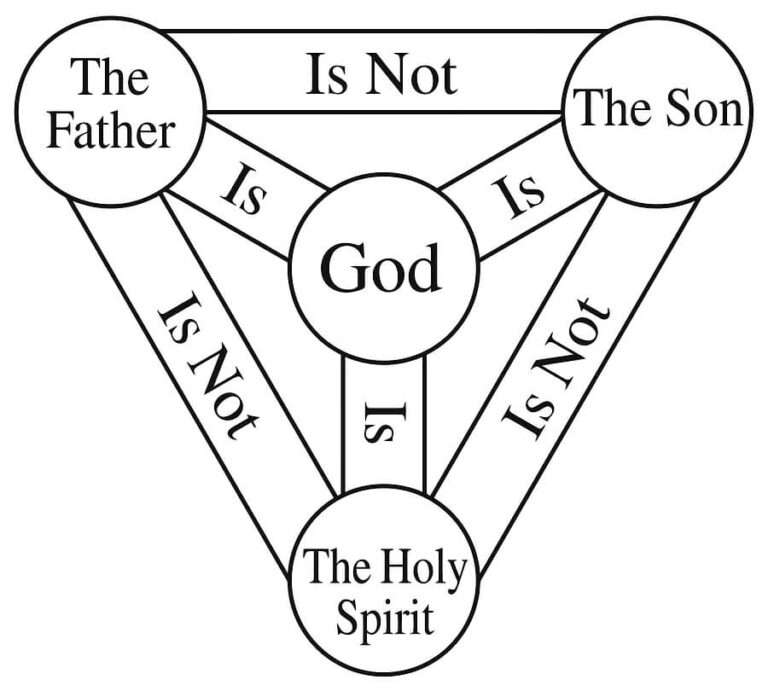
Trinity Shield from symbolsage.com

In the last post, it was pointed out that the Bible teaches there is only one God, and yet there are three persons in that one God.  This post will look at each person of the Trinity, and will take a look at some alternative views and provide some scripture against those views.

God the Father

Jesus referred to the God of the Old Testament as his Father.  He had a good reason since he was the Son of God.  He also encourages us to call him Father too. (There are also passages in the Old Testament, where God is referred to as Father.)  God the Father is considered to be the Creator of the world, but the Son and Holy Spirit also have roles in the creation of the world.   It is the Father that sent Jesus to be born as a human.  And from the Father (and the Son) proceeds the Holy Spirit.  If the word ‘God’ is mentioned, my first assumption is to assume that the passage is referring to God the Father (e.g. 2 Corinthians 13:14).  I believe that most of the time that assumption is correct.

Jesus Not Created

Jesus was born of the Virgin Mary, and yet the Bible makes it clear that he existed from eternity.  Some claim that Jesus was God’s first creation.  They use Colossians 1:15b, “the firstborn of all creation”, as proof of God’s first created being.  The word firstborn does not have to refer to being born first.  The firstborn son had special privileges and so the word firstborn can also refer to one with the special privileges of a firstborn son without being firstborn.  Moses was told to tell Pharaoh that “Thus says the Lord, Israel is my firstborn son” (Exodus 4:22b).  That verse as well as the Colossians verse the word ‘firstborn’ can not be taken literally especially if you take the phrase in context.  Here is the Colossians passage in context with the paragraph:

15 He is the image of the invisible God, the firstborn of all creation. 16 For by him all things were created, in heaven and on earth, visible and invisible, whether thrones or dominions or rulers or authorities—all things were created through him and for him. 17 And he is before all things, and in him all things hold together. 18 And he is the head of the body, the church. He is the beginning, the firstborn from the dead, that in everything he might be preeminent. 19 For in him all the fullness of God was pleased to dwell, 20 and through him to reconcile to himself all things, whether on earth or in heaven, making peace by the blood of his cross. (Colossians 1:15-20)

In context you can see that the paragraph is about the preeminence of Jesus Christ.  In verses 15a and 19b, imply that Jesus is God, not a creature.  In verse 18 firstborn is used again in “firstborn from the dead”.  I see the word  firstborn in this case as Jesus being the source and leader to those who will rise from the dead, and I see it as the same for “firstborn of all creation”.  He is the head of all creation.  And in verse 16 it says that “by him all things were created”.  If he had a hand in creating “all things” then he could not be created.

Jesus Equal to the Father

Is Jesus equal to the Father?  Jesus said “ the Father is greater than I” (John 14:28).  He said that because during his time here on earth Jesus “for a little while was made lower than the angels” (Hebrews 2:9).  Jesus is equal to the Father.  He put aside that equality to become human so that he could save us on the cross (Philippians 2:6-8).

Holy Spirit is a Person

The Holy Spirit is the least known of the three persons of the Trinity.  Many people consider the Spirit to be a force and not a person. I think they say that because the Holy Spirit empowers us.  Jesus clearly refers to the Holy Spirit as a person in John 14-16. Here is a sample

But when the Helper comes, whom I will send to you from the Father, the Spirit of truth, who proceeds from the Father, he will bear witness about me.” (John 15:26)

The Holy Spirit is not a force.  He is a person.  He gives witness to Jesus in the above passage. He teaches (John 14:26) and speaks (Acts 8:29).  He also can be grieved (Ephesians 4:30), lied to (Acts 5:3-4) and become outraged (Hebrews 10:29).  That sounds like a person, not a force.

Roles in the Trinity

There also tends to be some confusion over what the roles of each person of the Trinity. We want to assign specific roles, like the Father is the Creator, the Son is the Redeemer, and the Holy Spirit is the Sanctifier.  Doing so is not wrong, but these roles are not exclusive either.  We find out that the Father created the world through the Son, and the Spirit had a role too.  And it is the same with the Son and the Spirit.  The Bible points out that all persons of the Trinity are at work in all external actions that affect us.  Note this does not make the three persons of the Trinity uniform.  Each person of the Trinity has his own personality, so the actions of each person might not be the same. Norman Geisler describes the “roles” of each person of the Trinity this way:

In brief, the Father is the Planner, the Son is the Accomplisher, and the Holy Spirit is the Applier of salvation to believers. The Father is the Source, the Son is the Means, and the Holy Spirit is the Effector of salvation—it is He who convicts, convinces, and converts.

Again I do not want to make the “roles” exclusive. The Trinity is a mystery that we can not fully comprehend.   Let us look at a couple cases.

Though some people have differing views on the Trinity, this doctrine of the Trinity is of critical importance.  There is a reason that this doctrine has been central to church teaching for over 1500 years.  It is important to know who God is.  There is only one God and yet there are three persons to that one God, Father, Son, and Holy Spirit.  On that belief the Christian faith stands.

[T]he God of our Lord Jesus Christ, the Father of glory, may give you the Spirit of wisdom and of revelation in the knowledge of him (Ephesians 1:17)

The Trinity (Part 1)

Trinity Shield from symbolsage.com

Today, it seems many Christians do not understand the Trinity, that is the Triune God.  It is something that the Christian Church has believed and taught for centuries, and I believe from the beginning.  The Trinity is not directly mentioned in the Bible, but it is something that is strongly implied in the Bible.  When you put together all the Bible passages on God the Father, Jesus, and the Holy Spirit, you find that everything makes sense with the concept of the Trinity.  The Athanasian Creed lays out the doctrine of the Trinity with an emphasis on Jesus Christ in the latter half.

The Christian faith teaches that there is only one God with three persons (Father, Son, and Holy Spirit) to that one God. There are not three Gods under a Godhead council but only one God with one undivided essence/substance. Jesus is not a third of God but he is fully God, just as the Father and the Spirit are fully God.  Each person of the Trinity is equal to one another. There are many analogies for the Trinity, but they all fall short in some way or another.  It is a mystery that does not completely make sense to our limited minds, but the doctrine is derived from the Bible. 

An example from nature of something that does not make sense is the facts about light.  Light is a particle (a photon), and light is an electromagnetic wave.  It should be one or the other.  We have instruments that measure light as a particle and other instruments that measure light as a wave.  The Trinity is like that. We know it to be true but it does not make complete sense.

There are a couple of interesting passages that suggest the Trinity.  The Great Commision says

 Go therefore and make disciples of all nations, baptizing them in the name of the Father and of the Son and of the Holy Spirit (Matthew 28:19)

Note that “name” is singular, but it points to three names, Father, Son, and Holy Spirit.  And from the Old Testament the Great Shema which starts with

 Hear, O Israel: The Lord our God, the Lord is one. (Deuteronomy 6:4)

The word “God” in Hebrew is Elohim and it is actually plural, not singular as the passage or the corresponding verb would indicate.  These two passages suggest that there may be something to this Trinity idea. (Note I may be stretching the context too much for Elohim to be a reference to the Trinity. The word, Elohim, occurs more than 2500 times in the Old Testament, mostly in reference to the one true God.  The plural is also there to emphasize the awesome majesty of God, and maybe that is the only purpose of the plural.)

There are many passages (e.g. Isaiah 46:9, Romans 3:30a) that state that there is only one God.  This meant the many New Testament passages that claim that Jesus is also God (e.g. John 1:1,14, Titus 2:13) had to be resolved with the doctrine of the Trinity. Similarly for the Holy Spirit there are passages that equate the Holy Spirit with God (e.g. Acts 5:3-4, 2 Corinthians 3:17-18) that need to be resolved.  Scripture also records that Jesus and the Holy Spirit have the same attributes as God the Father. This makes the doctrine of the Trinity necessary and true.

Another concept that makes the Trinity necessary is the fact that one of the major defining attributes of God is love.  God needs someone to love.   Because our one God consists of 3 persons he can have that attribute of love.  He did not wait to create us to learn about love, rather love was known because each person of the Trinity is fully loved by the other persons of the Trinity. 

Part 2 will take a look at each person of the Trinity, and will take a look at some alternative views and proofs against those views.

Casual Christian?

Bible with heart shadow

Who are you?  Are you a Christian in name only?  Or are you a casual Christian?  Or are you a disciple of Jesus Christ? What determines your Christian identity?

A Christian in name only tends to know very little of the Christian faith.  They most likely will say they are a ‘good person’ and that makes them Christian.  Unfortunately for them, they are wrong.  Heaven is not for ‘good’ people.  Heaven is for those who recognize they are bad, sinners in need of a savior.  Christians have received forgiveness and salvation because of what Jesus Christ did on the cross.  He died for each one of us and rose again that we might have life in him.  A Christian has this relationship with the Triune God that was given to them.

A casual Christian is one who does ‘Christian things’ now and then or even weekly.  They most likely have that relationship with God, but they are casual about their faith.  They are Christian infants that still need milk instead of advancing to solid food (1 Corinthians 3:1-3).  They have not grown in their faith because they are casual about it. They seem to be missing the desire or the discipline to grow in their faith.

In response to one’s salvation, a disciple or follower of Jesus Christ should have that desire to follow Jesus, to love him, and to learn of him.  A disciple wants to become like Jesus, to imitate him (Ephesians 5:1-2). There are many Bible passages that can help us.  I will bring up only the one that has been recently on my mind.  In the Gospel of John Jesus says four times,  “If you love me, you will keep my commandments” (John 14:15,21,23,24).  That is a hard saying and he says it four times in just a few verses.  The commandments can be summed up with ‘love God and love people’ (Matthew 22:36-40). And that love is defined as acting out of the commitment to put the other person’s best interests ahead of your own.  Many times, I have trouble loving.  Many times, judgemental thoughts pop into my head, or I do not want to deal with these strange and different people.  Those times I am being self-centered.  And yet Jesus calls us to reach out to them and to love them, not just some of them but all of them.  Jesus has given us the Great Commission to go and make disciples (Matthew 28:19-20). That means we get to walk with them in life, love them, and share the good news of God’s love for them.

Fortunately, God does not leave us alone to become a disciple and to love.  The Holy Spirit comes to be our Helper, Comforter, Advocate, and Councillor. In that very same passage, where Jesus tells his disciples four times to “keep my commandments”, he also promises the Holy Spirit (John 14:15-27).  The Holy Spirit is there to assist and empower our Christian life.  We are not alone in our journey.  Moreover, Jesus helps us understand our dependence on him.  Jesus describes himself as the vine and we are the branches.  That power to love flows from him to us, and by abiding in him we bear that fruit of love (John 15:1-17). Without Jesus, we wither and die.  With God’s help, we are able to succeed. But God provides even more help for us.

We also have the help of local Christians who walk alongside us to help enable us to love God and love people more.  God did not plan for any ‘Lone Ranger Christians’, rather throughout the Bible you find God’s people always gather together in community.  It is through Christian community that spiritual growth happens (Ephesians 4:11-16). It is in the body of Christ that discipleship happens, and I have found that happens more in small group settings than not, so connect up with a small group at your local church and learn of Jesus. Our local congregations should be where we teach, learn and put into action the love of Jesus.

This post was inspired by a short book by Mike Falkenstine called “Being and Making Disciples in the Western Church”.  Here are his five focus areas for local church leaders on making disciples.

  1. A High View of Scripture
  2. A Steely-Eyed Commitment to Making Disciples that Make Disciples
  3. A Determination to Equip All Your People
  4. A Confident Expectation in the Power of the Gospel
  5. An Awareness that Spiritual Growth Happens Primarily through Community

So are we being too casual, individually and/or corporately, with our Christian Faith?

God Awareness

Prayer Photo by Jesper Noer

As I go about my daily tasks do I remember that God is right there with me and in me? Or do I do my daily tasks and leave God to help me with the big problems?  Am I more secular than Christian?  I do not want that to be me.  I want a close intimate relationship with my God, and he desires it too.  So how do I work on improving that relationship?  What tools can I use?

The first step is to daily read the Bible.  Think of reading the Bible as God talking to you in the context of him sharing timeless truths about himself from years ago.  The entire Bible points to Jesus, so look for him.  Remember the Bible is a library of “books” so one does not have to read straight through.  Start with one of the four Gospels.  Learn of Jesus.  (If you are inexperienced in Bible reading, then get a study Bible with comments.  It helped me.)  And take time to stop and ponder what God is trying to tell you in the scripture passage.

Along with reading the Bible take time to pray. Prayer is simply talking to God.  Praise him for being a great and wonderful God.  Thank him for the little and big things in your life. And share with him the things that are on your heart.  Since God is always with you,  he is always there to listen to you.  You can talk to him anytime and all the time. 1 Thessalonians 5:17 says to “pray without ceasing”.  God wants our continual prayers.  He wants that intimate relationship.

Way back in the 1600’s, Nicholas Herman became a monk.  He became known as Brother Lawrence and he worked in the kitchen at the monastery.  So why do we know of him?  Because he strove to walk in the presence of God in all his tasks, big and small.  In order to do that he nurtured the practice of being in a continual conversation with God.  Word got around what he was doing and many letters were written.  After he died, 15 of his letters and 4 conversations were compiled into a small book, called “The Practice of the Presence of God”.  

This is something I am trying to work on.  I am taking small steps toward a continual conversation with God and to recognize that God is always with me.  That awareness that God is always with me is a good feeling.  When a person pops into my mind, I try to say a short prayer for them, right then and there.  Also in the small daily things that happen in my life, I thank God for them.  Why, because God is here to hear me and to help me build that intimate relationship.

There is an ancient short prayer, called the Jesus Prayer, that people use to nurture that connection with God.  The prayer is “Lord Jesus Christ, Son of God, have mercy on me, a sinner”. People for centuries have said this prayer over and over again during the day.  It is a good prayer to remind us who we are.  I have two short prayers that I say many times during the day.  One is “Thank you Jesus”, which may be thanking him for something that just happened, or it may be thanking him for dying on the cross to save me.  My other short prayer is “I am yours”, in which I acknowledge God is my master and I am his. It is a happy surrender.

Another way that I have seeked to grow closer to God was, when I was still working I would right after my devotion time hop in the car and head to work.  I would first spend time praying, imagining Jesus was right in front of me on the hood of my car.  (Imagining Jesus sitting next to me took my eyes off the road too much.)   I would talk to him and share my concerns on the way to work.  I would then pop in a Christian tape (it was an old car) and sing praises to God the rest of the way to work.  The point I want to make is you can transform some of these mundane activities, like driving to work, to ways that connect you with God.

Sometimes it is good to set an “reminder”.  I have a 1:00 PM appointment every Monday to pray for my local church.  My cell phone reminds me every Monday to pray for Immanuel.  That way when my cell phone “beeps” at me at 1:00 PM on Monday, I know it is time to stop what I am doing and to take a minute to pray for my church.

Why do this?  I believe it builds good habits, it strengthens that God relationship, and it is one way to rewire your brain to be more focused on God. One needs to be intentional and it does take discipline. I have failed many times in my attempts.  But I have learned to not think of the failure as a test that you have failed, but rather remind yourself that you are in training while God is doing that brain rewiring.  Your failing is motivation to improve and do better next time. Remember God is at work, changing you to be more like him.

PS This post was inspired by chapter 5 in Ken Boa’s book, “Life in the Presence of God”.

Self Destruction

I believe we are all engaged in self destruction, everyone of us, though most of us would deny it. We all are doing and thinking in ways that harm ourselves, and there are deadly consequences to our thoughts and actions.  I am talking about sin, that is the wrongdoing and wrong-thinking that we do. We are all guilty of doing it, and it is not healthy.

I know that it is not popular to talk about this today.  Sin is a countercultural topic. People for 50+ years have been saying “I’m okay and you’re okay”.  Most would say that they are, by and large, good people.  And they would say that of others too so as to at least not damage their self esteem. (It is easier to see the faults of others than to see faults in ourselves.)  Reality is we are all damaged goods. We are not okay.  We are broken and not good at all.  Problems in the world are not just out there.  The problems in the world start inside each one of us.  It is ultimately an internal problem, our own sin. 

What does sin look like?  The list of the “Seven Deadly Sins” is a good way to categorize various sins.  They are lust, gluttony, greed, sloth, wrath, envy, and pride.  Pride is considered to be the original and most serious of the sins.  It is where ego and self are directly opposed to God. It is where you say “I can do better than God”, or “I know better than God”.  It is you being self centered. According to a Vatican study, the sin that men were most likely to confess was lust,  while for women it was pride.  What is the sin category you struggle most with?

How does one fall into sin? Father Maximos of Mount Athos says the “holy elders” have described five stages of temptation to sin as: 

  1. Assault: The tempting or evil thought first attacks a person’s mind.
  2. Interaction: A person opens up a dialogue with the tempting thought.
  3. Consent: A person consents to what the tempting thought urges them to do.
  4. Captivity: A person becomes a hostage to the tempting thought, finding it more difficult to resist each time one falls.
  5. Passion or obsession: The tempting thought becomes an entrenched reality within the person’s mind.

Sin is habit forming. What can you do with that sinful habit of yours?  It is not easy to deal with, but with the Holy Spirit’s help you can nip the tempting thought in the bud.  At stage one, you ignore the tempting thought and put it out of your mind.  That is easier said than done, but it is possible. It is especially difficult if you have fallen many times to that same temptation. The sin can become second nature to you.  To help, there are a variety of 12 step recovery groups around to help and support you in your struggle.  Celebrate Recovery is a Christian 12 step recovery program that covers all you may be struggling with.  It does not matter what your addiction or sinful habit is, whether it be drugs, porn, or gossip.  Celebrate Recovery can help.  They are nationwide with groups all over the USA.

The reality of sin is depressing and very self esteem crushing, but there is good news. Each and every one of us is fully loved by God, despite our sin.  Jesus Christ came into this world to deal with sin and to restore us to God.  Because of him we can have an abundant life in him and ultimately will become free from our sin.  In Christ, we can face the brokenness of the world and of ourselves. Also because of him we have become forgiven children of God. Our sins will no longer define us. God will restore us from our self destruction and we will be made whole.

Forgiveness versus Justice?

Gavel Photo by Jason Morrison

Is forgiveness a bad thing? Does it hinder justice?  Some activists would say, “yes, forgiveness is a bad thing”.  My Christian faith would say the opposite.  I read a very interesting essay by Timothy Keller on the current state of forgiveness in America.   In today’s individualistic culture, where Critical Race Theory and the Cancel Culture are major influences,  there is very little room for forgiveness.

Back in 2015, racist Dylann Roof entered a Charleston church and shot and killed nine African-Americans.  (Three others survived.)  Soon after the relatives forgave Dylann Roof for the killing.  Some activists opposed the forgiveness, because “The supposed moral obligation of forgiveness was seen as an instrument by which those in power maintained their position.”  They consider forgiveness as giving support to the enemy. In this case, the enemy was white racism.  “They argued that forgiveness is a form of ‘self-renunciation,’ giving up your perfect right to pay back to the person what they did to you.”  That is true but without forgiveness there is little, if any, hope of healing and reconciliation. As Martin Luther King Jr. wrote, “He who is devoid of the power to forgive is devoid of the power of love. . . .We can never say, ‘I will forgive you, but I won’t have anything further to do with you.’ Forgiveness means reconciliation, and coming together again.”  

That is what the Christian Faith is all about.  God forgave us so that we might be reconciled to him.  It did not mean that justice was not served.  Jesus paid the price for our sin.  There was a cost. Justice was not forgotten.  We need to forgive in a way that honors justice.

Since God forgives us yet in a way that honours justice, so we should also forgive in a way that honours justice. As Don Carson once wrote, “Christians are called to abandon bitterness, to be forbearing, to have a forgiving stance even where the repentance of the offending party is conspicuous by its absence; on the other hand, their God-centered passion for justice, their concern for God’s glory, ensure that the awful odium of sin is not glossed over.”

An example of this on the national scale is the nation of Germany.  After World War I, justice was served and Germany suffered the cost of making war reparations. I believe because of the heavy cost of justice Hitler rose to power and World War II happened.  After World War II, Germany was a part of the Marshall Plan and received assistance in recovering from the war.  That was forgiveness in action.  There was a cost borne by the USA, but that is a part of the forgiveness, and today Germany is reconciled to the allies.  But note there was still justice.  Its leaders were tried and prosecuted for the horrible things done, and still today German school children learn of the wrongs their nation did.  Forgiveness with justice happened. (Marshall Plan motivation was not about Christian love, but I believe it is still a good example of forgiveness on a national scale.)

Another example of forgiveness on a national scale happened in South Africa, where Desmond Tutu set up the Truth and Reconciliation Commission, which offered amnesty and forgiveness to any person guilty of violence who came forward and publicly confessed what they had done.  This allowed for reconciliation between the former white oppressors and the black majority. Civil war was avoided.

Today forgiveness is countercultural.  Today’s individualistic culture “stresses looking inward to forge one’s own identity based on our desires, and then moving outward to demand that society honour our individual identity and interests.”  That does not allow for the cost of “self-renunciation”, only the exaltation of oneself.  The starting point of the Christian Faith is that we all are broken sinners.  No one is exalted above another. No one is superior. At the same time, as Christians our identity is secure.  We are children of God, and no matter what happens that is who we are.  This is what makes forgiveness possible.

There are three aspects to forgiveness.  We, first, need to embrace the free forgiveness that God has given us.  We can forgive because we have been forgiven due to the costly sacrifice of Jesus Christ.  Then we can give up the desire to get even.  We forgive them inwardly, so that we do not dwell on it. It does cost us to give up what is due us.  And thirdly, we seek repentance and reconciliation from the offender.  The goal is to reconcile with each other.

Through the years, Christianity has changed the world for the better.  Forgiveness has played a big part in that change and it will again in the future.


PS All quotes (in italics) were from the essay.  The essay is insightful and is worth a read.

Is the Bible Wicked?

Bible with heart shadow

I have become aware that many people consider the Bible to be an evil or wicked book.  There are more than just a few with that opinion.  I like to believe that is because there is a lot of ignorance of the Bible behind many of those opinions, and maybe it is also in part due to our Postmodern culture where you choose what you want to believe.  Part of the issue is there are some Bible passages that can sound horrible if we do not put those passages in proper context.  The Bible is not a wicked book.

My awareness peaked this last January when a commenter said this on Joe Biden’s inauguration:

“Out of all the books your choose, the bible must be one of the worst examples of a text on which you swear an oauth. Can anyone think of another collection of stories that demonstrates worse morals, ethics and which lacks any basis for system of right and wrong that could be used by a just society?” (slashdot)

Because there is so much wrong with that comment, I am not going to discuss it since it would require me to spend the entire blog post on that comment. (Okay, the most obvious rebuttal is “the Ten Commandments are from the Bible”.)  But that comment started quite the discussion between a variety of people, and I learned that a lot of people believe that the Bible promotes horrible morals..  I also learned that there is a website called www.evilbible.com,  which uses Bible passages to show how evil God is. The website takes some misunderstood or hard to understand passages as well as some completely misinterpreted passages and puts the worst possible spin on God. This website expresses the horrible morals of God. Fortunately for us, the website has it all wrong. 

Note you can put the same spin on the movie “Mary Poppins”.  You think “Mary Poppins” is a sweet family friendly movie. Well with the right clips from the movie you end up with “Scary Mary”. So instead of the family friendly movie, you have a horror short.  I think that is what the evil Bible website is doing.

Providentially, also in January, my adult Sunday school class started going through the book “How (Not) to Read the Bible’‘ by Dan Kimball, in which the book addresses many of these misunderstood passages and gives four helpful facts for reading the Bible. You have to admit there are some passages in the Bible that from today’s viewpoint suggest that the Bible is anti-women, anti-science, pro-violence, and pro-slavery, as well as being intolerant.  These are the hard to understand passages.  I will focus on the four helpful facts that will allow you to navigate these tough Scripture passages.

The Bible is a library not a book. The Bible was written over about 1500 years by many authors in three languages.  There are 66 books in two volumes, the Old Testament and the New Testament.  These  books have several different literary styles.  The Bible consists of letters, history, poetry, law, apocalyptic literature, and prophecy.  So you must take those differences into account.  You do not read a chapter in 1 Kings the same way you would read a Psalm.

The Bible was written for us, but not to us.  Each book of the Bible was written to a particular people in a particular situation. This truth can be clearly seen in Paul’s letters.  Most of the time he dealt with real problems the local Christians were having at that time, in that culture, and at that location.  Things today have changed.  The culture is different, and yet God’s truths are still found in those letters.  We need to take into account those cultural differences to understand what is being conveyed.  Many times the meaning is clear, but with some of those harder to understand passages you need to look at what the passage meant to those in that time and place and culture.  Ask yourself what is the purpose of the passage? Is it dealing with a problem?  Is there a cultural issue?  What is the principle that the passage is trying to convey? Does your interpretation agree with the rest of Scripture? It is important to note that God works within the culture, so for an example the Old Testament laws concerning slavery does not mean God approved of slavery, rather the laws were there to lessen the bad effects of slavery and to provide some protection to those enslaved.

Never read only a Bible verse.  Read the verse in context.  Look at the Bible verse in context with the surrounding verses.  Zoom out some more and ask yourself what is the verse in context to the Bible book.  And then look at the verse in context of the overarching story of the entire Bible. Your interpretation of the verse should fit in each one of those contexts.  If it does not then you are missing something.  To help you with getting the context, the Bible Project has great overviews of each book of the Bible.

All the Bible points to Jesus.  When we read the Bible we should always keep Jesus in mind, because Jesus is at the center of that overarching story of the Bible. His story is what is really important. There are six acts to the big story.

  1. God created the universe and was in relationship with Adam and Eve. (Genesis 1-2)
  2. Adam and Eve rebelled and due to disobedience the relationship was broken. (Genesis 3-11)
  3. Redemption was initiated. (Genesis 12 – Malachi)
    1. God chose Abraham/Israel to bless the nations.
    2. Israel failed.
    3. Israel was exiled and then restored. Hope remains.
  4. Redemption has been provided through Jesus. (Matthew – John)
  5. We are sent to all nations. (Acts – Revelation 21)
  6. Restoration will be completed. (Revelation 22)

Jesus also believed that his teaching of love and forgiveness was consistent with the stories and teaching of the Old Testament.  If he believed that, then one should be able to reconcile those hard to understand passages. The God of the Old Testament is the same God of the New Testament.  He is not a mean evil god, rather he is loving and good as Jesus shows us. That should be our starting point when encountering these hard to understand passages.

To summarize, context is very important.  For a Bible passage one needs to consider the literary context, the historical context, the cultural context, and the Biblical context with a focus on Jesus.  Doing so will help you gain some understanding of these tough passages.  

There are many resources available to counter the evil Bible meme and the misrepresentation of the hard to understand Bible passages.  I will suggest a few resources. The book I read, “How (Not) to Read the Bible’‘ by Dan Kimball, is one good resource. The book “Is God a Moral Monster?” by Paul Copan is a more complete resource that is widely recommended.  On the web, you need to be careful of the resources you use.  They can and do vary a lot in quality.  However, www.gotquestions.org seems to be a good resource.  Another good resource is the  “What Would You Say?” video series from the Colson Center.  (An example from that series is  “Is the Bible Sexist?”.  Note the importance of context in the video.)   Unfortunately you may find on the web several different answers for these hard to understand passages. So you will have to evaluate the answers, but remember it is ultimately about Jesus and what he did for us.

Connection Makers

Bible with heart shadow

One of my favorite passages in the Bible is 1 Peter 2:9-10.  It says

But you are a chosen race, a royal priesthood, a holy nation, a people for his own possession, that you may proclaim the excellencies of him who called you out of darkness into his marvelous light.  Once you were not a people, but now you are God’s people; once you had not received mercy, but now you have received mercy.  (1 Peter 2:9-10)

This passage tells me my identity.  I am chosen.  God has made me holy..  He has made me royalty.  I am his.  And my favorite description is that I am his priest.

What is a priest?  In the Old Testament, they represented the people before God and they represented God before the people.  They were the connection between God and us.  They assisted Israel in the worship of God and they were messengers of God, teaching the people (Malachi 2:7).  They were connection makers.  They were from the tribe of Levi, specifically descended from the family of Aaron, but God did not consider them to be the only priests.  In fact, God called all of Israel to be priests right before he gave the Ten Commandments.

Now therefore, if you will indeed obey my voice and keep my covenant, you shall be my treasured possession among all peoples, for all the earth is mine; and you shall be to me a kingdom of priests and a holy nation.’ These are the words that you shall speak to the people of Israel.” (Exodus 19:5-6)

Here we see another example of how our Christian calling is not different from Israel’s calling. The 1 Peter 2:9-10 passage echoes the Exodus 19:5-6 passage.  The people of Israel were called to be  “a kingdom of priests”. I believe, to be “a kingdom of priests” means as Israel was to be a witness to the surrounding nations.  They were to connect the surrounding peoples to God, just as we, Christians, are to do so today by proclaiming “the excellencies of him who called you out of darkness into his marvelous light”. 

Note that every descriptive term in 1 Peter 2:9-10 describes a group of people.  If we step back a few verses, we see in 1 Peter 2:4-5 that we, individually, are part of a bigger structure, a spiritual house.

As you come to him, a living stone rejected by men but in the sight of God chosen and precious, you yourselves like living stones are being built up as a spiritual house, to be a holy priesthood, to offer spiritual sacrifices acceptable to God through Jesus Christ. (1 Peter 2:4-5)

So Christians are to act together to be a holy priesthood.  That is why we meet together.  Each congregation works together to connect people with God.  It is not a purely individual effort.  One may individually share the faith, but eventually that person needs to be connected to other Christians as well as to God, to fully participate and grow.

So because of our identity as Christians, we have been given a special task.  We are connection makers.  In sharing God’s love and the Good News about Jesus, we assist in connecting people to God.  Or in other words, we connect people to God because that is what priests do.

My Broken Story

Photo of crepuscular rays by Peter Hostermann

When I look back at my life I see various events that help define me.  Many of the events were part of my brokenness.  I can let those events define my future, or I can define my life backwards.  As a child of God, I know who I am and whose I am.  I know my future is determined.  I will spend eternity with God.  If that is the case, I should define my future in light of that eternal perspective.  My life is not just a cause and effect life, defined by the past, broken as it may be, but instead I can define my life based on its outcome, eternity with God.

Let me give an example from my life. I am a strong introvert. I really did not learn to chit chat until I was in college. The church I attended during my college years was an outreach to college students. I would after church stand around, sipping punch and eating a cookie waiting for someone to come up and talk to me. Conversations were happening all around me but not with me. I was somewhat of a wallflower. After quite a long while, I decided I have had enough of this and I attempted to take part in the conversations. It worked sometimes and not so well other times. Eventually, I learned to chit chat. Still today, others tend to be better at it than me, but I can do it. Because of this broken part of my life story, today, when I see a person alone at church, I will usually approach them and try to strike up a conversation. I want them to feel welcomed and not the loneliness that I felt. God has rewritten that part of my broken story and turned it into a good thing. My life has been redefined by that eternal perspective, and not by the brokenness of the past.

How do we define our lives? We seem to define ourselves by doing.  We respond to the question “Who are you?” by giving our occupation.  Doing seems to define us, but should it?  We might better be defined by our inner self, our “being”.  It is out of our thought life flows all our doings. Unfortunately, this also includes our fears, our struggles, our broken relationships, and our selfishness.  We are broken deep down inside.  But as Christians, we have hope.  God is for us, and he has made us his own.  We can be defined by our identity as a child of God. We are not defined by our broken doings.

With the enabling help of the Holy Spirit, we can begin to repair our brokenness and turn it into a blessing. Too many times we conform to the brokenness around us, to the culture of the world. We may say we are Christian, but many times we act like we are an atheist, thinking only of temporal desires and ignoring God and his wisdom. We need to be transformed and our minds renewed.

I appeal to you therefore, brothers, by the mercies of God, to present your bodies as a living sacrifice, holy and acceptable to God, which is your spiritual worship.  Do not be conformed to this world, but be transformed by the renewal of your mind, that by testing you may discern what is the will of God, what is good and acceptable and perfect. (Romans 12:1-2)

That Romans passage tells us to submit ourselves to God, because of what God has done. We are not to be influenced by the broken world around us, rather we need to be transformed and renewed. This means we need to be intentional and disciplined in dealing with our inner self.  We should not become distracted by the many temporal things around us, rather we need to look to our eternal relationship with God and strengthen that intimate relationship. By focusing on God, and not on the events of the past, we will find wisdom and fulfillment.  (Daily reading of the Bible helps you grow in that relationship.  The S.O.A.P. method is one way of many ways to study Scripture.)

A good start is to note who we are, and whose we are. That definition of “being” is important and it sets the focus. We are God’s own, his children, saved for a life of good works which he has prepared for us to do (Ephesians 2:10). We need to recognize that our story is a part of God’s big story of salvation, and he wants to use us. With the enabling help of the Holy Spirit, we can renew our minds and “take every thought captive to obey Christ” (2 Corinthians 10:5).

This post was inspired by Ken Boa’s book, “Rewriting Your Broken Story”.

Our Certain God in an Uncertain World

China Flag by Raphael Pto

We live in an uncertain world.  The pandemic came out of nowhere and changed our lives and our routines.  It was a huge change and some of that change will remain for years to come.  Even when things are going smoothly and our future appears certain, there is still uncertainty that causes us to worry, grumble, and complain. Not only that, we are envious and we covet, and that adds to our discontent.  Things don’t always go the way we would want.  We can be unhappy even in the best of times. And yet we desire to be content and satisfied.  I think we can learn from our brothers and sisters in China, who are currently in a really tough situation.

I recently read an article about how China has been clamping down on Christians (and other religious groups) since new laws went into effect on 1 February 2020 (and in February 2018).  The new laws basically say that all religious activity is to be overseen by the State and operated in accordance with the Chinese Communist Party policy. And the new laws specify that all religious activity within China must promote and support the Chinese Communist Party.  As a Chinese Catholic priest commented: “In practice, your religion no longer matters, if you are Buddhist, or Taoist, or Muslim or Christian: the only religion allowed is faith in the Chinese Communist Party.”  The official legal churches now have a lot more oversight done by unbelievers, and the unofficial house (jiating) churches will no longer be ignored.  Some of the house churches were large churches that rented space.  They can not rent any more and will now have to keep a low profile.  I think that means returning to small groups meeting in homes again.  The majority of Chinese Christians are a part of the house churches.

And yet in this article, I find that they seem to be not worried or complaining even though their situation has made a big turn for the worse.  They remain firm in their faith.  As you read the quotes below, note their faith that God is in control, despite the circumstances.  My added comments on the quotes are found in the brackets.

“The Christian hope lies in this—we are not stronger or purer than others, but rather than believing in ourselves, we believe in Jesus, who upholds us whenever we fall, who strengthens us when our strength is drained, who loves us when we are in pain.” [They recognize that God will be there to sustain them.]

“The Devil is using this opportunity to crack down on the church, that’s for sure, but God will use it in a different way.”  [They believe God will take a bad situation and ultimately turn it for good.]

“We still do a lot of active planning, but more humbly we say, ‘Lord, if you are willing: this is your time. Use it.’ . . . We don’t know what the future holds.” [They are not fatalistic.  They still plan, but they ask God to guide them and use their plans.]

“But we know that everything is under his control, and he is behind everything. Whatever happens is God’s way to prepare his church. He is always preparing his church.”  [They see that God is in control and they believe what happens will be for the good of the church as a whole.]

“Through uncertainty, we depend on our certain God,” he said. “God calls us to live an uncertain life, so that we can trust and rely on him.” [They don’t know what the future holds, but they trust God to be their firm foundation.]

The last quote reminds me of this passage from Isaiah:  You keep him in perfect peace whose mind is stayed on you, because he trusts in you. (Isaiah 26:3)  We can be content and need not worry, grumble, or complain.  We have a firm foundation found in the loving God we trust, and that is where contentment is found.