Warm Earth?

Hurricane Beryl was the earliest Category 4 Atlantic hurricane (June 30) and the earliest Category 5 (July 1) Atlantic hurricane on record. Major hurricanes (Category 3 and higher) typically happen two months later.   In 48 hours, Beryl rapidly developed from a tropical depression (June 28) to a tropical storm (June 29) and into a Category 4 hurricane (June 30). Beryl did not give much warning to the islands of Grenada.  This rapid intensification there was due to very warm sea surface temperatures for June.

Hurricane Beryl then went on to pass close to Jamaica”s southern coast before slamming into Mexico’s Yucatan peninsula. It then continued north in a weakened form to the Houston area where it hit as a Category 1 hurricane.  Houston was flooded with about 9 inches of rain, and 2.7 million people lost power.  With no electricity for air conditioning, people suffered in the humid and hot Houston with temperatures in the 90s and a heat index over 100F.  (It is my impression that Houston has been hit by many hurricanes and tropical storms, and the Houston area is prone to flooding every few years.  I appear to be right.)

I grew up in the Portland, Oregon area (on the Washington side of the Columbia River).  If you look at the decadal count of 90F days and above for Portland you will see that the 2010 decade had the most days with the 2020 decade already strongly trending to beat the 2010 decade. It looks like the big decadal change has been more 95-99F days in the later decades.  When I grew up in the 1960’s and early and mid 1970s there were not that many really hot days.  Now there are more of those hot days in the Portland area.  And here in Colorado, where I have been for the last 37 years, I have seen the temperatures warm. Denver has a 152 year weather record.  Since 2000 there have been 20 years with at least 40 90F and above days and four years with less.  Before 2000, there have been only 15 years with at least 40 90F and above days, and that is for a 128 year time period.

The Earth is warming.  According to the European Copernicus Climate Change Service (connected with the European space program), the last 12 months, from July 2023 through June 2024, were all record breaking and were all at least 1.5C (2.7F) above their monthly pre-industrial baseline with an increase of 1.64C for the 12 month average.  Are we ready for a warmer Earth?

A warmer Earth means more energy in the atmosphere.   Hurricane Beryl is an example of what could happen on a warmer Earth with its rapid intensification, strong wind, and lots of rain.  I showed the increase in temperatures in Portland and Denver.  In the NW people are starting to buy air conditioners for their houses, and the same thing has been true in Colorado.  When I moved to Colorado, an air conditioner was not needed.  A whole house fan was the thing to have instead of an air conditioner.  Today I consider an air conditioner a must for both the car and the house.  Rising sea levels are another challenge that we will need to face due to a warming earth.  How many urban areas are at or just above sea level?  Quite a few.  

We need to prepare for a warmer Earth.  The warm Earth has already arrived, and I believe that the temperatures will continue to rise.  I believe much of the warming is human caused, so cutting back on CO2, methane, and other greenhouse gas emissions is a good thing to do.  Governments have set goals to cut back on emissions.  Even though we are making some progress, I believe we will miss those goals.  I am not an alarmist forecasting doom, and I am not a denier who thinks this is all made up, but we need to realize that the Earth is already warmer and it will be even warmer, so we need to prepare for it.  There may be places where the temperatures may become so extreme that humans will need to abandon those places.  People from warmer climes will likely suffer more and will want to move poleward.  In America we will need to be ready for them.  

The warm Earth is here for the foreseeable future, and we need to be ready for it.
Fire, Weather, and Climate

The recent firestorm that hit Colorado on December 30 was a wakeup call.  The Marshall Fire shows a new reality of a warm dry Colorado.  Right after the fire, we had our first significant snowfall.  It was about 2-3 months late.  The last 6 months have been very dry and very warm.  In fact they were one of the driest and by far warmest 6 months (July through December) on record for the Front Range.  The very strong winds with the 100+ mph gusts on rare occasions do happen in the Boulder area, but combined with the very dry conditions it created the ideal conditions for the firestorm that destroyed 1084 homes and damaged another 149 homes.

Drought is not uncommon to Colorado, however in the last 20+ years, we have been in drought most of the time.  It seems to be becoming a new normal. And the summers have become increasingly warmer, or should I say just plain hot.  When Gail married me and moved to Colorado, I told her that we did not need air conditioning, because the nights cool off and there are not all that many hot days.  That was 22 years ago and a few years later we had air conditioning. I have been in Colorado for 35 years and it is getting hotter, especially in the last two decades.

A warmer climate means there is more energy in the system, and more energy available for these extreme events.  The warming climate has raised the energy level so the heat dome over the Pacific Northwest this summer, and the very dry conditions with the wind storm were made worse by the warming climate.   Some experts say “climate change is a threat multiplier”.  I am not certain it is as simple as that, but weather events can be made more severe due to the warming climate.  In Colorado, we used to talk about the fire season.  It would start in the spring and end in the fall.  But for many years now the talk has changed. People now say it is always fire season in Colorado.

The Marshall Fire we had here in Colorado was similar to the Camp Fire in California that burned Paradise, CA to the ground.  Both were fueled by strong winds and very dry vegetation.  Both grew to a large size, engulfing towns in a matter of hours.  Amazingly, only two people will have lost their lives due to the Marshall Fire. That is truly amazing considering how fast the fire moved.

To give you a flavor of how fast the fire moved, a friend of a friend of mine, who lost his house in the fire, sent out an email describing his experience.  The fire started at about 11:00am about 2.85 miles away from his house. At his house he noticed the wind and the increasing smoke.  He started packing (around 11:45?) and left his house at 12:10 with his family.  By that time the smoke was so thick that he could barely see past the front of his car.  The evacuation order came to his phone at 12:15. And it was not easy driving in the very strong wind.  At 12:38 his home weather station stopped reporting to the website meaning that his house was on fire and likely had been for awhile.  They got out just in time.  In the rush they forgot many things, including a packed bag, but they made it out and were safe.

It makes me wonder about how safe my house is.  I live about a few blocks from farm land to the north and about half a mile to a mile from the western edge of Loveland and the foothills.  (Strong winds usually come from the west.)  I believe I am at or near that wildland urban interface.   There is a Wildfire Risk Assessment Public Viewer, and just west of my place the fire risk is low (but not the lowest rating) for under high to extreme fire danger conditions.  So that is good, though about three miles to the NNW of my place the risk rises to moderate. That brings up a bunch of questions.  What steps should I take to better protect my place?  Should I have a list of things to pack if needed?  Would I be ready to evacuate on a moment’s notice?  What preparations would be prudent?  These questions I have never considered until now.

Events like this make me pause and realize how short and fragile life is.  While writing this post I read this from the prophet Joel, concerning a disaster of a plague of locusts:

“Yet even now,” declares the Lord, “return to me with all your heart, with fasting, with weeping, and with mourning; and rend your hearts and not your garments.”  Return to the Lord your God,  for he is gracious and merciful, slow to anger, and abounding in steadfast love; and he relents over disaster.  (Joel 2:12-13)

It is always a good time to stop, evaluate our lives, and return to the Lord God, but disasters can be a clarion call for us to repent and return to God.  I am ready.  I am not perfect.  I need to return and receive God’s love and forgiveness.

Blazing Hot!

An extraordinary weather event occurred in the Pacific Northwest (NW) on June 26-28, 2021.  An Omega Block High set up over the British Columbia (BC) and the NW creating a heat wave.  There is nothing extraordinary about that, except for the fact this one was extremely strong.  What surprised me was the extremely high temperatures that it created. Portland, Oregon now has a higher record high temperature (116°F) than all of Colorado (115°F), and almost as high as Las Vegas, Nevada’s record (117°F).  The old records were exceeded by several degrees. Portland’s prior record was 107°F so the record was broken by 9 degrees!  It was broken for each of the three days with 116°F happening on the last day (June 28).  Seattle, Washington had only reached 100°F or more on three separate days in the past, but under this heat wave Seattle also broke 100°F for 3 days in a row (June 26-28).  But the biggest record breaker was Lytton, BC which had a record high temperature of 121.3°F. That shattered the Canadian record and it is higher than or equal to all but 4 state records in the USA.  Unfortunately for Lytton, soon after the record, a wildfire started and destroyed much of the town. For a retired meteorologist like me this heat wave was exciting, but also kind of scary.  (Note the heat in the West continues in July.)

So was this heat wave a rare event? And will it still be that rare in the future? Yes, I believe it was a very rare event.  But the second question is much harder to answer.  It depends how much climate change/global warming affects the weather in the NW.  I believe in human-caused global warming, so I am not a denier, but I am not an alarmist either.  I believe the world is warming and I believe it is at least partially due to humankind.

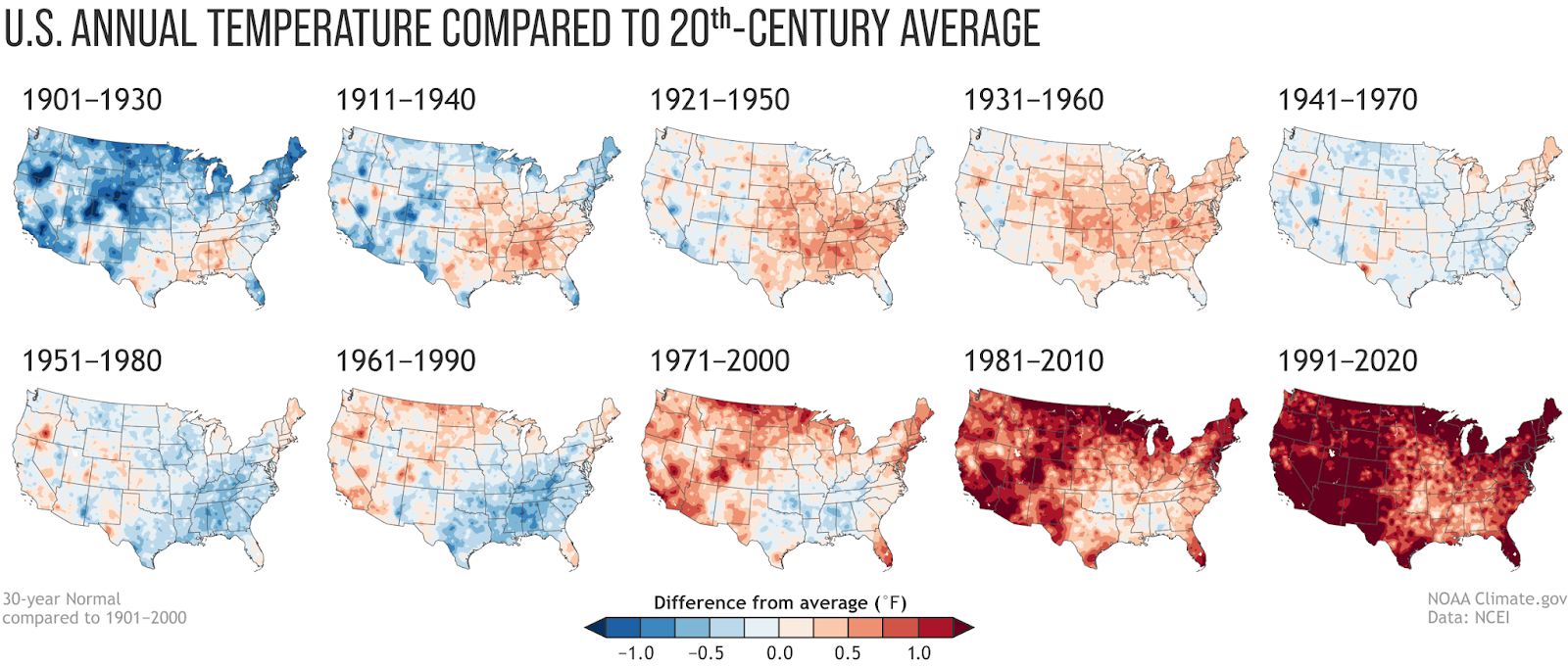
The earth is warming.  The image below shows the change in 30 year normals.

Professor Cliff Mass, University of Washington says that the heat wave was natural variability and was not really affected by climate change.  (Note Cliff Mass believes in climate change.)  However the Oregon State Climatologist is quoted saying,

High-pressure systems like the one driving the Pacific Northwest heat wave are “something like three times more likely to occur when we have a tropical cyclone out in the Pacific,” he [Larry O’Neill, Oregon’s state climatologist] said. “So climate change is impacting tropical cyclone activity through modulation of sea surface temperatures, and also things like wind shear.”

And there was a tropical cyclone that could have been indirectly strengthening the high pressure ridge. Similarly there is the climate change weak lazy jet stream theory which allows for big ridges of high pressure.  That theory is still being debated with pros and cons.  And there is World Weather Attribution, which is a European effort that calculates probabilities, and they have said this heat wave “was virtually impossible without human-caused climate change” for the extreme temperatures to have occurred. 

What do I think? If I had to make a choice, I think, except for the 2°F warming from climate change that has already occurred, the heat wave was not directly affected by climate change and it was mostly just a very extreme case of natural variability (like what Professor Cliff Mass said), but I am not certain.  Indirectly, it is possible that the tropical cyclone in the Pacific could have strengthened the Omega Block High with that tropical cyclone being more likely to form in warmer ocean temperatures due to climate change.  And is it “virtually impossible without human-caused climate change” as stated by the World Weather Attribution people?  Maybe, but I would need to better understand more how they determined the probabilities. 

Does that mean that events like this will be more common?  Maybe, I really do not know.  I personally would rather not label individual events as “caused by climate change”, though it is possible they may be strongly influenced by climate change.  Global warming is a long term happening, and it does affect individual weather events, but I believe the effects tend to be indirect (e.g. warmer temperatures, increased available energy, etc.), so therefore I would not like to declare a weather event to be caused by global warming rather I would say individual weather events are influenced by climate change.  It may just be wording, but I like the word “influenced” better.  

However note that I believe climate change does make a difference.  I do not feel confident in saying how much, but this is how I see it.  Today it is like jumping off a 6 foot high diving board.  50 years ago the diving board was 1 foot high and 50 years from now it may be a 20 foot diving board.  Jumping off (the weather event), is the same no matter what the height of the board is but the splash will be bigger jumping off the higher board.  The height does influence the splash.  Climate change does make a difference.  To sum up where I stand, I do believe that the earth is warming and human-caused climate change is real.  We need to be concerned, because doing nothing will make it harder on future generations.