Santa Claus and Saint Nicholas

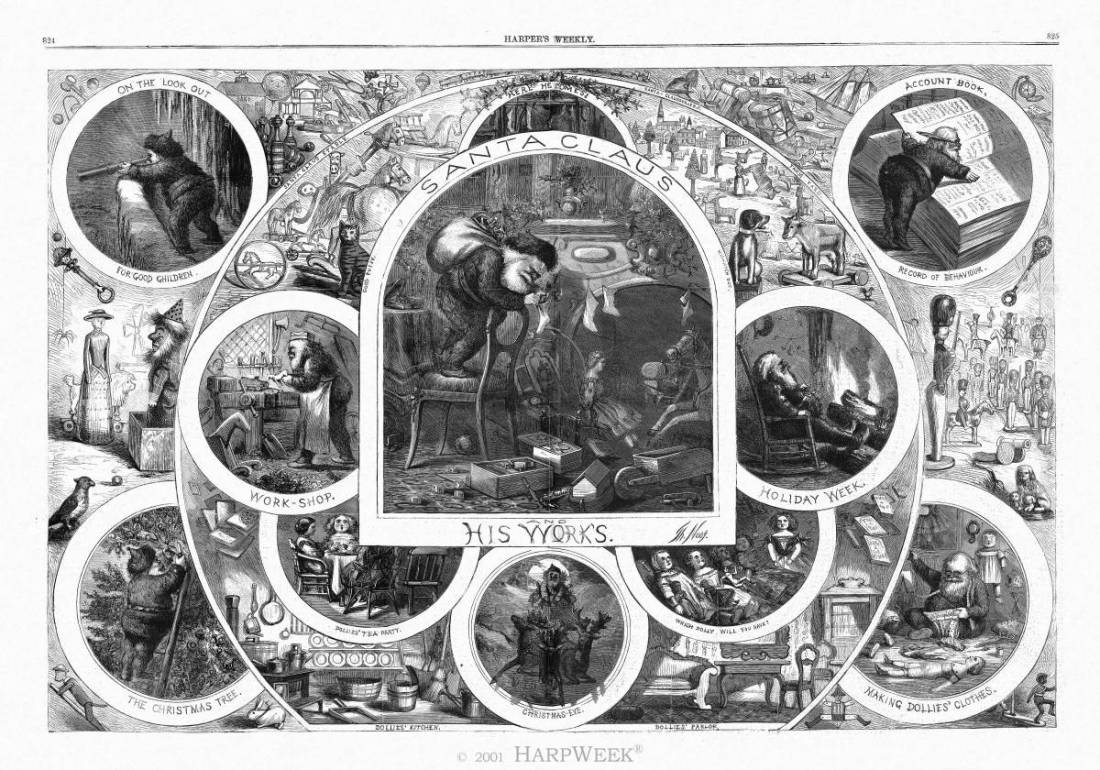
Old Picture of Santa Claus by Nast

In today’s culture, Santa Claus is the main icon of Christmas.  Christmas today is a secular holiday whose religious origins are forgotten or ignored by many people. (Even atheist Richard Dawkins celebrates Christmas.)  So who is this Santa Claus?  Did a bunch of stores create him so that they could sell more toys?  Today’s Christmas is definitely very commercialized and the stores do make use of Santa Claus to sell their goods at this time of the year, but no, there is a lot of history and tradition behind Santa Claus. Behind the modern version of Santa Claus are the traditions of the historical figure of Saint Nicholas, the English Father Christmas, and the Dutch Sinterklaas.

Saint Nicholas of Myra was the Christian bishop of Myra (present day Demre, Turkey).  He was born on March 15, 270 and died on December 6 in 343.   Saint Nicholas was known for his generosity. The most famous Saint Nicholas story is the story where St. Nicholas for three nights dropped a small bag of gold coins each night in an open window so that the three daughters of the house would have a dowry and would not remain single and be forced to become prostitutes.  He was known to have made a pilgrimage to Egypt and Palestine.  He was also imprisoned during Diocletian’s persecution.  And he was likely at the First Council of Nicaea in 325, where some say he slapped (or punched) Arius, the heretic. Though he does not have any writings existing, he has been a very popular saint down through the centuries.

Saint Nicholas Day is December 6.  In some parts of the world, people wake up on the morning of December 6 to find sweets in their shoes or in their hanging socks.  Folklore has had a large part in determining who the giver of gifts is in the various parts of Europe and from Europe to the rest of the world with Santa Claus being the main figure.  The dates when the gifts are given vary from December 6 to January 6, depending on who the giver is. In America, the 1823 poem “Twas the Night before Christmas” influenced how we see the Santa Claus legend, and other 19th century authors and illustrators also influenced our view of Santa Claus.

Though not all that much is known for certain about Saint Nicholas of Myra (there is a tomb and bones that date back to the right time period), I did find one quote, only one quote, attributed to him.  And this quote fits the theme of giving.

The giver of every good and perfect gift has called upon us to mimic His giving, by grace, through faith, and this is not of ourselves.” (Saint Nicholas of Myra)

So let us give, by God’s grace through faith, remembering God who gave his Son that we might have a full life in him.  “Every good gift and every perfect gift” is from God (James 1:17).

For God so loved the world, that he gave his only Son, that whoever believes in him should not perish but have eternal life. (John 3:16)

Gratitude

Photo of wheat by Jimmy Lemon

We recently celebrated the Thanksgiving Holiday. Did you have an attitude of gratitude?  For many people Thanksgiving is a holiday of family, food, and football with shopping also on their minds.  And sometimes there may be some talk about what they are thankful for, but it seems that seldom God enters in the conversation.  There is nothing wrong with that, but Thanksgiving was about giving thanks to God in the original 1789 Thanksgiving Proclamation.  The proclamation by George Washington at the urging of Congress was to set aside “a day of public thanksgiving and prayer” in response to the many blessings poured out on America by Almighty God, in particular acknowledging God’s hand in the nation’s independence and the peaceful transition to a national government. That gratitude perspective seems to be lacking today.

I am guilty of treating Thanksgiving only as a time for food and fellowship, and not acknowledging God’s “kind care and protection”, and asking God “to bless them with good government, peace, and concord”, and also asking God to “to pardon our national and other Transgressions” as found in the 1789 Thanksgiving Proclamation. Fortunately, I am in the habit of going to a Thanksgiving church service that covers those things. It is important to me to reset my mind on the goodness and providence of God.  Our Heavenly Father is gracious and merciful, providing for all our needs.  We need to be reminded that everything is God’s, and we own nothing.  

Behold, to the Lord your God belong heaven and the heaven of heavens, the earth with all that is in it. (Deuteronomy 10:14)

It is all God’s, and even our abilities come from God.  

Beware lest you say in your heart, ‘My power and the might of my hand have gotten me this wealth.’ You shall remember the Lord your God, for it is he who gives you power to get wealth (Deuteronomy 8:17-18a)

In America, we live a luxurious life, and as Americans we want to be self-reliant.  God reminds us that reality is different.  It is all God’s and we are just managing what we have been given. God asks us to use what he has given us to his glory. We seldom have that stewardship perspective.  We are focused on ourselves, and we do not realize that everything we have is really God’s.  From the air we breathe to the car we drive, it is all God’s.  The good news for us Christians is God has control, and he is working things out for our good (Romans 8:28). Therefore we can 

Rejoice always, pray without ceasing, give thanks in all circumstances; for this is the will of God in Christ Jesus for you. (1 Thessalonians 5:16-18)

If you are going through tough times and are not feeling very thankful because things are not going as desired, turn to God and tell him how you feel, and then look back and remember all God has done and thank him for that.  Because knowing all God has done for us, we can look forward with hope.  It lifts our spirits and stops our grumbling.

Do you have an attitude of gratitude?  It has been shown to be good for your health and your relationships to have that gratitude perspective.  By thanking God, you take the focus off yourself, and put it on God and how he has provided for you. Like our Founding Fathers, let us thank God for his gracious provision.  It is good to do so.

It is truly meet, right, and salutary, that we should at all times, and in all places, give thanks unto Thee, O Lord, Holy Father, Almighty Everlasting God

The Trinity (Part 2)

Trinity Shield from symbolsage.com

In the last post, it was pointed out that the Bible teaches there is only one God, and yet there are three persons in that one God.  This post will look at each person of the Trinity, and will take a look at some alternative views and provide some scripture against those views.

God the Father

Jesus referred to the God of the Old Testament as his Father.  He had a good reason since he was the Son of God.  He also encourages us to call him Father too. (There are also passages in the Old Testament, where God is referred to as Father.)  God the Father is considered to be the Creator of the world, but the Son and Holy Spirit also have roles in the creation of the world.   It is the Father that sent Jesus to be born as a human.  And from the Father (and the Son) proceeds the Holy Spirit.  If the word ‘God’ is mentioned, my first assumption is to assume that the passage is referring to God the Father (e.g. 2 Corinthians 13:14).  I believe that most of the time that assumption is correct.

Jesus Not Created

Jesus was born of the Virgin Mary, and yet the Bible makes it clear that he existed from eternity.  Some claim that Jesus was God’s first creation.  They use Colossians 1:15b, “the firstborn of all creation”, as proof of God’s first created being.  The word firstborn does not have to refer to being born first.  The firstborn son had special privileges and so the word firstborn can also refer to one with the special privileges of a firstborn son without being firstborn.  Moses was told to tell Pharaoh that “Thus says the Lord, Israel is my firstborn son” (Exodus 4:22b).  That verse as well as the Colossians verse the word ‘firstborn’ can not be taken literally especially if you take the phrase in context.  Here is the Colossians passage in context with the paragraph:

15 He is the image of the invisible God, the firstborn of all creation. 16 For by him all things were created, in heaven and on earth, visible and invisible, whether thrones or dominions or rulers or authorities—all things were created through him and for him. 17 And he is before all things, and in him all things hold together. 18 And he is the head of the body, the church. He is the beginning, the firstborn from the dead, that in everything he might be preeminent. 19 For in him all the fullness of God was pleased to dwell, 20 and through him to reconcile to himself all things, whether on earth or in heaven, making peace by the blood of his cross. (Colossians 1:15-20)

In context you can see that the paragraph is about the preeminence of Jesus Christ.  In verses 15a and 19b, imply that Jesus is God, not a creature.  In verse 18 firstborn is used again in “firstborn from the dead”.  I see the word  firstborn in this case as Jesus being the source and leader to those who will rise from the dead, and I see it as the same for “firstborn of all creation”.  He is the head of all creation.  And in verse 16 it says that “by him all things were created”.  If he had a hand in creating “all things” then he could not be created.

Jesus Equal to the Father

Is Jesus equal to the Father?  Jesus said “ the Father is greater than I” (John 14:28).  He said that because during his time here on earth Jesus “for a little while was made lower than the angels” (Hebrews 2:9).  Jesus is equal to the Father.  He put aside that equality to become human so that he could save us on the cross (Philippians 2:6-8).

Holy Spirit is a Person

The Holy Spirit is the least known of the three persons of the Trinity.  Many people consider the Spirit to be a force and not a person. I think they say that because the Holy Spirit empowers us.  Jesus clearly refers to the Holy Spirit as a person in John 14-16. Here is a sample

But when the Helper comes, whom I will send to you from the Father, the Spirit of truth, who proceeds from the Father, he will bear witness about me.” (John 15:26)

The Holy Spirit is not a force.  He is a person.  He gives witness to Jesus in the above passage. He teaches (John 14:26) and speaks (Acts 8:29).  He also can be grieved (Ephesians 4:30), lied to (Acts 5:3-4) and become outraged (Hebrews 10:29).  That sounds like a person, not a force.

Roles in the Trinity

There also tends to be some confusion over what the roles of each person of the Trinity. We want to assign specific roles, like the Father is the Creator, the Son is the Redeemer, and the Holy Spirit is the Sanctifier.  Doing so is not wrong, but these roles are not exclusive either.  We find out that the Father created the world through the Son, and the Spirit had a role too.  And it is the same with the Son and the Spirit.  The Bible points out that all persons of the Trinity are at work in all external actions that affect us.  Note this does not make the three persons of the Trinity uniform.  Each person of the Trinity has his own personality, so the actions of each person might not be the same. Norman Geisler describes the “roles” of each person of the Trinity this way:

In brief, the Father is the Planner, the Son is the Accomplisher, and the Holy Spirit is the Applier of salvation to believers. The Father is the Source, the Son is the Means, and the Holy Spirit is the Effector of salvation—it is He who convicts, convinces, and converts.

Again I do not want to make the “roles” exclusive. The Trinity is a mystery that we can not fully comprehend.   Let us look at a couple cases.

Though some people have differing views on the Trinity, this doctrine of the Trinity is of critical importance.  There is a reason that this doctrine has been central to church teaching for over 1500 years.  It is important to know who God is.  There is only one God and yet there are three persons to that one God, Father, Son, and Holy Spirit.  On that belief the Christian faith stands.

[T]he God of our Lord Jesus Christ, the Father of glory, may give you the Spirit of wisdom and of revelation in the knowledge of him (Ephesians 1:17)

The Trinity (Part 1)

Trinity Shield from symbolsage.com

Today, it seems many Christians do not understand the Trinity, that is the Triune God.  It is something that the Christian Church has believed and taught for centuries, and I believe from the beginning.  The Trinity is not directly mentioned in the Bible, but it is something that is strongly implied in the Bible.  When you put together all the Bible passages on God the Father, Jesus, and the Holy Spirit, you find that everything makes sense with the concept of the Trinity.  The Athanasian Creed lays out the doctrine of the Trinity with an emphasis on Jesus Christ in the latter half.

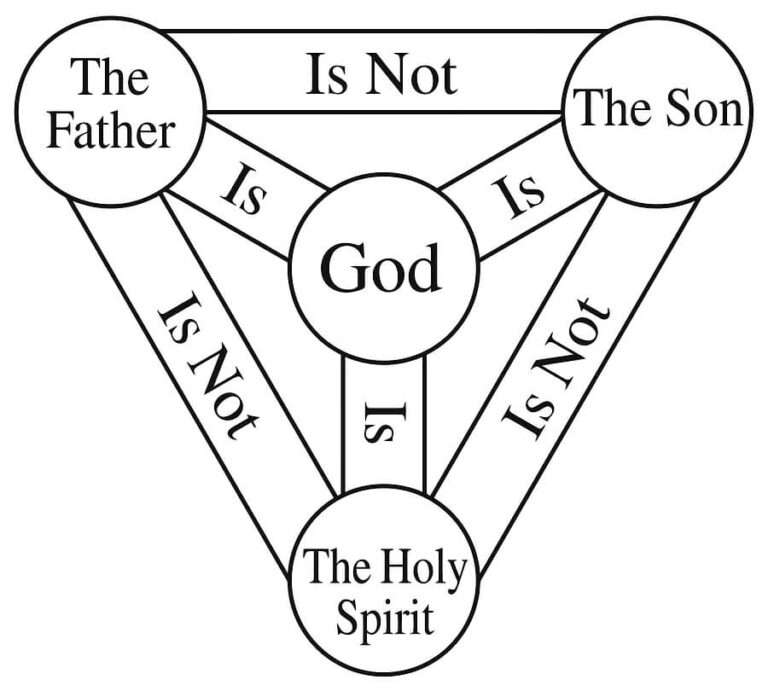
The Christian faith teaches that there is only one God with three persons (Father, Son, and Holy Spirit) to that one God. There are not three Gods under a Godhead council but only one God with one undivided essence/substance. Jesus is not a third of God but he is fully God, just as the Father and the Spirit are fully God.  Each person of the Trinity is equal to one another. There are many analogies for the Trinity, but they all fall short in some way or another.  It is a mystery that does not completely make sense to our limited minds, but the doctrine is derived from the Bible. 

An example from nature of something that does not make sense is the facts about light.  Light is a particle (a photon), and light is an electromagnetic wave.  It should be one or the other.  We have instruments that measure light as a particle and other instruments that measure light as a wave.  The Trinity is like that. We know it to be true but it does not make complete sense.

There are a couple of interesting passages that suggest the Trinity.  The Great Commision says

 Go therefore and make disciples of all nations, baptizing them in the name of the Father and of the Son and of the Holy Spirit (Matthew 28:19)

Note that “name” is singular, but it points to three names, Father, Son, and Holy Spirit.  And from the Old Testament the Great Shema which starts with

 Hear, O Israel: The Lord our God, the Lord is one. (Deuteronomy 6:4)

The word “God” in Hebrew is Elohim and it is actually plural, not singular as the passage or the corresponding verb would indicate.  These two passages suggest that there may be something to this Trinity idea. (Note I may be stretching the context too much for Elohim to be a reference to the Trinity. The word, Elohim, occurs more than 2500 times in the Old Testament, mostly in reference to the one true God.  The plural is also there to emphasize the awesome majesty of God, and maybe that is the only purpose of the plural.)

There are many passages (e.g. Isaiah 46:9, Romans 3:30a) that state that there is only one God.  This meant the many New Testament passages that claim that Jesus is also God (e.g. John 1:1,14, Titus 2:13) had to be resolved with the doctrine of the Trinity. Similarly for the Holy Spirit there are passages that equate the Holy Spirit with God (e.g. Acts 5:3-4, 2 Corinthians 3:17-18) that need to be resolved.  Scripture also records that Jesus and the Holy Spirit have the same attributes as God the Father. This makes the doctrine of the Trinity necessary and true.

Another concept that makes the Trinity necessary is the fact that one of the major defining attributes of God is love.  God needs someone to love.   Because our one God consists of 3 persons he can have that attribute of love.  He did not wait to create us to learn about love, rather love was known because each person of the Trinity is fully loved by the other persons of the Trinity. 

Part 2 will take a look at each person of the Trinity, and will take a look at some alternative views and proofs against those views.

Casual Christian?

Bible with heart shadow

Who are you?  Are you a Christian in name only?  Or are you a casual Christian?  Or are you a disciple of Jesus Christ? What determines your Christian identity?

A Christian in name only tends to know very little of the Christian faith.  They most likely will say they are a ‘good person’ and that makes them Christian.  Unfortunately for them, they are wrong.  Heaven is not for ‘good’ people.  Heaven is for those who recognize they are bad, sinners in need of a savior.  Christians have received forgiveness and salvation because of what Jesus Christ did on the cross.  He died for each one of us and rose again that we might have life in him.  A Christian has this relationship with the Triune God that was given to them.

A casual Christian is one who does ‘Christian things’ now and then or even weekly.  They most likely have that relationship with God, but they are casual about their faith.  They are Christian infants that still need milk instead of advancing to solid food (1 Corinthians 3:1-3).  They have not grown in their faith because they are casual about it. They seem to be missing the desire or the discipline to grow in their faith.

In response to one’s salvation, a disciple or follower of Jesus Christ should have that desire to follow Jesus, to love him, and to learn of him.  A disciple wants to become like Jesus, to imitate him (Ephesians 5:1-2). There are many Bible passages that can help us.  I will bring up only the one that has been recently on my mind.  In the Gospel of John Jesus says four times,  “If you love me, you will keep my commandments” (John 14:15,21,23,24).  That is a hard saying and he says it four times in just a few verses.  The commandments can be summed up with ‘love God and love people’ (Matthew 22:36-40). And that love is defined as acting out of the commitment to put the other person’s best interests ahead of your own.  Many times, I have trouble loving.  Many times, judgemental thoughts pop into my head, or I do not want to deal with these strange and different people.  Those times I am being self-centered.  And yet Jesus calls us to reach out to them and to love them, not just some of them but all of them.  Jesus has given us the Great Commission to go and make disciples (Matthew 28:19-20). That means we get to walk with them in life, love them, and share the good news of God’s love for them.

Fortunately, God does not leave us alone to become a disciple and to love.  The Holy Spirit comes to be our Helper, Comforter, Advocate, and Councillor. In that very same passage, where Jesus tells his disciples four times to “keep my commandments”, he also promises the Holy Spirit (John 14:15-27).  The Holy Spirit is there to assist and empower our Christian life.  We are not alone in our journey.  Moreover, Jesus helps us understand our dependence on him.  Jesus describes himself as the vine and we are the branches.  That power to love flows from him to us, and by abiding in him we bear that fruit of love (John 15:1-17). Without Jesus, we wither and die.  With God’s help, we are able to succeed. But God provides even more help for us.

We also have the help of local Christians who walk alongside us to help enable us to love God and love people more.  God did not plan for any ‘Lone Ranger Christians’, rather throughout the Bible you find God’s people always gather together in community.  It is through Christian community that spiritual growth happens (Ephesians 4:11-16). It is in the body of Christ that discipleship happens, and I have found that happens more in small group settings than not, so connect up with a small group at your local church and learn of Jesus. Our local congregations should be where we teach, learn and put into action the love of Jesus.

This post was inspired by a short book by Mike Falkenstine called “Being and Making Disciples in the Western Church”.  Here are his five focus areas for local church leaders on making disciples.

  1. A High View of Scripture
  2. A Steely-Eyed Commitment to Making Disciples that Make Disciples
  3. A Determination to Equip All Your People
  4. A Confident Expectation in the Power of the Gospel
  5. An Awareness that Spiritual Growth Happens Primarily through Community

So are we being too casual, individually and/or corporately, with our Christian Faith?

God Awareness

Prayer Photo by Jesper Noer

As I go about my daily tasks do I remember that God is right there with me and in me? Or do I do my daily tasks and leave God to help me with the big problems?  Am I more secular than Christian?  I do not want that to be me.  I want a close intimate relationship with my God, and he desires it too.  So how do I work on improving that relationship?  What tools can I use?

The first step is to daily read the Bible.  Think of reading the Bible as God talking to you in the context of him sharing timeless truths about himself from years ago.  The entire Bible points to Jesus, so look for him.  Remember the Bible is a library of “books” so one does not have to read straight through.  Start with one of the four Gospels.  Learn of Jesus.  (If you are inexperienced in Bible reading, then get a study Bible with comments.  It helped me.)  And take time to stop and ponder what God is trying to tell you in the scripture passage.

Along with reading the Bible take time to pray. Prayer is simply talking to God.  Praise him for being a great and wonderful God.  Thank him for the little and big things in your life. And share with him the things that are on your heart.  Since God is always with you,  he is always there to listen to you.  You can talk to him anytime and all the time. 1 Thessalonians 5:17 says to “pray without ceasing”.  God wants our continual prayers.  He wants that intimate relationship.

Way back in the 1600’s, Nicholas Herman became a monk.  He became known as Brother Lawrence and he worked in the kitchen at the monastery.  So why do we know of him?  Because he strove to walk in the presence of God in all his tasks, big and small.  In order to do that he nurtured the practice of being in a continual conversation with God.  Word got around what he was doing and many letters were written.  After he died, 15 of his letters and 4 conversations were compiled into a small book, called “The Practice of the Presence of God”.  

This is something I am trying to work on.  I am taking small steps toward a continual conversation with God and to recognize that God is always with me.  That awareness that God is always with me is a good feeling.  When a person pops into my mind, I try to say a short prayer for them, right then and there.  Also in the small daily things that happen in my life, I thank God for them.  Why, because God is here to hear me and to help me build that intimate relationship.

There is an ancient short prayer, called the Jesus Prayer, that people use to nurture that connection with God.  The prayer is “Lord Jesus Christ, Son of God, have mercy on me, a sinner”. People for centuries have said this prayer over and over again during the day.  It is a good prayer to remind us who we are.  I have two short prayers that I say many times during the day.  One is “Thank you Jesus”, which may be thanking him for something that just happened, or it may be thanking him for dying on the cross to save me.  My other short prayer is “I am yours”, in which I acknowledge God is my master and I am his. It is a happy surrender.

Another way that I have seeked to grow closer to God was, when I was still working I would right after my devotion time hop in the car and head to work.  I would first spend time praying, imagining Jesus was right in front of me on the hood of my car.  (Imagining Jesus sitting next to me took my eyes off the road too much.)   I would talk to him and share my concerns on the way to work.  I would then pop in a Christian tape (it was an old car) and sing praises to God the rest of the way to work.  The point I want to make is you can transform some of these mundane activities, like driving to work, to ways that connect you with God.

Sometimes it is good to set an “reminder”.  I have a 1:00 PM appointment every Monday to pray for my local church.  My cell phone reminds me every Monday to pray for Immanuel.  That way when my cell phone “beeps” at me at 1:00 PM on Monday, I know it is time to stop what I am doing and to take a minute to pray for my church.

Why do this?  I believe it builds good habits, it strengthens that God relationship, and it is one way to rewire your brain to be more focused on God. One needs to be intentional and it does take discipline. I have failed many times in my attempts.  But I have learned to not think of the failure as a test that you have failed, but rather remind yourself that you are in training while God is doing that brain rewiring.  Your failing is motivation to improve and do better next time. Remember God is at work, changing you to be more like him.

PS This post was inspired by chapter 5 in Ken Boa’s book, “Life in the Presence of God”.

COVID Thoughts

Coronavirus (Fusion Medical)

What is next with the COVID-19 story? Most of the world is still unvaccinated, but progress is being made. 41% of the world has received at least one dose, but only 1.9% of people in low-income countries have received at least one dose. It is in unvaccinated regions where the variants to the virus develop, whether it be Tanzania, Columbia, or Northern Idaho.  Will a virus that is immune to the vaccines and deliver a deadly dose develop?  It is possible.  That is why, I believe getting the vaccine to everyone as quickly as possible is very important.  We need to stop this virus before it mutates into something worse. (The delta variant is already worse than the original virus.  What is next?)

Right now the COVID’s fourth wave has hit America hard, but things are different for this wave because many of us are vaccinated and that is making a difference. However the difference is not big enough because we do not have enough vaccinated people for herd immunity.  The risk is lower for me since I have been vaccinated.  The people I hang around with are vaccinated too, but we still need to be careful not to spread it.  Unfortunately, the unvaccinated are catching the COVID virus and hospitals are filling up.  What does America need to do?  Is mask wearing needed?  Is a lockdown needed?  Mandatory vaccinations? Right now it is mostly up to the individual, to companies, or to the local governments.  I do not have the answers.

People have different comfort levels.  Some feel the need to wear face masks and others don’t. (And there are a few, mostly elderly, where a face mask makes it more difficult for them to breathe.)  I am comfortable without a mask, but I respect those who differ and I am willing to wear a mask if it makes the individual comfortable.  I am also willing to wear masks if the store or the local government requires it.  It is a small price to pay to keep the peace and maintain relationships.  And I believe that masks do make a difference.  There are many studies that show face masks do help reduce the risk of infection.

There are conspiracy theories out there that are convincing people that the vaccines are bad for them. Yes, I consider these stories to be conspiracy theories.  The evidence is missing, and the story requires large numbers of knowledgeable people to be lying. I cannot believe that a falsehood requiring so many knowledgeable people to lie can continue without being fully exposed.  Here is an article debunking many of the myths.  I ask you to look around and ask yourself, “How many people who I know have had lasting ill effects from the vaccine?”  For me it is zero.  The vaccine does not harm people. It is a very rare case when it causes problems.  

The vaccine is effective at protecting you from the virus. If you are vaccinated there is a one in 5,000 chance per day of becoming infected, and it may actually be a one in 10,000 chance per day.  Unvaccinated people are about five times more likely to become infected with the delta variant of the COVID virus than vaccinated people.  They are now ten times more likely to be hospitalized, and 11 times more likely to die of COVID than those vaccinated.  The vaccine works. One alternative treatment touted by conspiracy theories is a potential antiviral drug, ivermectin.  Current results from the studies show that ivermectin is not effective against COVID-19. (There are some more studies in progress.)  Those considering ivermectin should be very careful, because ivermectin is dangerous to take, especially in large doses.

Should we be getting  a third shot, a “booster shot”, when many in the rest of the world do not have their first shot?  The head of the World Health Organization says, we should wait, and there appears to be a question of whether the third dose is really needed.  The rich countries have promised 1 billion doses to the poor countries, but only 15% of the promised amount has been delivered.  Should we focus on helping poor countries get vaccinated? It would help prevent new strains of the virus from developing. Or should we first protect America’s vulnerable with a third shot? I am not certain if it is an “either/or” question.  I think both can happen.  I believe that we need to get the world vaccinated, the faster the better.  The vaccines need to get to poor countries quickly, but only if the logistics are in place to get the people vaccinated.  Logistics can be a problem.  And I think third shots can happen too, but they should be the extra doses that are not going to be used by those getting their first and second doses.

With all that is happening, as Christians, we can be rest assured that our God is good and loving and in control.  We need not fear.  In the end, heaven awaits, where everything will be made right for us.

Self Destruction

I believe we are all engaged in self destruction, everyone of us, though most of us would deny it. We all are doing and thinking in ways that harm ourselves, and there are deadly consequences to our thoughts and actions.  I am talking about sin, that is the wrongdoing and wrong-thinking that we do. We are all guilty of doing it, and it is not healthy.

I know that it is not popular to talk about this today.  Sin is a countercultural topic. People for 50+ years have been saying “I’m okay and you’re okay”.  Most would say that they are, by and large, good people.  And they would say that of others too so as to at least not damage their self esteem. (It is easier to see the faults of others than to see faults in ourselves.)  Reality is we are all damaged goods. We are not okay.  We are broken and not good at all.  Problems in the world are not just out there.  The problems in the world start inside each one of us.  It is ultimately an internal problem, our own sin. 

What does sin look like?  The list of the “Seven Deadly Sins” is a good way to categorize various sins.  They are lust, gluttony, greed, sloth, wrath, envy, and pride.  Pride is considered to be the original and most serious of the sins.  It is where ego and self are directly opposed to God. It is where you say “I can do better than God”, or “I know better than God”.  It is you being self centered. According to a Vatican study, the sin that men were most likely to confess was lust,  while for women it was pride.  What is the sin category you struggle most with?

How does one fall into sin? Father Maximos of Mount Athos says the “holy elders” have described five stages of temptation to sin as: 

  1. Assault: The tempting or evil thought first attacks a person’s mind.
  2. Interaction: A person opens up a dialogue with the tempting thought.
  3. Consent: A person consents to what the tempting thought urges them to do.
  4. Captivity: A person becomes a hostage to the tempting thought, finding it more difficult to resist each time one falls.
  5. Passion or obsession: The tempting thought becomes an entrenched reality within the person’s mind.

Sin is habit forming. What can you do with that sinful habit of yours?  It is not easy to deal with, but with the Holy Spirit’s help you can nip the tempting thought in the bud.  At stage one, you ignore the tempting thought and put it out of your mind.  That is easier said than done, but it is possible. It is especially difficult if you have fallen many times to that same temptation. The sin can become second nature to you.  To help, there are a variety of 12 step recovery groups around to help and support you in your struggle.  Celebrate Recovery is a Christian 12 step recovery program that covers all you may be struggling with.  It does not matter what your addiction or sinful habit is, whether it be drugs, porn, or gossip.  Celebrate Recovery can help.  They are nationwide with groups all over the USA.

The reality of sin is depressing and very self esteem crushing, but there is good news. Each and every one of us is fully loved by God, despite our sin.  Jesus Christ came into this world to deal with sin and to restore us to God.  Because of him we can have an abundant life in him and ultimately will become free from our sin.  In Christ, we can face the brokenness of the world and of ourselves. Also because of him we have become forgiven children of God. Our sins will no longer define us. God will restore us from our self destruction and we will be made whole.

It is our 264th Monthiversary!

Marriage Rings Photo by Mike Goodwin

22 years ago on Sunday August 15, 1999, I married Gail Halstead. As I recounted in last year’s blog post, my life plans had not worked out as I had planned.  Instead God’s plans were better.  It was an unusual courtship back then with Gail in Oregon and me in Colorado.  Because of that distance, we did a lot of emailing. Our six month engagement turned out to be unusual too.

Two months into our engagement, I became deathly ill with Guillain Barre syndrome.  Nerves disconnected and I was paralyzed from the rib cage down with other parts of my body slightly less affected.  I could not close my eyes, or pucker my lips.  My hands were pretty useless.   I spent 2 weeks in the ICU with a total of 6 weeks in the hospital.  I then spent 7 weeks recovering in a nursing home, doing physical therapy and learning to walk again.  After that, I continued my recovery at home. I ended up missing six months of work.  My goal was to be able to walk with one cane down the aisle to get married.  That I did, however I went back to two canes after the wedding for a period of time.

In many ways, this was not totally a negative experience.  It gave Gail a chance to ask if she could love a man who might remain bedridden.  Yes, she decided she could.  She was able to get off work and fly out to visit me more often than she would have.  It was very nice to see her even though I was in bed.  I had to trust her with my finances and the selling of my townhouse. It was a bonding experience for us.  And it was a faith growing experience for me.  I grew more aware of God’s grace and goodness during this illness.

When we became engaged, Gail started reading several books on marriage and gave me three books to read.  We wanted our marriage to be successful, because it is a vow, a commitment, we make for life to each other and to God.   What I learned is that marriage takes work.  I also learned that Gail’s love language was very different from mine.  Over the years, we have taken several marriage courses to keep our marriage going strong, and of course we were always reminded that communication is very important. About a year ago, we took another marriage course, Marriage in Christ.  It is a good course and we are planning on offering it at our church. You can also take the course online.

Our marriage has turned out great.  I am very happily married to Gail.  Marriage does take work and commitment.  You can not and should not take the other person for granted. And you need to be intentional in your marriage.  They are your partner in life and with some work you can have a wonderful marriage.

Distrust!

Newspaper Boxes (photo by David Resseguie)

It seems like there is a lot of distrust in America these days. In my conversations, I have been surprised at how much distrust there is.  There is a lot of distrust on both sides of the political divide, and I believe distrust is tearing the country apart.  From my perspective, there are a lot of reasons to trust societal authorities, the government, police, journalists, etc.  So my default mode is to trust, not distrust, the authorities. This post is about why I trust, and not distrust, societal authorities even though they all have their problems. 

I believe behind much of this distrust is today’s Postmodern culture.  The culture makes us suspicious of the facts because we recognize that there is always a bias (no matter how small) in how the facts are presented.  Unfortunately, we have a tendency to believe only the stories that we want to agree with. We are not properly discerning the facts and are falling prey to the spin that promotes our preferred perspective on how things are.  There is no self correction, because we, as autonomous individuals, make ourselves out to be the only authority.  We alone can discern the truth.  All other authorities are suspect, spinning the facts to put their perspective out front. (And today’s culture also allows us to spin the facts the way we want.)

Is it true that the government, police, journalists, churches, etc. put a spin on the facts?  Yes, everyone has a bias.  That includes you and me, but I believe that American society has built in safeguards to hold people accountable for falsehoods.  It does not always work but in general I believe we can trust the societal authorities.  There  is no need for the institutional disrespect we see today.  Yes, we need to hold people and institutions accountable, and there may be biases that need to be dealt with, but in general I believe we should trust our societal institutions.

Let us first take a look at  journalists.  Their job is to report the news.  I believe conspiracy theories are due to not trusting the journalists and the news sources.  A  journalist would win a Pulitzer Prize if they could prove one of the conspiracy theories to be true.  It is that motivation and competition that keeps the journalists honest.  So whether the conspiracy theory is one of the 9/11 conspiracy theories or the “Stop the Steal” conspiracy theory or a different conspiracy theory, the likelihood that the theory is true is very unlikely.  The “what if” possibilities in the conspiracy theories are not evidence of facts.  You may want it to be true but it does not make it so.  I believe it is the distrust of societal institutions and the journalists reporting that allows these conspiracy theories to flourish.  Journalists and the institutions supplying them with information are not perfect, but in America the journalists do a pretty good job.  There are biases of varying degrees, but you need to discern those biases.  I  find the Reuters news service to be pretty unbiased.

(Yes, many of you believe the “Stop the Steal” story, but why were almost all the lawsuits dismissed and why did the Attorney General William Barr say “To date, we have not seen fraud on a scale that could have affected a different outcome in the election” if the “Stop the Steal” story is true? Maybe you want it to be true, but I believe it is not.)

Many people distrust the police.  Some would want to ban police departments, or cut the funding for the police way back.  I believe that the vast majority of police officers are good and honest.  There are few bad apples that need to be removed, and some department policies need to be reworked so that accountability can be enforced, but in general the American police are in good shape.  What happens if there are no police?  We have an example from Seattle, WA, June 2020, where for 23 days protestors occupied a few blocks in the Capitol Hill neighborhood of Seattle.  The police vacated the area, leaving their precinct station.  The protestors started with high hopes.  It was to be a police-free, self-governing utopia. Seattle’s mayor Jenny Durkan said the zone could herald a “summer of love”. Unfortunately, it turned out not to be an utopia, and after 23 days and two deaths later, Seattle’s mayor called in the police to end this utopian experiment.  The problem as I see it is that we all are sinners and we need the police to enforce some boundaries (i.e. laws) for our good.  The police are a necessary part of society. We need them but we also must hold them accountable.

There is a lot of distrust of the government, whether it be federal, state or local.  Again, like the police, I believe the vast majority of them are good honest officials, and worthy of our trust, even if we disagree with their policies.  Again there are just a few that are “bad apples”.  We need to find and remove those.  Those who distrust the government, many times say that the deep state or civil servants are hindering government change.  Both Trump and Obama supporters have been concerned about deep state interference.  My take is the federal government is a huge organization and I see making change to be like trying to quickly turn a massive oil tanker.  It will take time.

And today, churches tend to be ignored more than being distrusted.  However the sexual abuse scandals have affected the trust in churches. Again I believe the vast majority of clergy and church workers are good and honest, but churches are human institutions, and all humans are sinful so it is no surprise that scandals also are found in churches.  And yet we can put our trust in God.  He is the trustworthy one, a solid rock that can not be moved, and his love is amazing!

These societal institutions are not perfect, but in America I believe they are worthy of our trust.  They do need to be held accountable for their failings.  In America, one should default to trusting the authorities.  That is where I stand.  As a Christian, I take comfort that God has all this in his control.  Bad things may happen because of our sin but in the end God will fix all the brokenness.