Be Kind!

Bible with heart shadow

Social media amplifies mean spirited posts. They propagate in the matter of minutes across the social media sphere.  They grab people’s attention and thus make more money for Facebook, Twitter, Instagram, and the like. The sad result is these mean spirited posts hurt and divide people.  It is not the Christian thing to do.  Scripture is clear.

22 So flee youthful passions and pursue righteousness, faith, love, and peace, along with those who call on the Lord from a pure heart. 23 Have nothing to do with foolish, ignorant controversies; you know that they breed quarrels. 24 And the Lord’s servant[a] must not be quarrelsome but kind to everyone, able to teach, patiently enduring evil, 25 correcting his opponents with gentleness. God may perhaps grant them repentance leading to a knowledge of the truth, 26 and they may come to their senses and escape from the snare of the devil, after being captured by him to do his will.  (2 Timothy 2:22-26; ESV)

What does the Apostle Paul tell Timothy:

  • Pursue righteousness, faith, love, and peace.
  • Have nothing to do with foolish, ignorant controversies.
  • Must not be quarrelsome.
  • Kind to everyone.
  • Able to teach.
  • Patiently enduring evil.
  • Correcting his opponents with gentleness. 

Why do this so that “God may perhaps grant them repentance leading to a knowledge of the truth”.  Too many Christians post or repost half truths, lies,  and mean spirited content.  That is not being a good witness, and it does not promote the Christian Faith.  It does the exact opposite.  Don’t let the Christian name be dragged through the mud of falsehoods.

Another passage that strongly suggests that we are to be a force for good.

14 Bless those who persecute you; bless and do not curse them. 15 Rejoice with those who rejoice, weep with those who weep. 16 Live in harmony with one another. Do not be haughty, but associate with the lowly.[a] Never be wise in your own sight. 17 Repay no one evil for evil, but give thought to do what is honorable in the sight of all. 18 If possible, so far as it depends on you, live peaceably with all. 19 Beloved, never avenge yourselves, but leave it[b] to the wrath of God, for it is written, “Vengeance is mine, I will repay, says the Lord.” 20 To the contrary, “if your enemy is hungry, feed him; if he is thirsty, give him something to drink; for by so doing you will heap burning coals on his head.” 21 Do not be overcome by evil, but overcome evil with good. (Romans 12:14-21; ESV)

Here we see that we are to

  • Bless and do not curse them.
  • Be empathetic.
  •  Live in harmony.
  • Associate with the lowly.
  •  Repay no one evil for evil.
  • Do what is honorable in the sight of all.
  • Live peaceably with all.
  • Never avenge yourselves.
  • Do not be overcome by evil, but overcome evil with good.

I think a good summary of this passage is “overcome evil with good”.  There are plenty more passages that speak to how we should act.  Here are a few more passages with the key idea phrases and context links.

So as Christians, be kind to everyone online and off. Please do not post or repost mean spirited messages.  That includes even those posts you consider funny but others will find that post offensive.  Check and make certain what you are posting comes from reliable sources.  That means that you should also make certain other reliable sources carry the same information.  Realize what you post will be seen by many different types of people who may not understand the context of your post.  Again, be kind and show love to everyone.

To sum up from Luther’s Small Catechism:

You shall not give false testimony against your neighbor.

What does this mean?

We should fear and love God, so that we do not tell lies about our neighbor, betray him, slander him, or hurt his reputation, but defend him, speak well of him, and explain everything in the kindest way.

Note there are some instances when speaking the truth in love to a person eventually requires you speak harshly to them to wake them up out of their sin (e.g. self-righteous hypocrisy) but those instances should not be social media posts for all to see.

The Communion Divide

Photo of Chalice by James Chan

Christians are divided over a variety of doctrines.  Some people will argue and demand agreement over the most minor of points (doctrinal sectarianism).  Others will allow any belief to exist in order to promote unity (doctrinal minimalism).  And then there is the spectrum of people in between those two extremes.  What is needed is some “theological triage”, where it is determined which doctrines are critical, which are important, which are less important, and which are unimportant.  However, even then, different people will treat different doctrines differently, so what might be considered a critical doctrine by one would be considered less important by another.  

Today, I believe, there are two big doctrines that divide people into many denominations.  They are Baptism and Holy Communion (Lord’s Supper or Eucharist).  500 years ago during the Reformation, it was Holy Communion that prevented Protestants from uniting.  (The anabaptists were few in number so baptism was not an issue like it is today.)  We are going to take a look at the 5 major ways Christians view Holy Communion.  Note I believe Holy Communion is an important doctrine, but a right understanding of Holy Communion is not critical for salvation.

I am Lutheran and because of that I am going to explain what theologically conservative (confessional) Lutherans believe and why.  (At least how I understand it.)  And we will compare that with the other 4 ways of looking at Holy Communion.  You should expect some Lutheran taint since that is where I am coming from.

Let us look at what the Bible says, because it is the authority (the only authority for conservative Lutherans).   Here is what Matthew 26:26-29 says:

26 Now as they were eating, Jesus took bread, and after blessing it broke it and gave it to the disciples, and said, “Take, eat; this is my body.” 27 And he took a cup, and when he had given thanks he gave it to them, saying, “Drink of it, all of you, 28 for this is my blood of the[c] covenant, which is poured out for many for the forgiveness of sins. 29 I tell you I will not drink again of this fruit of the vine until that day when I drink it new with you in my Father’s kingdom.”

For context see Matthew 26.  There are also accounts in Mark and Luke and in 1 Corinthians.  All four accounts are pretty much the same.  The one important phrase missing from the Matthew account is “Do this in remembrance of me”  (Luke 22:19b).  That phrase is found in the Luke and 1 Corinthians accounts.

Conservative Lutherans take the phrases “this is my body” and “this is my blood” literally.  There is no scripture to suggest that the phrases only represent the body and blood.  Lutherans believe that Jesus’ body and blood are physically present.  Roman Catholic and Eastern Orthodox Churches also believe in the real physical presence of Jesus in Holy Communion.  The Reformed Church (and Presbyterian Church) believe that Jesus is present in the bread and wine, but the body and blood are passed to the communicant in a spiritual manner.  And the other belief of churches (hereafter referred to as Baptist) is that bread and wine only represent the body and blood.

Lutherans believe that the body and blood of Christ physically exists in, with, and under the bread and wine.  So both, bread and wine and body and blood, are present as described in 1 Corinthians 10:16, which says “The cup of blessing that we bless, is it not a participation in the blood of Christ? The bread that we break, is it not a participation in the body of Christ?”  Roman Catholics believe that the bread and wine are changed into Christ’s body and blood while retaining the form of bread and wine.  It is called Transubstantiation and uses some Aristotelian philosophy to define Transubstantiation. Eastern Orthodox has not doctrinally defined Holy Communion.  It just calls it a mystery that bread and wine are turned into the body and blood.

Lutherans also believe that the forgiveness of sins won by Jesus’ death on the cross is given to us in Holy Communion (Matthew 26:28).  The Roman Catholic and the Eastern Orthodox 

Churches also believe that the forgiveness of sins is found in Holy Communion. The Reformed Church sees Holy Communion as providing spiritual nourishment. The Baptist belief sees Holy Communion as only a remembrance of Christ’s death.

Conservative Lutherans also practice close or closed communion.  This means that not all are welcome at the communion table.   The scripture from 1 Corinthians 11:27-29 says

27 Whoever, therefore, eats the bread or drinks the cup of the Lord in an unworthy manner will be guilty concerning the body and blood of the Lord. 28 Let a person examine himself, then, and so eat of the bread and drink of the cup. 29 For anyone who eats and drinks without discerning the body eats and drinks judgment on himself. 

Holy Communion is serious stuff.  One can eat and drink to their harm (v. 27, 29).  One should also examine themselves (v. 28) before partaking of Holy Communion. That is why for Lutherans practice close/closed communion.  Holy Communion is only for Christians who recognize that they are sinners in need of the sacrament and are willing with the help of the Holy Spirit to change their lives.  They also need to recognize that the body and blood of Christ is present in the bread and wine (v. 27).  Conservative Lutherans also believe there is a need for doctrinal unity/fellowship (Because there is one bread, we who are many are one body, for we all partake of the one bread. 1 Corinthians 10:17).

It is out of pastoral concern that close/closed communion is practiced, so that no harm is caused.  Some Lutheran pastors will only commune those they know.  Many will commune only those in the same denomination that they are in.  And others allow for more leeway, asking only those who believe what the Lutherans believe to commune.

All of the five different beliefs, whether open or closed communion beliefs, believe that Holy Communion is meant for Christians.  Roman Catholics and Eastern Orthodox also practice closed communion.  Other denominations may or may not practice closed communion, even some Baptists practice close communion.  However, most Protestant churches practice open communion, where they allow anyone to participate in Holy Communion.

In my very limited experience, these differences of closed communion has been the most offensive to other Christians. As Christians they are offended to not be able to share communion with their Lutheran brother as part of a united body of Christ.  So where does this fall on the spectrum of doctrinal minimalism to doctrinal sectarianism.  I do not know.  It appears that the more theologically conservative you are the more likely you lean toward doctrinal sectarianism.  I personally believe in the idea of closed communion, but I don’t want to end up as a sectarian.  I want to allow for a broad view of Christianity with differing beliefs within the Christian boundaries, while holding strongly to my beliefs.  That is why I am interested in “theological triage”.

Note there is a lot more that can be said about Holy Communion and the differences in belief, but I believe this is a decent summary.

Happy 21st Wedding Anniversary

You never know how things are going to turn out.  When I headed off to college, I figured I would work for the National Weather Service somewhere in the Pacific Northwest, and I would settle down, get married and have a couple of kids.  And this would all happen by the age of 30.  Guess what?  None of that happened as planned.  As I grew older, I realized as a strong introvert that I liked being single and getting married was not going to happen.  Again I was wrong.

Back in 1995, I went on a mission trip to Latvia.  I had felt the need to step out of my comfort zone and do something different, something “risky” for God.  I was glad I went on the mission trip.  It was a milestone in my life.  Then in 1998, the wife of the couple who led the mission trip contacted me and said that Gail wanted an email pen pal.  She had gone on the same mission trip 2 years before me in 1993.  I realized the wife was matchmaking and because of that I almost did not email Gail.  The only reason I emailed Gail was that I was certain nothing would come of this long distance relationship.  She was in Oregon and I in Colorado.  Thank God, I was wrong yet again.

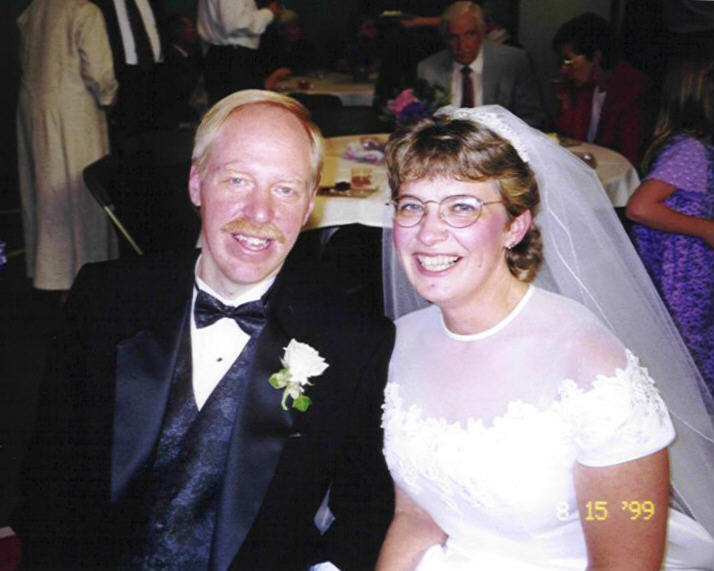
We emailed.  We met.  No sparks flew, but I felt comfortable talking to Gail and I enjoyed her company.  Then I belatedly realized I had fallen in love, and I was way out of my comfort zone.  Seeing God’s hand in all of this, I again embraced the risk.  We were married on August 15, 1999, and now I have been happily married to Gail for 21 years.  I am thankful that God put her in my life.  She is a wonderful woman and I am very happy to have her as my life partner. 

The heart of man plans his way, but the LORD establishes his steps. (Proverbs 16:9; ESV)

Here are a few pictures from that day 21 years ago.

The New 21st Century Normal

Photo by Pongsak Kitirojpan

The only thing constant is change or so they say.  Big events like a major war, a depression, or a pandemic causes the change to new ways to accelerate, and the old ways to die off more quickly.  The question I have been pondering is “What will the new normal look like after the pandemic is over?” Or will it ever be over?  COVID19 might just be a part of the “new normal”.  There are a lot of unknowns and many choices that will be made, but we can look at what is happening and be prepared for various possible scenarios that may occur.  We need to prepare to be resilient and robust.  We need to be flexible and adaptable to the changes around us.  Being not willing to adjust to the new normal will lead to failure.

Some would say that the 21st century really started in 2020 with the pandemic.  All those new 21st century ways of doing things are firmly taking root now.  It happened before.  World War I was the catalyst for the 20th century to “really start”.  A lot of aristocratic ways were discarded after the war and the 20th century truly began.

How has the pandemic changed our lives? Are these changes part of the new normal? Or are they temporary?  Looking at what has happened, we see a lot of changes.  People are wearing masks.  People are not shaking hands.  People are working from home.  People are buying online.  Students are learning online, instead of in a classroom.  Meetings are being conducted via video chat.  Concerts are performed online.  People are streaming videos to entertain themselves instead of visiting a movie theater.  People are isolating with no large gatherings allowed.  How much of this is temporary?  How much will become part of the new normal?

Looking at Tourism and the Travel Industries, you can see they have been hit very hard by the pandemic. Tourism provides 1 out of every 10 jobs worldwide.  How does the future look for them?  One possible outcome is that the pandemic will end and people will begin to travel again.  This will likely happen with assurances from the airlines, cruise ships, hotels, and other event centers that they have and will continually disinfect and clean everything to close to hospital standards.  They would also monitor people for fevers and employ other disease monitoring equipment.  They would be motivated because an outbreak would be very bad for business. Likely business would not return to the numbers they saw before.  The worst case scenario would be if the pandemic continues and they are unable to fully open.  They would go bankrupt, or would have to charge enormous rates for the very rich to travel and see the sites.  The rest of us would view the sites from our home in virtual reality or by video.  Travel would be very limited.  That would be a disaster for the travel and tourism industries.  The travel and tourism industries make their money by packing lots of people into close quarters.  Unfortunately that is also the way disease spreads.

Already we see companies saying they will allow employees to continue to work from home after the pandemic is over.  How many offices will be vacant because of this change?  How many companies who rent out office space will be struggling financially due to too many empty offices? There are some adjustments that will need to be made.

Big box stores were in financial trouble before the pandemic.  How many of them will be able to survive with the increased online purchasing?  Many of them got their start with catalogs.  Online shopping is nothing more than using an online catalog, and yet they are struggling to make that change.  It seems to me that they are no longer flexible, and they can not change.  I like to think I see there will be a return to catalog stores, where you can get advice and place an order, and also where you can return those things that were the wrong size, color, or whatever that was not right for you.  I hope that will happen, if they are willing to make the change.

These big box stores remind me of Kodak.  Kodak was the company that invented the digital camera.  Yet Kodak was destroyed because it refused to adopt the digital camera until it was too late.  Its film business was too valuable for them to make the change to digital.  Today Kodak is only a shell of the original company.  

So how flexible are you?  How flexible is your favorite company or organization?  Can they quickly adjust to the changing environment?  I am amazed at the stories of how breweries and distilleries started producing bottles of disinfectant, and companies who changed their production line to produce face shields and even ventilators in a matter of weeks.  These are the companies that are resilient and robust. They saw the opportunity and made the change.  

Likely you have already adjusted a little to the 21st century.  Do you own a smartphone?  That is a 21st century device that is changing society.  I admit I don’t use it to its full potential.  It is more than just a phone and a camera that you carry around.  Some 21st century thinking is needed to make better use of it.  What adjustments will you need to make?

This post was inspired by a very interesting article by Tim O’Reilly, “Welcome to the 21st Century”.

PS For different reasons many local churches have been in distress for years.  They have lost the younger generations.  I feel they have been living in the past, and have not been willing to change and reach out to the younger generations.  Can they be resilient and still live out their calling?  I think for some churches, if they are willing, they can make the change and survive. Unfortunately for many of them with only senior citizens attending it is likely too late.

You Disclosed!

Cell Phone Photo by Steven Waite

There is a new phrase out there.  It is “surveillance capitalism”.   It is the way many companies in the 21st century make their money. Google was one of the companies that developed it.  It wants to know all about you so it can show you targeted ads.  What is valuable today for many companies is information about you.  From grocery stores to tech companies, they all want information about you, and they are collecting it.  There are data brokers who will buy and sell your information.  These are private companies collecting data, like your location, your license plate information, and even your real estate information.  They organize the data to sell it.

Let us look at the 5 big tech titans.  Google and Facebook are really advertising companies that offer you free services so they can learn as much about you as possible so they can show you targeted ads and thus they make their money.  Amazon is also in the business of collecting data on you, so it can better run the Amazon store and sell you its many services.  And Microsoft is also collecting your data, but right now it is playing catch up.  Apple is a hardware company so it has less reasons to collect data on you but it still collects data to help lock you into its ecosystem.

Cell phones can easily track you and with GPS they track you down to about 16 feet.  For example, Google Maps is great for finding places, but that means Google knows exactly where you are.  I realized how much Google Maps tracks you, when I saw Google Maps on my smartphone accurately reporting the speed of my car in the middle of nowhere.  It made me realize that I am most likely always being tracked with my cell phone.  It seems to me that the cell phone is the biggest surveillance device around.  Here is a comic strip (Baldo) that drives home the point of “surveillance capitalism”.

In the last post, we saw all the surveillance that China uses on its citizens.  In the US, your surveillance data is available to the government but it does require a warrant or money to purchase it. It is legal for the government to buy surveillance data and there are plenty of companies collecting the data.  On the other hand, we also see that the police are more accountable due to all the cameras surveilling us today.

Is privacy a thing of the past?  What should our expectations be?  Should surveillance be regulated?  Or are we past the point of no return and we need to accept that we live in a transparent society where privacy is no longer an important value?  So how much privacy is really needed? Those are 21st century questions.

Authoritarian China

China Flag by Raphael Pto

I have known several people who have done mission work to the Chinese people, and because of that I have developed an interest in China.  Over the years, I have seen China open up and Chinese Christians worship without concern.  Unfortunately that began to change about 5 plus years ago.  The Chinese government has become more and more authoritarian.  The Chinese ruling elite have become, in my opinion, increasingly concerned with potential rivals and threats to their power.

July 1, 2020 was the 23rd anniversary of the treaty of the British returning Hong Kong to China which set up the “one country, two systems” arrangement between Hong Kong and China.  Unfortunately July 1, 2020 will also be remembered as the day China in the name of national security forced Hong Kong to enact a new law that greatly restricts freedom of expression. Secession, subversion of state power, terrorism, and collusion with foreign entities are now broadly defined illegal activities with up to life in prison if convicted.  Due to “national security”, the trials can now be moved to mainland China where the trials may be done in secrecy. Hong Kong’s judiciary can now be superseded by China.  A man with a flag calling for Hong Kong independence was one of the first to be arrested.  The “one country, two systems” seems to now be “one country, one dominating system”.  

Also the law empowers China to set up a national security agency in Hong Kong to oversee the investigation and prosecution of any violations.  This law allows China to act outside the law of Hong Kong.  The law also extends past Hong Kong, so that this blog post could be a reason for me to be arrested if I ever visited Hong Kong.  I believe this law is designed to suppress dissent in Hong Kong.  I believe it is already working with two political opposition parties disbanding and several activists resigning from organizations that might be considered subversive.  At least one activist has left Hong Kong out of fear of being arrested.

As you can tell this new law bothers me.  More information about the Hong Kong law can be found here.  But this is nothing new.  In China, you are tracked by many different means.  You are not trusted. You show your ID card everywhere.  For a couple of examples, you show your ID card when you mail something, when you enter or leave a university campus, and when you ride the subway.  Also cameras are everywhere observing you and facial recognition is being used.

I believe that China is now the leader in surveillance technology, and may already be exporting the technology to other authoritarian regimes.  China has the perfect test bed for surveillance technology.  Right now in NW China over 1 million Uighur Muslims are in re-education camps.  There they are monitored 24/7.  With these camps China is implementing social and behavioral controls. They are using surveillance to try to predict behaviors.  If you are in NW China and not in a camp, you are still very closely monitored.  You could be arrested for a ‘pre-crime’ if your behavior and identity suggest a possible crime in the future.  I believe their goal is to create a society where everyone is obedient to the authorities and there is no dissent.  I am afraid that the rest of China could be next. I am especially concerned for the Christians there.  They are viewed with suspicion because their allegiance is not totally for the State.  The legal Christian churches have been given the task to change Christianity to be more Chinese, which I take to mean more beholding to the State.  I am concerned!  More information on Chinese surveillance can be found here.

If you think that is bad, there is talk of ranking people in China, so that if you are in good standing with the government you can go where you want but if you are in bad standing you might not even be able to ride a bus or the subway.

Technology Changing Society

Wier Gear Photo by Nic Kilby

Have you ever considered how technology has changed society?  How has technology changed you?  Are you aware of the influence of technology on you?

Let us look at some “old” technology.  Consider the automobile.  The automobile has allowed us personally to travel great distances whenever we desire and to wherever we want to go.  It allowed us to move out of cities and live in the suburbs.  We no longer go to the corner grocery store to get food rather we go to a large supermarket.  The automobile has had a large effect on society.  Also consider the air conditioner.  It keeps our house cool and allows us to sleep on those hot nights.  Now consider today where we drive our cars into our garages and stay in our cool homes, entertained by TV, streaming video, and electronic games.  Consider what we lost.  Over a hundred years ago, we would have known our neighbors by going to the corner grocery store and sitting out on our porches in the cool of the night.  The neighborhood would have been a small community.  Today I don’t know my neighbors very well and I can go for months without even seeing them.  That isolation was a result of technology.

Neil Postman gave a talk back in 1998 where he brought up five insightful ideas on how new technology affects society.  With these ideas are questions we need to ask ourselves.

Every technology change is a trade-off.  Besides the advantages of the technological change there are always disadvantages.  When we ask the question “What will this technology change do?”, we also need to ask the question “What will this technology change undo?”.  The first insight is there is always a cost to any technological change.

His second insight is the advantages and disadvantages are never evenly distributed among the population.  Some will take advantage of the new technology while others are unable and/or unaware.  Who benefits from the new technology?  Who is harmed?

With every new technology, there is an underlying philosophy.  To exaggerate and oversimplify things, a person with a hammer sees everything as a nail, and a person with a computer sees only data.  The new technology changes the way we see the world and how we use our minds.  How is technology affecting our thinking?  That is the third insight.

The fourth insight is that new technology is not additive, rather it changes everything.  It is not one more thing, because it will affect everything.   After the printing press was invented, it was not the same old Europe and the printing press, rather the printing press quickly changed Europe into a different society.  What will the consequences of technological change be?

The last insight is after a while technology becomes perceived as to be part of the natural order of life.  Once set, this perception is hard to change from.  What is the technology that you can not live without or would be unable to function due to societal expectations?

I am a techie and I love the web.  However, I need to be careful because the five insights make sense.  Since I am familiar with Facebook, I will use Facebook as an example.  Facebook is a great place to connect with friends and family, however the free cost is not free (Insight 1).  Facebook makes it money by targeted advertising.  Facebook works to find out as much as possible about you.   It even tracks you across the web so it can better target ads at you.  Facebook’s goal is to keep you on its site for you to see as many ads as possible.  From my experience it does a good job at keeping your attention.  It is easy to spend many addicting  hours on Facebook (Insight 5).  That is good for Facebook, and likely not so good for you (Insight 2).  It also limits interaction to your family and friends who usually have the same values you do.  By doing so it isolates groups and ideas.  It puts you in a bubble.  And that is not good for society (Insight 4).  Be aware!  This means the news you get on Facebook tends to be limited and one-sided.  Facebook does not seem to care.  You are just a point on their social graph and adjusting the algorithms to reduce divisiveness  is not in their best interests (Insights 2, 3, 4).

Am I going to leave Facebook?  No, but I will be diligent, aware of its effects on me and society.  I will especially be aware of the bubble of family and friends that hide viewpoints that I may disagree with.  (It is possible I could be wrong about some things.) I believe Facebook is here to stay (Insight 5?).

Four Acts of Love in Action

Heartshaped Hands by johan van den berg

From the last post we learned of four acts of love, Radical Hospitality, Fearless Conversation, Genuine Humility, and Divine Anticipation.  What do these acts look like in the real world? These four acts will help you to show God’s love to others by letting God’s love to flow through you.  To start you first should pray.  Pray that your heart would be one full of love.  Pray that you would show them respect and acceptance.  Pray that you would notice the opportunities that God is placing in front of you in the conversation. 

Radical Hospitality is welcoming people just as they are. Accepting the person does not mean you have to endorse their lifestyle, beliefs, behavior, or decisions.  Ask God to give you the heart and eyes of Jesus when you meet a person. To show hospitality you need to seek out and build relationships. Let people know you are thinking of them.  Note relationships and unconditional love take time, so be consistent. You build relationships by treating people with courtesy and respect. Let your words be good and helpful, an encouragement. Remember to forgive people, again and again. Relationships are messy, so expect surprises and disappointments. When in doubt, let love find a way. Smile! It makes a positive difference.

Fearless Conversation is a dialogue, which means you don’t lecture, rather you mostly listen and ask questions. Note it is also fearless, so that means we should not be afraid of having an open conversation. If you lose control of the conversation that is okay.  Do not get defensive. Do not be afraid for God is with you. Always love the person you are conversing with. Sharing both ways can build a friendship. Listening, truly listening, is very important.  Have an open mind and ask wondering questions. You can do that by starting the question with “I wonder”, “Could it be”, or “Some people say”. Asking questions is powerful. It is good to notice what people are really saying and doing. Pray often!  Tell your own story and be personal. Be willing to admit that you don’t have all the answers and that you too have questions. Invite others to meet your friend Jesus. Be interested in people and their stories. Be willing to be vulnerable. Create a safe environment for discussion and disagreement to take place. Fearless conversation takes time. Don’t be afraid to ask the unexpected question. Remember you are seeking to understand the other person.  Trust the Holy Spirit to work in the conversation. Use scripture and let scripture speak for itself. Encourage, thank, complement, and affirm people. Use direct communication. Ask permission for prayer and sharing. 

“True humility is not thinking less of yourself, but it is thinking of yourself less” (C. S. Lewis).  Jesus humbled himself for us (Phillipians 2:6-11). Genuine humility is relational: meeting people where they are at; being open to learn from others; and being willing to admit mistakes. Communicate in an open, clear, straight­forward manner. Being humble can put you out of your comfort zone, and you may not end up in control of the conversation. Humility is wrapped in love and in serving others.  We need to be truly present and paying attention when talking with people. Give them your undivided attention. Look them in the eye. Ask questions to clarify what is being said.  Be intentional about relationships. Nurture the relationships. Be intentional about being with others. Be open to meet the person where they are at. Work on building trust and honesty rather than solving a problem. Let your loving presence infect those around you. Be vulnerable in your relationships. Let people know that you are thinking of them. Be authentic. Do not merely tolerate people but accept them. Be willing to say you have questions too. You do not have all the answers. Let your actions speak for themselves. Let the fruit of the Spirit (love, joy, peace, patience, kindness, goodness, faithfulness, gentleness, and self control) speak for you. Seek to understand the other person. Be gracious and forgiving.  Pray for even your enemies and leave the rest to God. Remember God is in control. 

God is at work in our daily lives. Are we looking for or anticipating his actions? That is Divine Anticipation. God is here ready to connect with you in a fresh way. Since God is actively at work, we need to trust the Holy Spirit to do his work. Most of the time the supernatural is camouflaged in the natural. Remember that God’s mighty power is at work in and through us. God is relevant to everyone. Addressing the concerns of people is being relevant. Expect God to be showing up. You just don’t know when he will appear. He is the one in control. Trust that God will do what only God can do. We need to tell others our story in an authentic and natural way. Tell them what God is doing in our own lives and in the lives of others. People will express their faith in their own way. Look for God sightings (i.e. God working in your life).  Go ahead and embrace your weaknesses. God can work through your weaknesses. Have a soft heart and be open to God’s action. Help people connect the dots and point them to Jesus and the cross. Be a safe place and welcome other people’s spiritual encounters. God can do some amazing things. Trust God and realize that you don’t know what God is up to. Pray! Pray! Pray! God always wants to be connected to you.  You need to slow down, be still, pray, and listen to God by reading the Bible daily. Let the biblical truths sink in again and again.  And be thankful in all things. It is good for you and being thankful makes us mindful of God’s presence.

When you do the four acts of love, be a regular person like Jesus, who got dirty in the details of life. Our job is to be a matchmaker. We connect people with Jesus. Remember God is the one who saves people, and he is the one in control. So don’t be afraid. Fear is your worst enemy.

Most of this information is from the book “Why Nobody Wants to be Around Christians Anymore” by Thom and Joani Schultz (2014).

Four Acts of Love

Heartshaped Hands by johan van den berg

With all that has happened in the last week from the tragic death of George Floyd to the protests and to the riots, I debated whether to postpone or rewrite this post.  But I believe that all that has happened has only confirmed the message of this post.  It is not only a toxic online environment (discussed in the following paragraph) but the toxicity flows through everyday life.  Though I am leaving the post as is, consider how in your life, in your conversations, and even in your thoughts to put into action the 4 acts of love listed below.  As the Apostle Paul wrote to the messed up church at Corinth, “Do everything in love” (1 Corinthians 16:14), so we should strive to do that.  Then the healing can begin.

There is a toxic environment online. It seems to me, many people want to demonize the opposing view and those people with it.  This usually seems to happen in political social media posts.  Conversation, dialogue, and civility are missing.  It is very much a “us versus them” environment with the “I am right and you are so very wrong” as the prevailing attitude. It is not a friendly environment.  How do we change that? 

I believe we change it with love.  Christians know that God loves us and wants each one of us. Our job is to love others. Our lives are a witness of his love, and we need to share that love.  Note true love comes from God. If love is self sourced it ends up being about one’s self, and that is not really love. I believe to change this toxic environment, we need to practice the 4 acts of love in the table below. 

When people say … Imagine Jesus saying … Christians practice …
“I feel judged.”“You’re welcome just as you are.”Radical Hospitality
“I don’t want to be lectured. You don’t care what I think.”“Your thoughts are welcome; your doubts are welcome.”Fearless Conversation
“Church people are a bunch of hypocrites.”“We’re all in this together.” Genuine Humility
“Your God is irrelevant to my life.”“God is here, ready to connect with you a fresh way.” Divine Anticipation 

Radical hospitality is about being welcoming to even your enemies.  You do not have to agree with their ideas, lifestyle, or talk, but welcoming acceptance and respect of them as a person is one way to show them God’s love.  There is no need to judge, rather there is an opportunity to dialogue and build a relationship.

Fearless conversation is about sharing and conversing without fear.  There needs to be a lot of listening with questions asked to understand each other.  The welcoming respect of the person  allows one to not worry about the conversation.  Be natural, authentic, and humble because God has this.  There is nothing for you to prove.

Genuine humility means you can be yourself.  You can be vulnerable, because we are all in this together.  Humility is not defined as one’s shortcomings or by self depreciation. It does not involve comparing yourself to others. There is no judging. Rather “True humility is not thinking less of yourself, but it is thinking of yourself less” (C. S. Lewis). Genuine humility is relational: meeting people where they are at; being open to learn from others; and being willing to admit mistakes. 

Divine anticipation is recognizing that God is at work in our daily lives, and anticipating the work that God is doing around us and through us.  Don’t be afraid.  Tell your story in an authentic and natural way.  Just love them and let God work.  And remember to pray.  God is ready to connect with you and with them.

Toxic environments can be overcome with love.  Most of this information is from the book “Why Nobody Wants to be Around Christians Anymore” by Thom and Joani Schultz (2014).

Worldview: Critical Theory

Living Network 2 (Peter Farkas Photo)

A Postmodern optimist will seek to change the world and will often do it in the framework of critical theory.  Critical theory looks at society and critiques it looking for the underlying structures of domination.  It seeks “to liberate human beings from the circumstances that enslave them” (Max Horkheimer, 1982). It will often look at time honored traditions and critique them for bias in order to free society from the underlying oppression.  Critical theory also appears many times in literary criticism.

Critical theory is about power.  A critical theorist, who is a white woman, is concerned with being oppressed (as a woman) and also with one’s place in a dominant group (white privilege), besides other groups that she may be a part of.  She would be concerned with liberating nonwhites from the oppressive norms of society, as well as being concerned about her own oppression as a woman.  She as a woman would have special insights into the truth because of her “lived experience”, but also she would be missing the insights that a nonwhite person might have.  Critical theory says she would need to accept the truth that a nonwhite person might share because she does not have that “lived experience”.

For a literary example of critical theory let us take a look at the “generic he” (and the “singular they”).  Because English does not have a generic singular pronoun, the pronoun ‘he’ has been used to refer to a person of unspecified gender.  Do you say “A person entered and he sat down at the table with his notebook”?  Or do you say “A person entered and they sat down at the table with their notebook”?  Or do you say something else. Traditionally, you would use the “generic he”.  A critical theorist would see the sexist bias in the “generic he” and call for a change.  They (or He) would be more happy with using the “singular they”.  In fact that has become standard practice these days. It avoids societal gender bias.  I have also seen a “generic she” used instead of the “generic he”.

Today, with declared genders being flexible, the critical theorist would call for the use of the pronouns depending on personal preference to avoid the two gender lock-in.  I have seen at the bottom of emails a list of pronoun words to use in responding to the person, and I have seen documents recommending flexible use of pronouns based on personal preference.  A critical theorist would want to free the person from the societal constraints of genderism.

As a Christian I see some truth in critical theory.  There is oppression and domination in this world, not only overtly, but also in the hidden structures of society.  They are problems that need to be rooted out.  However, the Christian sees the root problem not as oppressive norms of society but as the sinful nature of each and every person.  Liberation does not come from being free from the norms of society but from a restored relationship with God.  When I would talk to a critical theorist, I would ask questions and do a lot of listening.  I would acknowledge the oppression, but would share that the root cause is our sinful nature and liberation from societal norms does not solve the problem.  We can not solve it, but God can.

This is a worldview that I am less familiar with, but I see people using its concepts.  For some more reading on critical theory, check out a short summary at https://www.thegospelcoalition.org/article/incompatibility-critical-theory-christianity/ and for an in-depth look check out https://shenviapologetics.com/intro-to-critical-theory/ .