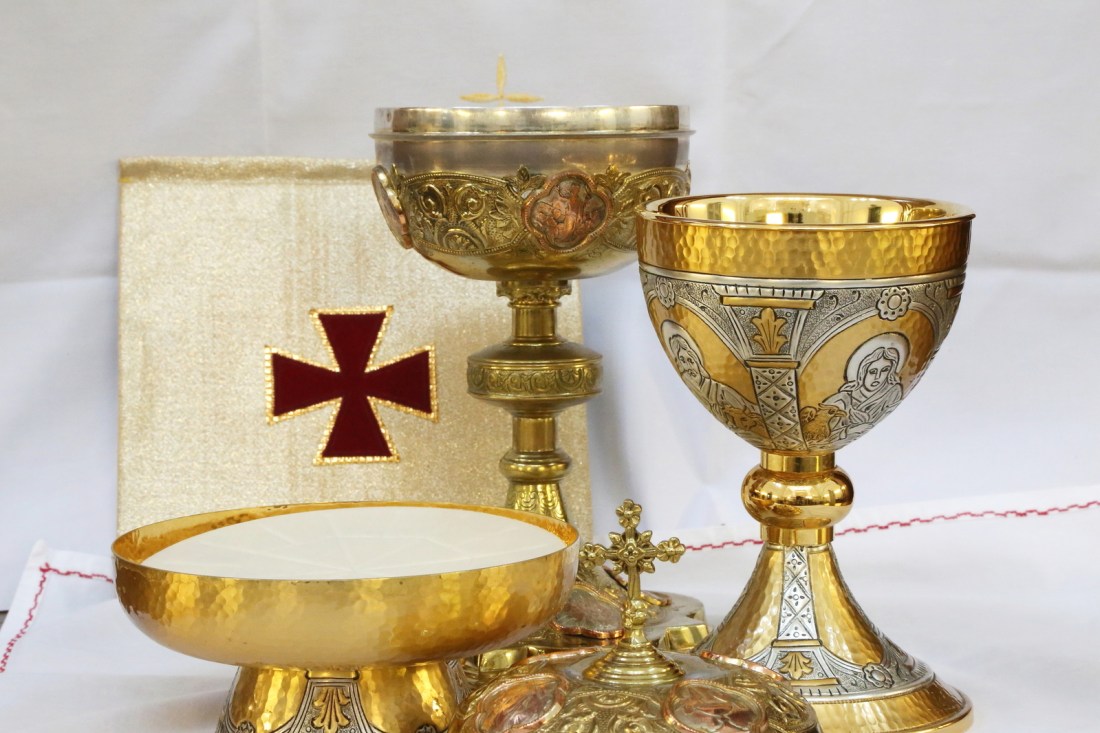
Christians are divided over a variety of doctrines. Some people will argue and demand agreement over the most minor of points (doctrinal sectarianism). Others will allow any belief to exist in order to promote unity (doctrinal minimalism). And then there is the spectrum of people in between those two extremes. What is needed is some “theological triage”, where it is determined which doctrines are critical, which are important, which are less important, and which are unimportant. However, even then, different people will treat different doctrines differently, so what might be considered a critical doctrine by one would be considered less important by another.
Today, I believe, there are two big doctrines that divide people into many denominations. They are Baptism and Holy Communion (Lord’s Supper or Eucharist). 500 years ago during the Reformation, it was Holy Communion that prevented Protestants from uniting. (The anabaptists were few in number so baptism was not an issue like it is today.) We are going to take a look at the 5 major ways Christians view Holy Communion. Note I believe Holy Communion is an important doctrine, but a right understanding of Holy Communion is not critical for salvation.
I am Lutheran and because of that I am going to explain what theologically conservative (confessional) Lutherans believe and why. (At least how I understand it.) And we will compare that with the other 4 ways of looking at Holy Communion. You should expect some Lutheran taint since that is where I am coming from.
Let us look at what the Bible says, because it is the authority (the only authority for conservative Lutherans). Here is what Matthew 26:26-29 says:
26 Now as they were eating, Jesus took bread, and after blessing it broke it and gave it to the disciples, and said, “Take, eat; this is my body.” 27 And he took a cup, and when he had given thanks he gave it to them, saying, “Drink of it, all of you, 28 for this is my blood of the[c] covenant, which is poured out for many for the forgiveness of sins. 29 I tell you I will not drink again of this fruit of the vine until that day when I drink it new with you in my Father’s kingdom.”
For context see Matthew 26. There are also accounts in Mark and Luke and in 1 Corinthians. All four accounts are pretty much the same. The one important phrase missing from the Matthew account is “Do this in remembrance of me” (Luke 22:19b). That phrase is found in the Luke and 1 Corinthians accounts.
Conservative Lutherans take the phrases “this is my body” and “this is my blood” literally. There is no scripture to suggest that the phrases only represent the body and blood. Lutherans believe that Jesus’ body and blood are physically present. Roman Catholic and Eastern Orthodox Churches also believe in the real physical presence of Jesus in Holy Communion. The Reformed Church (and Presbyterian Church) believe that Jesus is present in the bread and wine, but the body and blood are passed to the communicant in a spiritual manner. And the other belief of churches (hereafter referred to as Baptist) is that bread and wine only represent the body and blood.
Lutherans believe that the body and blood of Christ physically exists in, with, and under the bread and wine. So both, bread and wine and body and blood, are present as described in 1 Corinthians 10:16, which says “The cup of blessing that we bless, is it not a participation in the blood of Christ? The bread that we break, is it not a participation in the body of Christ?” Roman Catholics believe that the bread and wine are changed into Christ’s body and blood while retaining the form of bread and wine. It is called Transubstantiation and uses some Aristotelian philosophy to define Transubstantiation. Eastern Orthodox has not doctrinally defined Holy Communion. It just calls it a mystery that bread and wine are turned into the body and blood.
Lutherans also believe that the forgiveness of sins won by Jesus’ death on the cross is given to us in Holy Communion (Matthew 26:28). The Roman Catholic and the Eastern Orthodox
Churches also believe that the forgiveness of sins is found in Holy Communion. The Reformed Church sees Holy Communion as providing spiritual nourishment. The Baptist belief sees Holy Communion as only a remembrance of Christ’s death.
Conservative Lutherans also practice close or closed communion. This means that not all are welcome at the communion table. The scripture from 1 Corinthians 11:27-29 says
27 Whoever, therefore, eats the bread or drinks the cup of the Lord in an unworthy manner will be guilty concerning the body and blood of the Lord. 28 Let a person examine himself, then, and so eat of the bread and drink of the cup. 29 For anyone who eats and drinks without discerning the body eats and drinks judgment on himself.
Holy Communion is serious stuff. One can eat and drink to their harm (v. 27, 29). One should also examine themselves (v. 28) before partaking of Holy Communion. That is why for Lutherans practice close/closed communion. Holy Communion is only for Christians who recognize that they are sinners in need of the sacrament and are willing with the help of the Holy Spirit to change their lives. They also need to recognize that the body and blood of Christ is present in the bread and wine (v. 27). Conservative Lutherans also believe there is a need for doctrinal unity/fellowship (Because there is one bread, we who are many are one body, for we all partake of the one bread. 1 Corinthians 10:17).
It is out of pastoral concern that close/closed communion is practiced, so that no harm is caused. Some Lutheran pastors will only commune those they know. Many will commune only those in the same denomination that they are in. And others allow for more leeway, asking only those who believe what the Lutherans believe to commune.
All of the five different beliefs, whether open or closed communion beliefs, believe that Holy Communion is meant for Christians. Roman Catholics and Eastern Orthodox also practice closed communion. Other denominations may or may not practice closed communion, even some Baptists practice close communion. However, most Protestant churches practice open communion, where they allow anyone to participate in Holy Communion.
In my very limited experience, these differences of closed communion has been the most offensive to other Christians. As Christians they are offended to not be able to share communion with their Lutheran brother as part of a united body of Christ. So where does this fall on the spectrum of doctrinal minimalism to doctrinal sectarianism. I do not know. It appears that the more theologically conservative you are the more likely you lean toward doctrinal sectarianism. I personally believe in the idea of closed communion, but I don’t want to end up as a sectarian. I want to allow for a broad view of Christianity with differing beliefs within the Christian boundaries, while holding strongly to my beliefs. That is why I am interested in “theological triage”.
Note there is a lot more that can be said about Holy Communion and the differences in belief, but I believe this is a decent summary.




 heinsite