Return to the Lord

Return to the Lord your God,
     for he is gracious and merciful,
slow to anger, and abounding in steadfast love
(Joel 2:13)

The God, we Christians worship, is one who loves us deeply and desires that we return to him.  Though he loves us, he is also just and there are consequences for our wrongdoing and even our wrong thinking.  That wrongdoing and wrong thinking is called sin.  He wants the best for us but we are very self-centered and what we desire is many times bad for us.  It is easy to see that we are broken.

God’s initial creation was good, very good, but Adam and Eve disobeyed God and broke themselves and all of creation.  Ever since then God has desired to bring us back to him.  He put a restoration plan into action.  Beginning with Abraham and Sarah, he set out to make a people for himself that would bring blessing to all people (Genesis 12:1-3).   From Abraham and Sarah came the people of Israel.  They were to be “a kingdom of priests and a holy nation” (Exodus 19:6).  They failed over and over again, but God was not stymied. His plan for restoration still moved forward.

Out of love, Jesus came into the world (John 3:16) to do what we could not do.  He was the Israel that Israel could not be.  He lived a perfect life.  He fully loved people and God.   He went to the cross to take our sin upon himself.  His death was the death we deserved.  He paid for our sin on the cross.  And then he rose from the dead.  Because he did all this, we can have a full life in him.  With the Holy Spirit, we can be the people of God and bring blessing and restoration to all people.  We are to be “a royal priesthood, a holy nation” (1 Peter 2:9) like Israel of old, and like Israel we still fail and fail again, but God is still at work.  His restoration plan continues until when he will gather all who believe that Jesus is their Lord and Savior together with him in Heaven.

So what does this all mean to us?  First, we need to recognize that we are not good.  We are not even a little bit good.  We are corrupt through and through.  Oh, we may do “good” things but deep down inside is that self-centered selfish side of us that taints everything we do.  We all are bad.  And God wants perfection.  Picture of  a “totally white sheet of paper” as perfection. The very best we can manage is a “dark gray sheet with some black spots”.  We can not by ourselves even come close, but Jesus was perfect, that “totally white sheet of paper”.

Second, we need to recognize that even though we may be a “grimy black sheet of paper”, God still loves us and desires to be in relationship with us.  That is good news and that is why Jesus came so that we can become a “totally white sheet of paper”. Or in other words, we are set free and cleansed from all our sin.  We can then live the good life God has in store for us, and worship and serve him in all purity.

Third, we who follow Jesus are not there yet.  We need to daily turn from our sin and return to God to follow him and do what he desires.  The Holy Spirit continues to be at work in us, transforming us.  One day when we are united with God we will be whole, that “totally white sheet of paper”.

If you don’t have a church home consider attending a worship service at a church near you.  This time of year is a most important time. It is when we especially remember that Jesus died for us and rose from the dead so that we can have a full life in him.  This year, Palm Sunday, when Jesus entered Jerusalem, is  March 28.  Maundy Thursday, when Jesus celebrated Passover and changed it into the Lord’s Supper, is April 1.  Good Friday, when Jesus died, is April 2. And Easter Sunday, when Jesus rose from the dead, is April 4.  Many churches will have special worship services on these days. Do consider attending a worship service.  (In Loveland, Colorado, I attend Immanuel Lutheran Church and School.  You are welcome to join me and attend there. Or join us online (Youtube or Facebook), if you have Covid concerns.)

And if you want more information about the Christian Faith, feel free to contact me.

Living in a Digital Babylon

Das Bean Photo by Mark Publava

I believe today we are living in a “digital Babylon”.  The culture has shifted and Christianity now takes a backseat to other influences.  Today the big influencer is the Internet.  The younger you are, the more screen time you spend.  All ages say they spend too much time online.  It can be very addicting.  Just as the Jews found themselves in a foreign culture when they were exiled to Babylon, so we are now exiles in a foreign culture influenced by the Internet. Christianity has become countercultural. We need to recognize that we are countercultural exiles and we should not succumb to today’s prevailing culture.

The Barna Group did a couple of studies that looked at 18-29 year olds, first in 2011 and then in 2019.  They found three trends shaping culture.  The first trend is “Access”. Via WiFi and other internet connections we can have access from just about anywhere at any time on about almost any topic.  It is a great resource.  Unfortunately the second trend is “Alienation”.  The Internet is supposed to be a great connector and in many ways it is, but I believe this technology also isolates and promotes Individualism. It is you and your phone, or some other screen device.  Have you looked in a restaurant to see how many people are on their phones and not talking to the person they are with.  I find it kind of scary.  The third trend is a distrust of “Authority”.  Because of the Internet, you don’t need to rely on anyone.  That independence alienates one from tradition and institutions, and in doing so it produces a distrust of institutions. Though Barna’s focus is on those 18-29 years old, I see these trends across all generations.

Barna says these trends have significantly impacted those 18-29 year olds who have grown up in the church.  In 2011, 59% of those 18-29 year olds who had grown up in the church dropped out of any church involvement.  By 2019 the number grew to 64%.  Note these were children and teenagers who were there at worship and took part in youth activities, and now as adults they are gone.  Many of them no longer identify themselves as Christian.

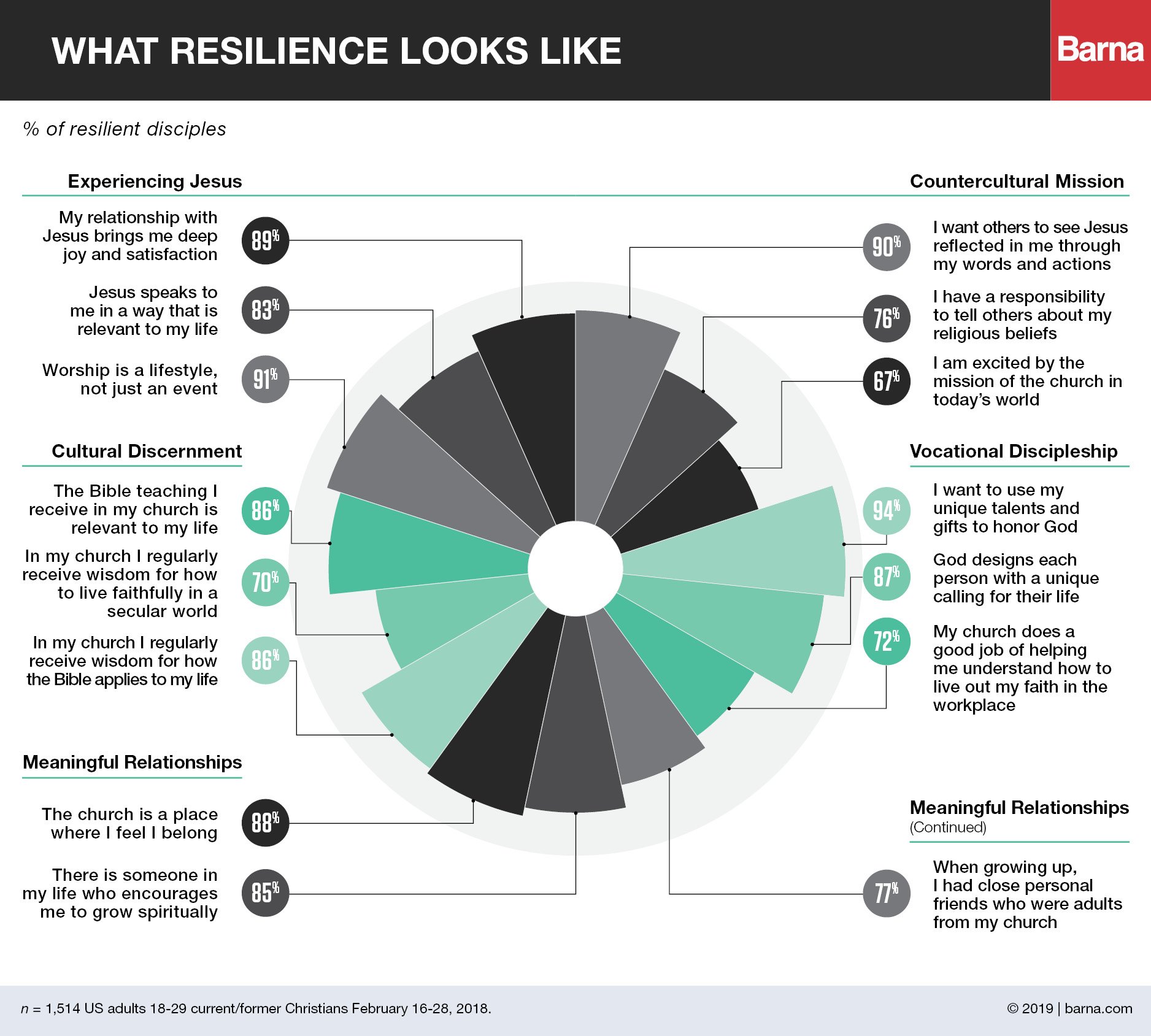
Only ten percent of those 18-29 year olds who went to church as kids are what Barna calls “Resilient Disciples”.  They have a strong faith and they understand that they are countercultural exiles living in a digital Babylon. They attend a local church regularly and engage in other faith activities outside of the worship services.They trust firmly in the authority of the Bible, and they are committed to Jesus personally and affirm his death and resurrection. And they express a desire to live out their faith so that God is honored.  Below is an infographic that gives more detail to what their resilience looks like.

What can we older church folk do?  Note the importance of meaningful relationships.  Be a friend to a teen or a young adult.  We need to support each other in this culture, and use the Bible to keep the countercultural truth front and center.  The Internet is a great resource but truth and falsehood are both easily found online, and there is nothing that tells one what is true.  We are tossed to and fro by different ideas and concepts unless we have been grounded in the truth of Scripture.  The Church provides that anchor of Jesus Christ to ground us, so we can find that needed support in a local church community.  Let us be there for each other, especially those young in the Faith.

Cultural Christianity

Are most American Christians Christian in name only? Cultural Christians say they are Christian only because it is the cultural thing to do.  I recently read a modern paraphrase of a 224 year old book by William Wilberforce called “Real Christianity” (paraphrased by Bob Beltz).  Being Christian in name only was William Wilberforce’s concern for his fellow English Christians back then in 1797, and it is my concern today.  65% of American adults will say they are Christian but I believe that most of them say it because it is the cultural thing to do.  I believe many of them believe in some variation of Moralistic Therapeutic Deism, not Christianity.  Reading this book showed me that these concerns are nothing new.  The problems back then are the same problems still here today. 

(Note a paraphrase conveys the meaning of each sentence or paragraph and it is not a word by word “translation” but it still carefully follows the flow of ideas in the book.  It was easy for me to compare passages in the original and the paraphrase. The flow of ideas tracked, and the ideas explained were the same.)

William Wilberforce was a British politician that supported many causes, but he is best known for his long campaign in Parliament to abolish of slavery in the British Empire.  He was motivated by a desire to put his Christian principles into action and to serve God in public life. (A good movie on his life is Amazing Grace.) He wrote this book because he was concerned that many people in his day were not Christian, even though they said they were.  They did not believe the Christian doctrines and/or understand what it was supposed to mean to call oneself Christian.

Cultural Christianity then and today has the state of humanity wrong.  Cultural Christians would consider the average human to be relatively good, and not evil.  The Bible says something different.  We are not good.  Because of our fallen nature, we are instead proud and selfish. 

Real authentic Christianity recognizes our depravity and our inability to save ourselves from our own sinful nature.  The good news is that God saw our plight, and Jesus came to save us from our sin.  He did it by living a perfect sinless life, and he then died on a cross in payment for all our sins.  After that he rose from the dead.  And by the Holy Spirit we can have a life in him. That humbles us.  We recognize that the grace we received was not cheap. It cost Jesus his life.  That is real authentic Christianity.   And as real authentic Christians, we believe those historic teachings of the Bible.

Cultural Christianity today seems to be either moralistic or therapeutic or both.  A moralistic cultural Christian will say “I am a good person and I will do good deeds so that I will be good enough to make it into heaven”.  They do not realize that only one sin is all it takes to keep them out.  God demands perfection. They also miss out on the fact that God has already done it all for them.  A therapeutic cultural Christian will hang onto the fact that they are loved by God.  They will say “I need God to make me feel better”. They don’t realize that God desires to grow them and that may mean uncomfortable discipline.  They miss out on the fact that God wants to be in a relationship with them and he is not a big lovable guy in the sky that is supposed to always make them feel good.  In both cases those cultural Christians are centered on themselves and not on God. And that means their relationship with God is transactional and is not relational.  Their Christianity is not true Christianity.

Real authentic Christians put their beliefs into practice, because what they believe is central to their life. To quote Wilberforce (via the paraphrase), they are “looking unto Jesus Christ!”  And 

“But to the men and women that possess authentic faith in Jesus Christ, these truths are the center of gravity toward which all life is in motion. They are the sun of their solar system! They are the origin of all that is excellent and lovely and the source of light and life.” [Italics are in the original and the paraphrase.]

As real authentic Christians, we commit to living life in the service to God and for his glory.  It is important that we live out our faith, because the roles we play are crucial for the well being of society, and for the witness of our faith to others.

That is what Wilberforce in his book had to say to me.  It is interesting, but not surprising, that a 224 year old book can speak to today’s situation.

PS I wonder if cultural Christians are becoming less common because today only 65% of Americans say they are Christian but in 2007 it was 78%.  In 14 years the percentage of adult Christians in America has dropped 13%. That is a huge drop.   Is that because some people no longer call themselves Christian? Or is it because the old, who are more likely to say they are Christian, are dying off and the new adults, the Millennials (and Gen Z), are less likely to say they are Christian? (Only 49% of Millennials say they are Christian.)

Nationalism

American Flag Photo by Lisa Setrini-Espinosa

Recent events have me concerned about the faith of many Americans.  It seems that many are worshiping Jesus AND America.  That is an idol.  I love my country, but my allegiance is to the King of Kings and Lord of Lords, Jesus Christ.  It is not in part to a country, a political party, or a political leader. My allegiance is to Jesus Christ alone! What he says goes.

God is very clear about it.  The first and foremost commandment is “You shall have no other gods before me” (Exodus 20:3).   This means that the Triune God (God the Father, Jesus Christ, and the Holy Spirit) is number one in your entire life.  You are to serve and worship him.  It is not the other way around. And there is no sharing of that allegiance. That is spiritual adultery.  God wants all of you. Unfortunately we all fall short of that, time and time again, but God’s grace and mercy is there to lift us up, and restore us to him. But that is not an excuse. God is serious about sin! When we fail, we need to recognize that is wrong and turn again from that wrong.

My allegiance to America is predicated on the fact that Jesus tells me to obey the government.   My allegiance to America is based only on and is under my allegiance to Jesus Christ.  I can be involved in politics and support candidates and political parties, but my actions must come under the rule and authority of Jesus Christ.  Recent events show that some Christians are ignoring God and what he says, and instead they are promoting people, political parties, and themselves to the detriment of the common good in America. In many cases it is all about power, or about using any means possible to promote their issue.  That is wrong!  It is not what Jesus desires.

Now people may have different ideas on how to achieve the common good, and that is okay.  I believe one should go through the political process promoting their ideas in a way that Christ would approve. Ask the question, how can we come to an understanding that benefits us all? And please remember this, the end does not justify the means.

Up until now, I have named no names.  I can find people in both parties who at times have been guilty of this idolatry, but what really raised my awareness was this rally called the “Jericho March” in Washington, D.C.  It mixed Christianity and nationalism and even other faiths. I found reading about it scary.  And now because of the rioters that attacked the Capital, I am writing this post. I believe many of the rioters have the dual worship of God and America, or of God and Donald Trump.  That is idolatry, plain and simple.

So what does our allegiance to Jesus Christ look like?  I am going to point you to a post by Ann Voskamp.  Please read this post for she says it much better than I can. (Note she likes lots of pictures, so keep scrolling to find more text until you reach the bottom.)

And if 2020 was too much, remember as followers of Jesus we have hope.  My pastor gave a short interview on the year 2020 in our local newspaper.  He speaks to the hope we have in Jesus. It is all about Jesus.

Merry Christmas

Christmas Nativity

2020 means Christmas will look a little different from past Christmases.  We will not be able to celebrate as we have done in the past with all our traditions.  We each have our own traditions and stories, but many of the traditions have developed over the centuries.  How would a personal celebration of Christmas today compare with one a 100 years ago or 500 years ago, or a 1000 years ago?  So many traditions have developed over the centuries that the original story of Christmas has become hidden for many people.  It seems today most everybody worldwide now celebrates Christmas.

Today, Christmas is truly a secular holiday.  Even atheist Richard Dawkins observes Christmas. (You can get an atheist Christmas card with a Dawkins quote wishing you a merry Christmas.)   Christmas has become a holiday of giving gifts.  Today there are sentiments of love, compassion, and peace connected with Christmas, but most of the time the original story of Christmas is missing.  Here is a short FAQ, answering some questions you may have and revealing some of the traditions connected with the original Christmas story but are not really part of the story.

What was the original celebration of Christmas all about?  The original celebration of Christmas was about the birth of Jesus Christ, Son of God, born to the Virgin Mary. 

Where is the story of the birth of Jesus recorded? It is found in the Bible, in the Book of Luke, Luke 2:1-20.  (Read Luke 1 for some of the back story.). And also in Matthew (Matthew 1:18 – 2:12) there is another account of Jesus’ birth.

Was Jesus born in a stable?  We don’t know.  The passage from Luke only says that Mary laid him in a manger.  The traditional spot of Jesus’ birth is in a cave.  It could also have been in a room for animals in a house, an attached “stable”. 

Was Jesus born in 0 AD? No, there was no zero at the time the Anno Domini system was set up in 525 AD.  So there is no 0 AD.  1 AD was when Jesus was supposed to have been born, but scholars today place Jesus’ birth at 6 BC to 4 BC. This is based on Luke 2:2.

Was Jesus born on December 25?  There is no date given for the birth.  Some scholars think some time during Spring would be likely.  Eastern Orthodox Christians celebrate the birth of Jesus on January 6.

What about the Magi, the Three Kings, or the Three Wise Men?  The Magi were members of a priestly caste of ancient Persia.  They are in Matthew’s account of the birth of Jesus (Matthew 1:18 – 2:12).   They are not necessarily kings or wise men.  

Were there three Magi?  The word Magi is plural suggesting more than one but the exact number is unknown. There were three gifts so tradition says three Magi.  Note the Syriac Church tradition (and some other Eastern churches) has the number of Magi at 12.

Did the Magi and the shepherds appear together at the manager?  Unknown. The shepherds hunted for a manger with a baby.  The Magi followed the star to a house. To me it is likely that the Magi came later.  King Herod would kill all the boys in Bethlehem, who were 2 years of age and under after the Magi failed to report back to him (Matthew 2:13-18).  My guess is that Jesus was under 2 years of age when Herod slaughtered the boys of Bethlehem.  He could have been about a year old, but again his age then is unknown.  (Mary and Joseph may have decided that it was a good idea to stay in Bethlehem with the locals treating them well because they were the parents of the Messiah.)

Why was Jesus born?  Jesus came to save us from our sins (Matthew 1:21). We are broken selfish people.  Because of Jesus, we can have a restored relationship with God.  Jesus paid the price on the cross for our wrongdoing and wrong thinking.  He is our Savior.  I believe my life is much better because of Jesus.  If you recognize that you are a broken selfish person in need of God, turn to Jesus, receive his love, and place your trust in him.  He will deliver you from your brokenness and set you on a path of life found only in him.

Many more entries can be added to this FAQ, but this is a good start.  Read the two accounts of the birth of Jesus.  See what is there and what traditions have been added to the accounts.

Thankful Resilience

In my last post I talked about being resilient in a changing world.  I believe one of the best ways we have to be resilient is to be thankful to God for all of what he has given us (i.e. everything).  1 Thessalonians 5:18 says to give thanks in all circumstances, and Ephesians 5:20 says to give thanks for everything.  It is not always easy to do, but I believe it is good for you, spiritually, emotionally, and physically. That thankfulness is supported by the confidence we have in God.  It is the sure hope that we have.

The foundation of that hope and thankfulness starts with the fact that God loves you. He desires the best for you.  He is on your side even through those tough times.  He is using the circumstances of life to help shape and form you.    Recognizing that, means that you can thank God for everything in all circumstances.  He can take the wrong things in life and bring good out of them.  In the end, he will make all things right. Note this is not optimism or positive thinking.  This video talks about the word hope in the Bible.  There are two Hebrew words for hope, which infer “waiting” (yakhal) and “tense expectations” (qavah). Biblical hope looks back and sees how God has faithfully acted and then looks forward and waits for God to act. It is in that looking back we can be thankful, and because of that thankful remembrance we can look forward in hope and be resilient.

It is fairly easy to be thankful for the good things that happen to you, but when you are in a tough situation it is harder to be thankful.  You need to trust God and see his hand in directing you through the tough situation.  Just making the effort to be thankful will help you to connect with God.  Over twenty one years ago I came down with Gillian Barre.  I missed 6 months of work.  I was in the ICU for two weeks.  It was a tough situation.  Yet because of the illness, today I have a greater awareness of God’s goodness and grace.  It also helped Gail and I to bond.  I am thankful for that illness.

I find that I am in a better mood if I give thanks several times during the day. It reduces my stress and worry.  Giving God thanks reminds me of God’s goodness and love.  That allows me to trust him and to be flexible and resilient in that hope.  It is a healthy attitude to have.

Racism Today

The last several years have shown that racism is alive and well in America. It is not just that some people are racist, though that is true, but that there is an underlying current of racism in American society, called systemic or structural racism.  Here are two videos by Phil Vischer (of VeggieTales fame) from which I learned a lot about racism in America. 

Much of what Phil talks about is the history of systemic or structural racism in the last 60+ years, that is racism that is built into society and our laws.  It does not make for a level playing field with people of color not being treated equally.  Phil lays out a good argument why this is the case. It is worth watching both videos.  Part 2 answers the common questions and objections to the first video.  

To bring up one point that really struck me is the typical white household ($171,000) has 10 times more wealth than the typical black household ($17,150). (6.7 times if you include the atypical households.)  Much of the wealth is usually found in home ownership, and it is also one of the best ways to grow your wealth. The lack of wealth limits your options.  This is in part due to the policies of the past and present, such as redlining, which is the systematic denial of services (e.g. house loans) by the government and the private sector.  

Racism is a complex problem with no simple solutions.   Many people of color have been kept in poverty, intentionally and unintentionally, by white Americans and by American laws.   Because this has gone on for generation after generation, many black people, especially men, have lost all hope. They see no way out of their poverty. Many have stopped trying.

The Bible speaks quite clearly about racism being wrong and that all are equal in the sight of God.  Here are a few phrases from the Bible:

  • Here there is not Greek and Jew, circumcised and uncircumcised, barbarian, Scythian, slave, free; but Christ is all, and in all. (Colossians 3:11)
  • For God shows no partiality. (Romans 2:11)
  • But if you show partiality, you are committing sin (James 2:9)

The result of racism is oppression. What does the Bible have to say about oppression?

  • The Lord is a stronghold for the oppressed, a stronghold in times of trouble. (Psalm 9:9)
  • Whoever oppresses a poor man insults his Maker, but he who is generous to the needy honors him. (Proverbs 14:31)
  • Learn to do good; seek justice, correct oppression (Isaiah 1:17)

What can we do? First, we need to care, and listen, and learn. If God is for the oppressed, then we should be to.  We need to act.  We should seek justice and correct oppression. We should be generous to the needy.  We should not continue to sit on the sidelines and do nothing. (Consider some of the ideas at the end of the second video to put into action.)

Paul was concerned about the racial divide between Jews and Gentiles in the Ephesian church so he wrote:

13 But now in Christ Jesus you who once were far off have been brought near by the blood of Christ. 14 For he himself is our peace, who has made us both one and has broken down in his flesh the dividing wall of hostility 15 by abolishing the law of commandments expressed in ordinances, that he might create in himself one new man in place of the two, so making peace, 16 and might reconcile us both to God in one body through the cross, thereby killing the hostility. 17 And he came and preached peace to you who were far off and peace to those who were near. (Ephesians 2:13-17)

It is Jesus Christ who brings peace to our racial divide and makes us one.

Be Kind!

Bible with heart shadow

Social media amplifies mean spirited posts. They propagate in the matter of minutes across the social media sphere.  They grab people’s attention and thus make more money for Facebook, Twitter, Instagram, and the like. The sad result is these mean spirited posts hurt and divide people.  It is not the Christian thing to do.  Scripture is clear.

22 So flee youthful passions and pursue righteousness, faith, love, and peace, along with those who call on the Lord from a pure heart. 23 Have nothing to do with foolish, ignorant controversies; you know that they breed quarrels. 24 And the Lord’s servant[a] must not be quarrelsome but kind to everyone, able to teach, patiently enduring evil, 25 correcting his opponents with gentleness. God may perhaps grant them repentance leading to a knowledge of the truth, 26 and they may come to their senses and escape from the snare of the devil, after being captured by him to do his will.  (2 Timothy 2:22-26; ESV)

What does the Apostle Paul tell Timothy:

  • Pursue righteousness, faith, love, and peace.
  • Have nothing to do with foolish, ignorant controversies.
  • Must not be quarrelsome.
  • Kind to everyone.
  • Able to teach.
  • Patiently enduring evil.
  • Correcting his opponents with gentleness. 

Why do this so that “God may perhaps grant them repentance leading to a knowledge of the truth”.  Too many Christians post or repost half truths, lies,  and mean spirited content.  That is not being a good witness, and it does not promote the Christian Faith.  It does the exact opposite.  Don’t let the Christian name be dragged through the mud of falsehoods.

Another passage that strongly suggests that we are to be a force for good.

14 Bless those who persecute you; bless and do not curse them. 15 Rejoice with those who rejoice, weep with those who weep. 16 Live in harmony with one another. Do not be haughty, but associate with the lowly.[a] Never be wise in your own sight. 17 Repay no one evil for evil, but give thought to do what is honorable in the sight of all. 18 If possible, so far as it depends on you, live peaceably with all. 19 Beloved, never avenge yourselves, but leave it[b] to the wrath of God, for it is written, “Vengeance is mine, I will repay, says the Lord.” 20 To the contrary, “if your enemy is hungry, feed him; if he is thirsty, give him something to drink; for by so doing you will heap burning coals on his head.” 21 Do not be overcome by evil, but overcome evil with good. (Romans 12:14-21; ESV)

Here we see that we are to

  • Bless and do not curse them.
  • Be empathetic.
  •  Live in harmony.
  • Associate with the lowly.
  •  Repay no one evil for evil.
  • Do what is honorable in the sight of all.
  • Live peaceably with all.
  • Never avenge yourselves.
  • Do not be overcome by evil, but overcome evil with good.

I think a good summary of this passage is “overcome evil with good”.  There are plenty more passages that speak to how we should act.  Here are a few more passages with the key idea phrases and context links.

So as Christians, be kind to everyone online and off. Please do not post or repost mean spirited messages.  That includes even those posts you consider funny but others will find that post offensive.  Check and make certain what you are posting comes from reliable sources.  That means that you should also make certain other reliable sources carry the same information.  Realize what you post will be seen by many different types of people who may not understand the context of your post.  Again, be kind and show love to everyone.

To sum up from Luther’s Small Catechism:

You shall not give false testimony against your neighbor.

What does this mean?

We should fear and love God, so that we do not tell lies about our neighbor, betray him, slander him, or hurt his reputation, but defend him, speak well of him, and explain everything in the kindest way.

Note there are some instances when speaking the truth in love to a person eventually requires you speak harshly to them to wake them up out of their sin (e.g. self-righteous hypocrisy) but those instances should not be social media posts for all to see.

The Communion Divide

Photo of Chalice by James Chan

Christians are divided over a variety of doctrines.  Some people will argue and demand agreement over the most minor of points (doctrinal sectarianism).  Others will allow any belief to exist in order to promote unity (doctrinal minimalism).  And then there is the spectrum of people in between those two extremes.  What is needed is some “theological triage”, where it is determined which doctrines are critical, which are important, which are less important, and which are unimportant.  However, even then, different people will treat different doctrines differently, so what might be considered a critical doctrine by one would be considered less important by another.  

Today, I believe, there are two big doctrines that divide people into many denominations.  They are Baptism and Holy Communion (Lord’s Supper or Eucharist).  500 years ago during the Reformation, it was Holy Communion that prevented Protestants from uniting.  (The anabaptists were few in number so baptism was not an issue like it is today.)  We are going to take a look at the 5 major ways Christians view Holy Communion.  Note I believe Holy Communion is an important doctrine, but a right understanding of Holy Communion is not critical for salvation.

I am Lutheran and because of that I am going to explain what theologically conservative (confessional) Lutherans believe and why.  (At least how I understand it.)  And we will compare that with the other 4 ways of looking at Holy Communion.  You should expect some Lutheran taint since that is where I am coming from.

Let us look at what the Bible says, because it is the authority (the only authority for conservative Lutherans).   Here is what Matthew 26:26-29 says:

26 Now as they were eating, Jesus took bread, and after blessing it broke it and gave it to the disciples, and said, “Take, eat; this is my body.” 27 And he took a cup, and when he had given thanks he gave it to them, saying, “Drink of it, all of you, 28 for this is my blood of the[c] covenant, which is poured out for many for the forgiveness of sins. 29 I tell you I will not drink again of this fruit of the vine until that day when I drink it new with you in my Father’s kingdom.”

For context see Matthew 26.  There are also accounts in Mark and Luke and in 1 Corinthians.  All four accounts are pretty much the same.  The one important phrase missing from the Matthew account is “Do this in remembrance of me”  (Luke 22:19b).  That phrase is found in the Luke and 1 Corinthians accounts.

Conservative Lutherans take the phrases “this is my body” and “this is my blood” literally.  There is no scripture to suggest that the phrases only represent the body and blood.  Lutherans believe that Jesus’ body and blood are physically present.  Roman Catholic and Eastern Orthodox Churches also believe in the real physical presence of Jesus in Holy Communion.  The Reformed Church (and Presbyterian Church) believe that Jesus is present in the bread and wine, but the body and blood are passed to the communicant in a spiritual manner.  And the other belief of churches (hereafter referred to as Baptist) is that bread and wine only represent the body and blood.

Lutherans believe that the body and blood of Christ physically exists in, with, and under the bread and wine.  So both, bread and wine and body and blood, are present as described in 1 Corinthians 10:16, which says “The cup of blessing that we bless, is it not a participation in the blood of Christ? The bread that we break, is it not a participation in the body of Christ?”  Roman Catholics believe that the bread and wine are changed into Christ’s body and blood while retaining the form of bread and wine.  It is called Transubstantiation and uses some Aristotelian philosophy to define Transubstantiation. Eastern Orthodox has not doctrinally defined Holy Communion.  It just calls it a mystery that bread and wine are turned into the body and blood.

Lutherans also believe that the forgiveness of sins won by Jesus’ death on the cross is given to us in Holy Communion (Matthew 26:28).  The Roman Catholic and the Eastern Orthodox 

Churches also believe that the forgiveness of sins is found in Holy Communion. The Reformed Church sees Holy Communion as providing spiritual nourishment. The Baptist belief sees Holy Communion as only a remembrance of Christ’s death.

Conservative Lutherans also practice close or closed communion.  This means that not all are welcome at the communion table.   The scripture from 1 Corinthians 11:27-29 says

27 Whoever, therefore, eats the bread or drinks the cup of the Lord in an unworthy manner will be guilty concerning the body and blood of the Lord. 28 Let a person examine himself, then, and so eat of the bread and drink of the cup. 29 For anyone who eats and drinks without discerning the body eats and drinks judgment on himself. 

Holy Communion is serious stuff.  One can eat and drink to their harm (v. 27, 29).  One should also examine themselves (v. 28) before partaking of Holy Communion. That is why for Lutherans practice close/closed communion.  Holy Communion is only for Christians who recognize that they are sinners in need of the sacrament and are willing with the help of the Holy Spirit to change their lives.  They also need to recognize that the body and blood of Christ is present in the bread and wine (v. 27).  Conservative Lutherans also believe there is a need for doctrinal unity/fellowship (Because there is one bread, we who are many are one body, for we all partake of the one bread. 1 Corinthians 10:17).

It is out of pastoral concern that close/closed communion is practiced, so that no harm is caused.  Some Lutheran pastors will only commune those they know.  Many will commune only those in the same denomination that they are in.  And others allow for more leeway, asking only those who believe what the Lutherans believe to commune.

All of the five different beliefs, whether open or closed communion beliefs, believe that Holy Communion is meant for Christians.  Roman Catholics and Eastern Orthodox also practice closed communion.  Other denominations may or may not practice closed communion, even some Baptists practice close communion.  However, most Protestant churches practice open communion, where they allow anyone to participate in Holy Communion.

In my very limited experience, these differences of closed communion has been the most offensive to other Christians. As Christians they are offended to not be able to share communion with their Lutheran brother as part of a united body of Christ.  So where does this fall on the spectrum of doctrinal minimalism to doctrinal sectarianism.  I do not know.  It appears that the more theologically conservative you are the more likely you lean toward doctrinal sectarianism.  I personally believe in the idea of closed communion, but I don’t want to end up as a sectarian.  I want to allow for a broad view of Christianity with differing beliefs within the Christian boundaries, while holding strongly to my beliefs.  That is why I am interested in “theological triage”.

Note there is a lot more that can be said about Holy Communion and the differences in belief, but I believe this is a decent summary.

Four Acts of Love in Action

Heartshaped Hands by johan van den berg

From the last post we learned of four acts of love, Radical Hospitality, Fearless Conversation, Genuine Humility, and Divine Anticipation.  What do these acts look like in the real world? These four acts will help you to show God’s love to others by letting God’s love to flow through you.  To start you first should pray.  Pray that your heart would be one full of love.  Pray that you would show them respect and acceptance.  Pray that you would notice the opportunities that God is placing in front of you in the conversation. 

Radical Hospitality is welcoming people just as they are. Accepting the person does not mean you have to endorse their lifestyle, beliefs, behavior, or decisions.  Ask God to give you the heart and eyes of Jesus when you meet a person. To show hospitality you need to seek out and build relationships. Let people know you are thinking of them.  Note relationships and unconditional love take time, so be consistent. You build relationships by treating people with courtesy and respect. Let your words be good and helpful, an encouragement. Remember to forgive people, again and again. Relationships are messy, so expect surprises and disappointments. When in doubt, let love find a way. Smile! It makes a positive difference.

Fearless Conversation is a dialogue, which means you don’t lecture, rather you mostly listen and ask questions. Note it is also fearless, so that means we should not be afraid of having an open conversation. If you lose control of the conversation that is okay.  Do not get defensive. Do not be afraid for God is with you. Always love the person you are conversing with. Sharing both ways can build a friendship. Listening, truly listening, is very important.  Have an open mind and ask wondering questions. You can do that by starting the question with “I wonder”, “Could it be”, or “Some people say”. Asking questions is powerful. It is good to notice what people are really saying and doing. Pray often!  Tell your own story and be personal. Be willing to admit that you don’t have all the answers and that you too have questions. Invite others to meet your friend Jesus. Be interested in people and their stories. Be willing to be vulnerable. Create a safe environment for discussion and disagreement to take place. Fearless conversation takes time. Don’t be afraid to ask the unexpected question. Remember you are seeking to understand the other person.  Trust the Holy Spirit to work in the conversation. Use scripture and let scripture speak for itself. Encourage, thank, complement, and affirm people. Use direct communication. Ask permission for prayer and sharing. 

“True humility is not thinking less of yourself, but it is thinking of yourself less” (C. S. Lewis).  Jesus humbled himself for us (Phillipians 2:6-11). Genuine humility is relational: meeting people where they are at; being open to learn from others; and being willing to admit mistakes. Communicate in an open, clear, straight­forward manner. Being humble can put you out of your comfort zone, and you may not end up in control of the conversation. Humility is wrapped in love and in serving others.  We need to be truly present and paying attention when talking with people. Give them your undivided attention. Look them in the eye. Ask questions to clarify what is being said.  Be intentional about relationships. Nurture the relationships. Be intentional about being with others. Be open to meet the person where they are at. Work on building trust and honesty rather than solving a problem. Let your loving presence infect those around you. Be vulnerable in your relationships. Let people know that you are thinking of them. Be authentic. Do not merely tolerate people but accept them. Be willing to say you have questions too. You do not have all the answers. Let your actions speak for themselves. Let the fruit of the Spirit (love, joy, peace, patience, kindness, goodness, faithfulness, gentleness, and self control) speak for you. Seek to understand the other person. Be gracious and forgiving.  Pray for even your enemies and leave the rest to God. Remember God is in control. 

God is at work in our daily lives. Are we looking for or anticipating his actions? That is Divine Anticipation. God is here ready to connect with you in a fresh way. Since God is actively at work, we need to trust the Holy Spirit to do his work. Most of the time the supernatural is camouflaged in the natural. Remember that God’s mighty power is at work in and through us. God is relevant to everyone. Addressing the concerns of people is being relevant. Expect God to be showing up. You just don’t know when he will appear. He is the one in control. Trust that God will do what only God can do. We need to tell others our story in an authentic and natural way. Tell them what God is doing in our own lives and in the lives of others. People will express their faith in their own way. Look for God sightings (i.e. God working in your life).  Go ahead and embrace your weaknesses. God can work through your weaknesses. Have a soft heart and be open to God’s action. Help people connect the dots and point them to Jesus and the cross. Be a safe place and welcome other people’s spiritual encounters. God can do some amazing things. Trust God and realize that you don’t know what God is up to. Pray! Pray! Pray! God always wants to be connected to you.  You need to slow down, be still, pray, and listen to God by reading the Bible daily. Let the biblical truths sink in again and again.  And be thankful in all things. It is good for you and being thankful makes us mindful of God’s presence.

When you do the four acts of love, be a regular person like Jesus, who got dirty in the details of life. Our job is to be a matchmaker. We connect people with Jesus. Remember God is the one who saves people, and he is the one in control. So don’t be afraid. Fear is your worst enemy.

Most of this information is from the book “Why Nobody Wants to be Around Christians Anymore” by Thom and Joani Schultz (2014).