
Islam

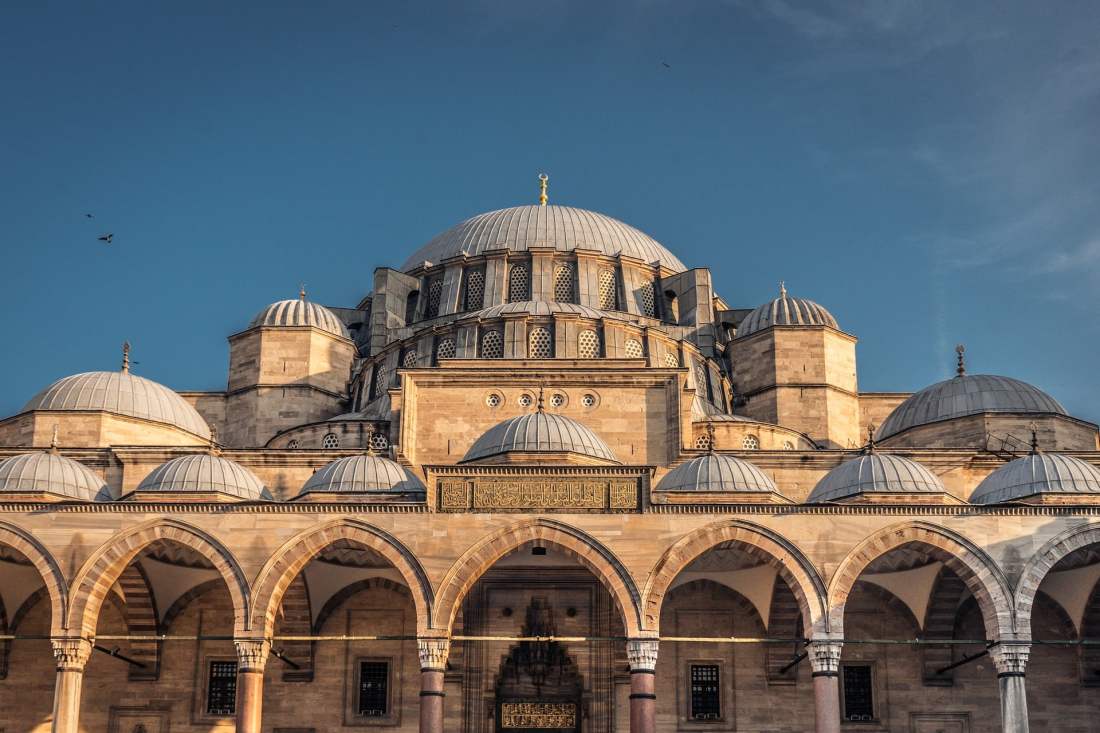
Istanbul mosque

Americans do not know much about Islam.  Many assume that Islam must be a lot like Christianity since Islam is a Abrahamic monotheistic religion.  Others are full of fear and are worried that all Muslims are potential terrorists.  There is some truth that can be found in both statements, but both statements are false.  Islam is very different from Christianity, and the average Muslim is not a terrorist and does not want to be a terrorist.  Muslims need to come to know Jesus, the only one who can save us from our brokenness. 

Muslims believe in one god, Allah.  Christians also believe in one god, God, who is Triune (Father, Son, and Holy Spirit).  The Quran denies the Trinity saying that Allah is above having a son, and many Muslims believe Christians worship three gods, Father, Son, and Mary. I will use “God” for our Christian god and “Allah” for the Muslim god.  (Allah means god in Arabic.)  Allah can not  be conceived or comprehended. He is transcendent like God.  God is personal and desires to connect with us in a personal manner (John 14:23).  Allah is completely separate from his creation.  Allah is impersonal, unlike God.  Muslims also believe Allah has preordained every event.  This fatalism can lead to a denial of responsibility though there is also the idea of Allah rewarding those who do good.

Muslims believe in angels.  Each person at birth gets two angels,  one to record all the good deeds and the other to record all the bad deeds.  One also gets a qarina (a jinn tempter (like a demon)) whose job is to haunt and distract people from the good straight path.  Christians too believe in the spirit world of angels and demons.  We believe in guardian angels and demons.  We do not believe in recording angels who keep track of our good and bad deeds, because of Jesus paying the price for us on the cross so we are free from any good and bad deed accounting.

Muslims believe in prophets, Allah’s messengers, communicating the message from Allah to the world.  The major prophets are Adam, Noah, Abraham, Moses, Jesus, and the final prophet, Muhammad.  According to Islam, Jesus is a prophet and nothing more than a prophet though he was unique because he was sinless and had a virgin birth.  He was not the Son of God, rather the Quran calls him, the Son of Mary.  According to the Quran, Jesus did not die on a cross rather he ascended into Heaven.  He will return for Judgement Day.

These prophets brought scriptures with them, and Muslims acknowledge the Torah, Psalms, Gospels, and Quran.  Except for the Quran, all the other scriptures have been corrupted and since the Quran exists, these scriptures have been superseded and canceled.   Muslims believe that the Quran is the final revelation and is eternal and uncreated, meaning it existed before the creation of the world.  In 650 A.D., Caliph Uthman standardized or canonized the Quran, and again in 1924 Egypt created an official version of the Quran, which is the version used today.  In both cases, any variant versions of the Quran were destroyed, so there is little evidence of the variant versions today.

The Hadith is a record of Muhammad’s sayings, actions, and approvals.  The Hadith is also important to Muslims for it tells them how to live.  From the Hadith is derived most of Sharia Law (part of Ahkam).  As Christians we are called to imitate Jesus (1 Corinthians 11:1), and Muslims use the Hadith to imitate Muhammad.

Allah requires obedience.  The Five Pillars of Islam (as well as Sharia Law) is what a Muslim needs to obey.  The first pillar is confession.  You need to confess that Allah is the only god and  Muhammad is his prophet.  The second pillar is prayer.  The ritual includes washing, facing the Kaaba in Mecca, greeting your personal angels, and reciting a prayer. This is done 5 times a day.  The third pillar is daytime fasting during the month of Ramadan.  At night you can feast.  The fourth pillar is almsgiving.  You give one fortieth or 2.5% to Islamic causes or to the poor.  It can cancel out some of your sins.  The fifth pillar is a pilgrimage to Mecca.  These acts increase one’s chances of making it to Paradise.  Note that all these actions are to please Allah. The external actions are what are important.  As Christians, we value all what God has done for us.  We do not have to do anything to get into Heaven.  Jesus did it all to restore a broken relationship with us. That relationship is internal and out of gratitude we do good deeds, not to earn our way to Heaven.  We pray to a God who hears us and cares for us.

Islam is more than just a religion.  It is also a political movement and a culture that ultimately wants to unite the entire world under a single Islamic government or at least having a single Islamic culture governing everyday life.  Muslims have a religious and a political identity.  Christianity is separate from politics (Mark 12:17).  Jesus did not come to govern.  He came to save us from our sins (1 John 2:2).  (Those times when the Christian Faith and government were connected, Christianity took a back seat to government priorities and its mission was corrupted.)  Muhammad militarily conquered the Arabian Peninsula.  He created a government under him.  His followers continued to conquer lands after Muhammad’s death.  Under Islamic Law, Christians and other non-Muslims were and are second class citizens that have to pay a special tax for being non-Muslim.

Radical Islam promotes the idea of martyrdom (Istishhad) as the only sure ticket to Paradise.  (Christians have the assurance of Heaven. Muslims do not.)  It is all about waging war against the enemies of Islam.  According to the Quran (sura 3:169-171), “those martyred in the cause of Allah” will be rewarded and transported to Paradise.  Islam has always highly regarded martyrs, and Radical Islam has used this passage to promote suicide killings.  These killings happen much more often in Islamic countries than in the West with rival factions using suicide killings to promote their version of Islam.

Islam is very different from Christianity, and I believe the difference comes down to the two primary individuals, Jesus who died a violent death and then rose again, and Muhammad who used violence to conquer Arabia.  And Jesus taught about the unconditional love God has for us, while Muhammad taught about our required obedience to Allah.  Christians imitate Jesus, and Muslims imitate Muhammad.  I believe this is the big difference between the two religions.

When we talk to a Muslim, we need to show them the love that Jesus brings, and we need to be aware that we may not totally understand what is being said and our Muslim friend may not understand what we are saying.  This is because of the differences between Islam and Christianity.  Be sure to ask questions to clarify so that you can understand each other.  And remember it is all about Jesus, the only way to Heaven (John 14:6).

Much of this information came from the excellent book “Engaging Islam” by Georges Houssney, and if a book is too much, I found that the booklet, “A Biblical Response to Islam” by Hesham Shehab, is also an excellent read and is only 32 pages.


Science

Weather vane

Science was the authority in the modern world.  People would try to prove their points by referring to science, even when there is no supporting evidence.  Unfortunately, many people really do not understand what science is, and others use the word to deceive.  Today in the postmodern world, science does not have the same authority, because each person is his own authority.  Today, each person decides what facts they want to believe, and what facts they do not want to believe. Reason and rational critical thinking have taken a back seat to one’s own feelings.

Science is a discipline that builds and organizes knowledge about the universe. Modern science has two major branches: the natural sciences, which study the physical world, and the social sciences, which study individuals and societies. Some include a third branch called “formal sciences” which includes mathematics and logic, but this branch does not use the scientific method, so I would not include it. I would say the “formal sciences” are part of the foundation of science.

Science uses the scientific method.  It can vary a little but scientists tend to follow these steps. 

  1. Make observations;
  2. Research the topic and develop questions;
  3. Formulate hypothesis for determining the cause;
  4. Test the hypothesis by making testable predictions;
  5. Collect and analyze the observations;
  6. Develop conclusions based on the evidence;
  7. If the data support the hypothesis then consider refining the hypothesis and returning to step 4.
  8. If the data do not support the hypothesis then reject the hypothesis and return to step 1.
  9. Publish the hypothesis and the results so that others can learn and replicate the results.

Note the scientific method does not prove anything to be true.  Instead the scientific method is about proving things false.  That said, there are hypotheses that have stood the test of time over and over again that are considered to be true.  Newton’s Laws, which are used everyday and have been used for centuries, can be considered facts, but even Newton’s Laws needed to be refined after some observations were found in some special cases.  Newton’s Laws were refined by Einstein with his Theory of Relativity.  (The refinement does not affect our everyday use of Newton’s Laws.)

Science works because we have a God who is consistent and rational in his actions.  On rare occasions, God may do something out of the ordinary and those occasions are known as supernatural events.  Science needs to ignore the existence of God, because if I drop a pencil the pencil will go wherever God wants it to go, but the fact that God is consistent and rational means we can assume the pencil will fall to the ground.  This means science is not at odds with God. It also means that science has a limited view of reality.  Science cannot see the supernatural.

And it needs to be noted that science describes the how and not the why something happens.  We usually equate the how to the why and that is useful but it is not totally accurate.  On earth a falling apple may be increasing its downward speed at 9.8 meters per second for every second (due to gravity), but that is describing how the apple is falling and not why the apple is falling. (John was mad and threw the apple over the cliff.)

Some people say they believe in science and not in God. They are not understanding what science is.  They may be believing the philosophies of scientism or methodological naturalism, but it is more likely they have created their own philosophy of life and have pulled in the parts of science they like into their worldview.  This is more true today in our postmodern society than it was in the modern era.  People today are less likely to acknowledge the findings of science they disagree with, because they are their own authority.

We are not rational people, not anymore (if we were ever all that rational).  A Barna survey showed that most Americans base truth on their feelings.  A Gallup survey says 70% of our decisions are based on emotions and only 30% of decisions are rational. (Think of the automobile ads on TV.  They play to your emotions without giving you any specs.)  Science belongs to the modern era, so in the postmodern era science will have a smaller role in society. Today the modern “Rational Human” is being replaced by the postmodern “Self-Determined Human”.

Divisions

Living Network 2 (Peter Farkas Photo)

America is very divided politically. I believe this is different from the cultural divisions of worldviews.  A version of the Christian worldview used to be the dominant worldview in America. Today, prevalent in America, there are several variations of the critical theory worldview (with expressive individualism mixed in).  And today both political liberals and conservatives use the critical theory framework to promote their agendas.

Critical theory states that there are unfair oppressive structures in society, and thus there are people being oppressed or in other words victims.  Critical theory states these various forms of oppression are what is wrong in the world and its goal is to liberate us from the oppression.  Some of the more common variations of critical theory are critical race theory, feminism, queer theory, and postcolonialism.  You can especially see critical theory in action with the agendas found in the Diversity, Equity, and Inclusion Movement.  This has been part of a big push by the political liberals. 

But the political conservatives use the same critical theory framework.  The oppressive structures are instead the mainstream media, the deep state government, and other concerns, like voting. So the conservatives see different structures that are oppressing America and making us victims of the current power structures. Donald Trump is big in promoting the oppressive nature of these so-called liberal power structures, and in this current election cycle with his legal troubles he is especially promoting the idea that he is the victim and that he is taking the “attacks” for us. I believe this critical theory framework is one of the main reasons he has been able to resonate with so many voters because critical theory is already embedded in today’s culture.

“Wait, wait”, you say, “there is some truth in what they say”.  Yes, there is some truth found in both the liberal and conservative statements.  But note that every good lie has a kernel of truth.  I believe the framework of critical theory twists the truth and makes it divisive. It ends up being less than the whole truth.

You need to be aware that critical theory’s way of thinking in terms of oppression is the dominant way of thinking in today’s culture. You still need to acknowledge the truth found in the twisted statements, but only the truth.  You especially need to avoid using the critical theory framework.  It is divisive. It is not an us versus them (the enemy and the oppressor) situation.  There is really only one enemy.  His name is Satan.

The Christian asks how I can help and make the situation better. The Christian realizes that it is not an us versus them situation, because we are all sinners in need of a Savior.  We need to, as much as possible, work together and not be divisive. We are to be generous, kind, and gracious in our speech.  We do not lie, but we speak the truth in love.  We do everything from an attitude of love, wanting the best for the other person. The Christian Faith is about reconciliation and forgiveness, first with God, but also with our fellow human beings.  Critical theory is about justice and fairness, whereas Christianity has justice with mercy.  Relationships cannot be restored with only justice.  Mercy and forgiveness is needed to end the divisions and restore healthy relationships.

I believe the political dysfunction in Congress and throughout American politics is due in part to critical theory thinking.  Avoid it!