Ruts

Living Network 2 (Peter Farkas Photo)

We all have our ruts we live in.  Some ruts are good for us and other ruts are bad and still others are neither bad nor good. Ruts are habits or beliefs that are hard to get out of or hard to change.  Society or culture helps us set up our ruts.  Those ruts may be good for us or not.  70 years ago it was cool to smoke, however we know now that that is a bad rut to be in. Today, American society is very individualistic.  We like to think we are the master of our own destiny, but are we really? Culture’s ruts have a great influence on our choices.

According to George Barna (now with Arizona Christian University), 92% of American adults have a syncretistic worldview.  What that means is that the vast majority of Americans pick and choose what they believe in.  They will choose various beliefs from a variety of viewpoints from Biblical Theism to Secular Humanism to Marxism to Eastern Mysticism.  They will pick what they like and create their own belief system.  It may be in places contradictory and not logical but it is what they believe.  Now most of us will not sit down and spend time determining what we believe.  We just live our lives, but we are influenced by our parents and friends, and by the culture we live in.  For the most part, these influencers determine our beliefs or our ruts.  

Note George Barna says only 4% of American adults have a biblical worldview, and yet still today the majority of Americans would call themselves Christian.  I would argue most of those who say they are Christian without a biblical worldview really do not understand what it means to be a Christian and are really Christian in name only.  Though I suspect there are some Christians who truly believe but have a messed up belief system and so got labeled as syncretistic.

About 25 years ago there was a study on what teenagers believed.  It was discovered that the majority of teens in general believed to varying degrees in 5 tenets or principles (Creator God watches over us; Be good, nice, and fair; Our goal is to be happy; God is available to help; Good people go to heaven).  And those teens had been primarily influenced by their parents who also believed in these principles.  These 5 principles ended up being called “Moralistic Therapeutic Deism” (MTD).  In a blog post 5 years ago, I called it America’s civil religion.  Today, I would argue that it was America’s civil religion 25+ years ago, but it is no longer true today and was already not true 5 years ago when I wrote that post.  Note MTD has never been a religion or a formal belief system, but it was what many people believed back then. Or to put it another way it was a major cultural rut for people at the end of the 20th century and start of the 21st century.

With MTD, we drifted away from our Christian heritage, and today, I believe we have moved even further away from our Christian heritage.  Though MTD is still around, culture has moved on to what I call “Critical Expressive Individualism” (CEI).  CEI is a combination of Critical Theory (viewing the world in terms of oppressed people, oppressors and oppressive structures) and Expressive Individualism (looking inside yourself at your feelings and desires to find the authentic you).  You can see the influence of CEI, today, in that 74% of American Adults discern moral truth with their feelings.  Again like MTD, CEI is not a formal belief system or a religion, but it is what many people believe today.   CEI is what culture promotes today.  It is a rut of beliefs we can fall into.

Because culture strongly influences our beliefs, there is a paradox today between being autonomous individuals that culture promotes and the reality that culture influences you. Culture says “You be you” but then tells you how to behave and what to believe.  It expects certain behaviors and condemns other behaviors.  Culture promotes its own ruts even when it promotes being completely independent.

And I need to mention American Individualism (focus is on me). It is a huge rut that goes back many generations. You need to be aware of it.  It colors how we think and act.  Both MTD and CEI are self oriented.  We need to be aware of its effects. Instead of being self focused, we need to be God oriented or God centered.  In reality, individualism goes all the way back to Adam and Eve.  They became self-centered when they tried to become like God. 

We also have our own personal ruts or habits.  Some of them may be good for you (e.g. Bible study, exercise) and others may be bad for you (e.g. watching porn, losing your temper).  These ruts can be hard to get out of too.   I have found that my good ruts are easier to leave than my bad ruts.  Many of my bad ruts keep reappearing.  I think that is because I am a broken sinful person who goes for instant gratification instead of being disciplined.  But if you stick with it and with God’s help, you can put your bad habits behind you.  Do not become discouraged.  Yes, you will fail, but God’s forgiveness is there for you to start again.  

To sum up, be aware of the ruts you are in and the ruts that culture and others promote.  Focused on being in the good ruts that are God centered, like that good “Thankful for Jesus” rut.

Love and Kindness

Heartshaped Hands by johan van den berg

People today seem to want to replace the word love with the word kindness.  I can understand since the English word love has a broad set of meanings and in society today the focus is on the romantic meaning of love, but though the words are similar they are also very different.  To be kind is a good thing. In fact it is one of the nine attributes of the fruit of the Spirit.  Love is another attribute.  Love wants the best for the other person.  Kindness does not necessarily have that motivation. 

Being kind means you are friendly, generous, and considerate.  Showing love (agape love) means the love is unconditional, sacrificial, and is an act of the will.  Love is not a feeling, rather love acts with regard for the other person’s best interest. I like this definition from the book “God Space” (by Doug Pollock, p. 92): “Love is a commitment you make to act in someone else’s best interest. True love can only be known by the actions that it prompts.”

To illustrate the difference, suppose a grandmother was making dinner and her grandkids come up and want to have some cookies from the cookie jar.  She would be kind if she handed them the cookie jar, but the loving thing to do would be to say no and say to wait until after dinner.  Love puts the best interest of the other first.  Being kind may not always be the best thing for the other person.

Another illustration shows that kindness is not demanding but love is.  Suppose you give $10 to a homeless person.  That is a kind act, but love would not give the $10 if you smelled alcohol on his breath.  Instead in love you would volunteer to take him to a detox center.  Love is demanding.  With love you cannot keep the person at arm’s length like you can with kindness, rather you care and show concern with their best interests in mind.

There is a meme that states “Kindness is everything” and another meme that states “Just be kind”.  These campaigns to be kind are good but they are lacking.  They equate love and kindness, or they see kindness as love in action.  By being kind you cannot use tough love.  Kindness means you need to affirm and lift up the person.  Sometimes you need to point out to the person some hard truths, like their actions are really destructive behavior.  That would be the loving thing to do and it would not be kind.

Showing kindness is a good thing to do, but let us let our kind acts also be acts of love to show we truly care and are concerned for them.  Kindness without love is empty.

The Identity of the Expressive Individual

Living Network 2 (Peter Farkas Photo)

The individual is king in today’s Western Culture. I  just finished reading a very enlightening book that made sense of how this messed up world in the West has changed in the last 50+ years.  This excellent book is “Strange New World” by Carl R. Trueman.  While reading it, there were times, I stopped and said to myself, “So that is why those people think that way” and by the end of the book I was also wondering how much of my thinking has been influenced by these ideas. The problem is every good lie has a kernel of truth in it.  That is what makes these false ideas believable for many people.

The expressive individual wants to be authentic and to express the real person they are, so they look inside themselves to find their core feelings and intuition, while dismissing any external influences, such as the surrounding culture. That defines them and gives them their identity. The person then expresses their inner core to be an authentic individual. The authority is only in themselves.  Jean-Jacques Rousseau (1712-1778) developed the idea and you can see his influence in the following centuries.  The traditional identity authorities of nation, family and faith would say of me that I am an American, son of Erwin and Irene Hein, and a Christian.  And there are also other ways to identify oneself (e.g. occupation, sex, marital status, etc).  Whereas the expressive individual rejects all that and only looks to oneself as the only authority.

Along comes Friedrich Nietzsche and Karl Marx who both said that morality is society’s way of oppressing or controlling the individual.  In other words, they believe that there is no natural morality. It is only a societal construct used to oppress or control us.  That idea is present in today’s culture.  Also today’s cultural thinking was strongly influenced by Sigmund Freud, who declared sex is fundamental to human happiness.  He considered that the inner self was primarily defined by our sexual desires. Because of Freud, our identity became our sexual psychological self,  His student, Wilhelm Reich, a Marxist, put it all together to form the intellectual underpinnings of today’s culture change.  Only one thing missing was the technology to make it practical.  The birth control pill allowed sex to become much more recreational, and the internet allowed the porn industry to easily reach us and influence us in all things sexual.  (Note the author of the book, Carl Trueman, said the evolution of this culture change is more complicated than his broad overview, and in this post I have significantly simplified it a whole lot more.)

So an expressive individual today will usually look inside oneself and decide one’s identity with the eye on one’s sexual desires. With the collapse of the traditional identities (nation:loss of trust in government, family:high divorce rate, and faith: church scandals), the LGBTQ+ community has stepped in to encourage the individual to consider their alternate sexual identities.  They have become a major influencer, in part, because they also provide a sense of belonging as they praise you and validate your chosen sexual identity.

With the individual being the only authority, it has left Western Culture in a very unstable fluid state.  Your self, your identity, is fluid.  It can change. It can be anything.  Nothing seems to be solid. You get to decide.  With your identity being personal and psychological (and many times sexual) that sets situations where one’s identity can offend another identity. Or one finds a viewpoint to be oppressive to them and an attack on who they are. Dealing with a variety of identities can be tricky business. This is especially true with transgender people. How do you handle a boy who identifies as a girl or vice versa? Do you let a transgender boy, who is biologically a girl, use the boy’s locker room? Or let a transgender girl, who is biologically a boy, use the girl’s locker room?  This is happening today.

Also today’s thinking is that moral codes of society are oppressive and  support the (past) status quo (where white heterosexual males dominate). So then, one needs to rebel against this systematic bias, and oppose all institutions (like the Christian Church) who were part of the old culture.  They declare that they are victims of this systematic bias, and therefore deserve our support.  If this sounds a lot like Critical Theory, that is because it is at least related to it.  Anyone who does not support them is an oppressor who is attacking their identity, the core of their being.  Those whose identity is found in the past status quo could be considered to be a threat to the emerging status quo and must be censored and in this way prevent hurting the feelings and thus the identity of the oppressed victims. Thus, this radical freedom of the individual can end up restricting freedom of speech, in the name of preventing an attack on an individual’s identity and feelings.

As Christians, we need to realize that this emerging culture is not friendly to the Christian Faith. Because of this we need to have strong communities in our local churches. We need solid meaningful worship services. We do have our identity as forgiven and loved children of God, being found in Jesus Christ.  We are his. We need to know that and have a firm foundation in the who, whats, and whys of the Christian Faith.  Though the Bible is our authority, it is not an authority for many people today, so we will need to also use Natural Law to help share our Christian ideas.  Those ideas are quickly becoming lost to Western Culture.  We need to stand firm in the Christian Faith.

The book ends with this paragraph:

The world in which we live seems set to be entering a new, chaotic, uncharted and dark era. But we should not despair. We need to prepare ourselves, be informed, know what we believe and why we believe it, worship God in a manner that forms us as true disciples and pilgrims, intellectually and intuitively, and keep before our eyes the unbreakable promises that the Lord has made and confirmed in Jesus Christ.  This is not the time for hopeless despair, nor naive optimism. Yes, let us lament the ravages of the fall as they play out in the distinctive ways that our generation has chosen. But let that lamentation be the content for sharpening our identity as people of God and our hunger for the great consummation that awaits at the marriage feast of the Lamb. 

Moralistic Therapeutic Deism

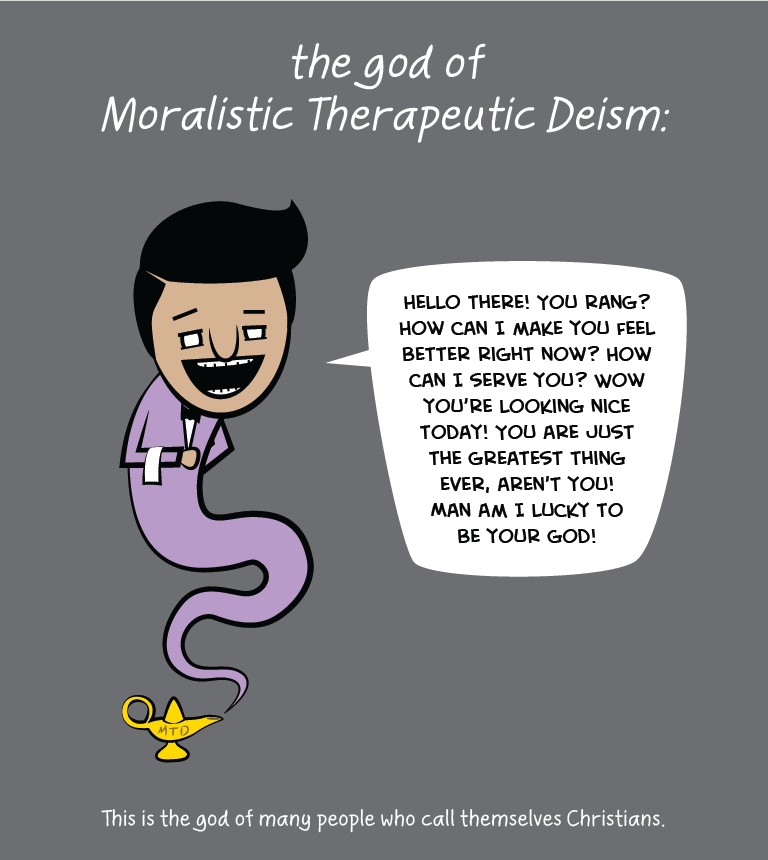
Moralistic Therapeutic Deism Genie by Adam Ford

What do Americans believe?  In my last post, I suggested that even though 65% of Americans say they are Christian, I and others believe that many (most?) of them are not. Many of them believe in the Moralistic Therapeutic Deism worldview and not the Christian worldview.  What is Moralistic Therapeutic Deism (MTD)?  Those with MTD beliefs tend to believe in 5 tenets.

  1. A God exists who created and ordered the world and watches over human life on earth.
  2. God wants people to be good, nice, and fair to each other, as taught in the Bible and by most world religions.
  3. The central goal of life is to be happy and to feel good about oneself.
  4. God does not need to be particularly involved in one’s life except when God is needed to resolve a problem.
  5. Good people go to heaven when they die.

This comes from a survey of teenagers (15+ years ago). The survey (Smith, Christian; Lundquist Denton, Melina (2005). Soul Searching: The Religious and Spiritual Lives of American Teenagers) also asked where the teens got their beliefs.  For most, their beliefs came from their parents, so these beliefs cover at least a few generations. 

Moralistic Therapeutic Deism is not an organized faith, however it is so pervasive in America that some call it the civil or civic religion of America.  Tenets 2 and 5 describe the moralistic beliefs while tenets 3 and 4 describe the therapeutic beliefs. They are considered deists because of the minimal interaction of their creator god with the world (tenets 1 and 4). One can see these beliefs in American culture over the past 50+ years.

Even though many MTD deists will say they are Christian, MTD is not at all like traditional Christianity.  First MTD is very “Me” oriented and is not focused on God and what he has done for us.  For MTD, god is not involved and there is no relationship with us except being ready to help when needed.  In Christianity God desires a relationship of love with him and is very involved in the world.  Life as a Christian is about serving him in love and thankfulness, not as MTD says about being happy and feeling good. In fact, the God in Christianity does not promise happiness, but he does promise being there in the tough times.  

The Christian Faith is about bad people going to heaven, not good people, because we all are bad and in need of God’s forgiveness and grace. We find our identity in the fact that we are loved by God, not in our own goodness.  We can be realistic about our shortcomings because we are loved by God.  

Tenet 2 says “God wants people to be good, nice, and fair to each other, as taught in the Bible and by most world religions.”   That is true in a broad general sense, but with Tenet 5 it makes MTD into what we do to get to God, not God reaching down to save us as the Christian Faith declares.  It also implies that all major world religions are effectively the same. That is far from the truth, but is a fairly common belief among Americans. 

So what do you say when you are talking about spiritual matters to an American?  First you can not assume they believe what you believe.  Americans tend to pick and choose what they believe.  MTD is a summary of what the common beliefs are.  You need to ask and listen carefully to what they say they believe.  Ask questions and nail down the best you can of what they believe.  And then respectfully share with them what you believe.

Check out this explanation of Moralistic Therapeutic Deism in comic form by Adam Ford.