Authoritarian China

China Flag by Raphael Pto

I have known several people who have done mission work to the Chinese people, and because of that I have developed an interest in China.  Over the years, I have seen China open up and Chinese Christians worship without concern.  Unfortunately that began to change about 5 plus years ago.  The Chinese government has become more and more authoritarian.  The Chinese ruling elite have become, in my opinion, increasingly concerned with potential rivals and threats to their power.

July 1, 2020 was the 23rd anniversary of the treaty of the British returning Hong Kong to China which set up the “one country, two systems” arrangement between Hong Kong and China.  Unfortunately July 1, 2020 will also be remembered as the day China in the name of national security forced Hong Kong to enact a new law that greatly restricts freedom of expression. Secession, subversion of state power, terrorism, and collusion with foreign entities are now broadly defined illegal activities with up to life in prison if convicted.  Due to “national security”, the trials can now be moved to mainland China where the trials may be done in secrecy. Hong Kong’s judiciary can now be superseded by China.  A man with a flag calling for Hong Kong independence was one of the first to be arrested.  The “one country, two systems” seems to now be “one country, one dominating system”.  

Also the law empowers China to set up a national security agency in Hong Kong to oversee the investigation and prosecution of any violations.  This law allows China to act outside the law of Hong Kong.  The law also extends past Hong Kong, so that this blog post could be a reason for me to be arrested if I ever visited Hong Kong.  I believe this law is designed to suppress dissent in Hong Kong.  I believe it is already working with two political opposition parties disbanding and several activists resigning from organizations that might be considered subversive.  At least one activist has left Hong Kong out of fear of being arrested.

As you can tell this new law bothers me.  More information about the Hong Kong law can be found here.  But this is nothing new.  In China, you are tracked by many different means.  You are not trusted. You show your ID card everywhere.  For a couple of examples, you show your ID card when you mail something, when you enter or leave a university campus, and when you ride the subway.  Also cameras are everywhere observing you and facial recognition is being used.

I believe that China is now the leader in surveillance technology, and may already be exporting the technology to other authoritarian regimes.  China has the perfect test bed for surveillance technology.  Right now in NW China over 1 million Uighur Muslims are in re-education camps.  There they are monitored 24/7.  With these camps China is implementing social and behavioral controls. They are using surveillance to try to predict behaviors.  If you are in NW China and not in a camp, you are still very closely monitored.  You could be arrested for a ‘pre-crime’ if your behavior and identity suggest a possible crime in the future.  I believe their goal is to create a society where everyone is obedient to the authorities and there is no dissent.  I am afraid that the rest of China could be next. I am especially concerned for the Christians there.  They are viewed with suspicion because their allegiance is not totally for the State.  The legal Christian churches have been given the task to change Christianity to be more Chinese, which I take to mean more beholding to the State.  I am concerned!  More information on Chinese surveillance can be found here.

If you think that is bad, there is talk of ranking people in China, so that if you are in good standing with the government you can go where you want but if you are in bad standing you might not even be able to ride a bus or the subway.

Technology Changing Society

Wier Gear Photo by Nic Kilby

Have you ever considered how technology has changed society?  How has technology changed you?  Are you aware of the influence of technology on you?

Let us look at some “old” technology.  Consider the automobile.  The automobile has allowed us personally to travel great distances whenever we desire and to wherever we want to go.  It allowed us to move out of cities and live in the suburbs.  We no longer go to the corner grocery store to get food rather we go to a large supermarket.  The automobile has had a large effect on society.  Also consider the air conditioner.  It keeps our house cool and allows us to sleep on those hot nights.  Now consider today where we drive our cars into our garages and stay in our cool homes, entertained by TV, streaming video, and electronic games.  Consider what we lost.  Over a hundred years ago, we would have known our neighbors by going to the corner grocery store and sitting out on our porches in the cool of the night.  The neighborhood would have been a small community.  Today I don’t know my neighbors very well and I can go for months without even seeing them.  That isolation was a result of technology.

Neil Postman gave a talk back in 1998 where he brought up five insightful ideas on how new technology affects society.  With these ideas are questions we need to ask ourselves.

Every technology change is a trade-off.  Besides the advantages of the technological change there are always disadvantages.  When we ask the question “What will this technology change do?”, we also need to ask the question “What will this technology change undo?”.  The first insight is there is always a cost to any technological change.

His second insight is the advantages and disadvantages are never evenly distributed among the population.  Some will take advantage of the new technology while others are unable and/or unaware.  Who benefits from the new technology?  Who is harmed?

With every new technology, there is an underlying philosophy.  To exaggerate and oversimplify things, a person with a hammer sees everything as a nail, and a person with a computer sees only data.  The new technology changes the way we see the world and how we use our minds.  How is technology affecting our thinking?  That is the third insight.

The fourth insight is that new technology is not additive, rather it changes everything.  It is not one more thing, because it will affect everything.   After the printing press was invented, it was not the same old Europe and the printing press, rather the printing press quickly changed Europe into a different society.  What will the consequences of technological change be?

The last insight is after a while technology becomes perceived as to be part of the natural order of life.  Once set, this perception is hard to change from.  What is the technology that you can not live without or would be unable to function due to societal expectations?

I am a techie and I love the web.  However, I need to be careful because the five insights make sense.  Since I am familiar with Facebook, I will use Facebook as an example.  Facebook is a great place to connect with friends and family, however the free cost is not free (Insight 1).  Facebook makes it money by targeted advertising.  Facebook works to find out as much as possible about you.   It even tracks you across the web so it can better target ads at you.  Facebook’s goal is to keep you on its site for you to see as many ads as possible.  From my experience it does a good job at keeping your attention.  It is easy to spend many addicting  hours on Facebook (Insight 5).  That is good for Facebook, and likely not so good for you (Insight 2).  It also limits interaction to your family and friends who usually have the same values you do.  By doing so it isolates groups and ideas.  It puts you in a bubble.  And that is not good for society (Insight 4).  Be aware!  This means the news you get on Facebook tends to be limited and one-sided.  Facebook does not seem to care.  You are just a point on their social graph and adjusting the algorithms to reduce divisiveness  is not in their best interests (Insights 2, 3, 4).

Am I going to leave Facebook?  No, but I will be diligent, aware of its effects on me and society.  I will especially be aware of the bubble of family and friends that hide viewpoints that I may disagree with.  (It is possible I could be wrong about some things.) I believe Facebook is here to stay (Insight 5?).

Four Acts of Love in Action

Heartshaped Hands by johan van den berg

From the last post we learned of four acts of love, Radical Hospitality, Fearless Conversation, Genuine Humility, and Divine Anticipation.  What do these acts look like in the real world? These four acts will help you to show God’s love to others by letting God’s love to flow through you.  To start you first should pray.  Pray that your heart would be one full of love.  Pray that you would show them respect and acceptance.  Pray that you would notice the opportunities that God is placing in front of you in the conversation. 

Radical Hospitality is welcoming people just as they are. Accepting the person does not mean you have to endorse their lifestyle, beliefs, behavior, or decisions.  Ask God to give you the heart and eyes of Jesus when you meet a person. To show hospitality you need to seek out and build relationships. Let people know you are thinking of them.  Note relationships and unconditional love take time, so be consistent. You build relationships by treating people with courtesy and respect. Let your words be good and helpful, an encouragement. Remember to forgive people, again and again. Relationships are messy, so expect surprises and disappointments. When in doubt, let love find a way. Smile! It makes a positive difference.

Fearless Conversation is a dialogue, which means you don’t lecture, rather you mostly listen and ask questions. Note it is also fearless, so that means we should not be afraid of having an open conversation. If you lose control of the conversation that is okay.  Do not get defensive. Do not be afraid for God is with you. Always love the person you are conversing with. Sharing both ways can build a friendship. Listening, truly listening, is very important.  Have an open mind and ask wondering questions. You can do that by starting the question with “I wonder”, “Could it be”, or “Some people say”. Asking questions is powerful. It is good to notice what people are really saying and doing. Pray often!  Tell your own story and be personal. Be willing to admit that you don’t have all the answers and that you too have questions. Invite others to meet your friend Jesus. Be interested in people and their stories. Be willing to be vulnerable. Create a safe environment for discussion and disagreement to take place. Fearless conversation takes time. Don’t be afraid to ask the unexpected question. Remember you are seeking to understand the other person.  Trust the Holy Spirit to work in the conversation. Use scripture and let scripture speak for itself. Encourage, thank, complement, and affirm people. Use direct communication. Ask permission for prayer and sharing. 

“True humility is not thinking less of yourself, but it is thinking of yourself less” (C. S. Lewis).  Jesus humbled himself for us (Phillipians 2:6-11). Genuine humility is relational: meeting people where they are at; being open to learn from others; and being willing to admit mistakes. Communicate in an open, clear, straight­forward manner. Being humble can put you out of your comfort zone, and you may not end up in control of the conversation. Humility is wrapped in love and in serving others.  We need to be truly present and paying attention when talking with people. Give them your undivided attention. Look them in the eye. Ask questions to clarify what is being said.  Be intentional about relationships. Nurture the relationships. Be intentional about being with others. Be open to meet the person where they are at. Work on building trust and honesty rather than solving a problem. Let your loving presence infect those around you. Be vulnerable in your relationships. Let people know that you are thinking of them. Be authentic. Do not merely tolerate people but accept them. Be willing to say you have questions too. You do not have all the answers. Let your actions speak for themselves. Let the fruit of the Spirit (love, joy, peace, patience, kindness, goodness, faithfulness, gentleness, and self control) speak for you. Seek to understand the other person. Be gracious and forgiving.  Pray for even your enemies and leave the rest to God. Remember God is in control. 

God is at work in our daily lives. Are we looking for or anticipating his actions? That is Divine Anticipation. God is here ready to connect with you in a fresh way. Since God is actively at work, we need to trust the Holy Spirit to do his work. Most of the time the supernatural is camouflaged in the natural. Remember that God’s mighty power is at work in and through us. God is relevant to everyone. Addressing the concerns of people is being relevant. Expect God to be showing up. You just don’t know when he will appear. He is the one in control. Trust that God will do what only God can do. We need to tell others our story in an authentic and natural way. Tell them what God is doing in our own lives and in the lives of others. People will express their faith in their own way. Look for God sightings (i.e. God working in your life).  Go ahead and embrace your weaknesses. God can work through your weaknesses. Have a soft heart and be open to God’s action. Help people connect the dots and point them to Jesus and the cross. Be a safe place and welcome other people’s spiritual encounters. God can do some amazing things. Trust God and realize that you don’t know what God is up to. Pray! Pray! Pray! God always wants to be connected to you.  You need to slow down, be still, pray, and listen to God by reading the Bible daily. Let the biblical truths sink in again and again.  And be thankful in all things. It is good for you and being thankful makes us mindful of God’s presence.

When you do the four acts of love, be a regular person like Jesus, who got dirty in the details of life. Our job is to be a matchmaker. We connect people with Jesus. Remember God is the one who saves people, and he is the one in control. So don’t be afraid. Fear is your worst enemy.

Most of this information is from the book “Why Nobody Wants to be Around Christians Anymore” by Thom and Joani Schultz (2014).


Four Acts of Love

Heartshaped Hands by johan van den berg

With all that has happened in the last week from the tragic death of George Floyd to the protests and to the riots, I debated whether to postpone or rewrite this post.  But I believe that all that has happened has only confirmed the message of this post.  It is not only a toxic online environment (discussed in the following paragraph) but the toxicity flows through everyday life.  Though I am leaving the post as is, consider how in your life, in your conversations, and even in your thoughts to put into action the 4 acts of love listed below.  As the Apostle Paul wrote to the messed up church at Corinth, “Do everything in love” (1 Corinthians 16:14), so we should strive to do that.  Then the healing can begin.

There is a toxic environment online. It seems to me, many people want to demonize the opposing view and those people with it.  This usually seems to happen in political social media posts.  Conversation, dialogue, and civility are missing.  It is very much a “us versus them” environment with the “I am right and you are so very wrong” as the prevailing attitude. It is not a friendly environment.  How do we change that? 

I believe we change it with love.  Christians know that God loves us and wants each one of us. Our job is to love others. Our lives are a witness of his love, and we need to share that love.  Note true love comes from God. If love is self sourced it ends up being about one’s self, and that is not really love. I believe to change this toxic environment, we need to practice the 4 acts of love in the table below. 

When people say … Imagine Jesus saying … Christians practice …
“I feel judged.”“You’re welcome just as you are.”Radical Hospitality
“I don’t want to be lectured. You don’t care what I think.”“Your thoughts are welcome; your doubts are welcome.”Fearless Conversation
“Church people are a bunch of hypocrites.”“We’re all in this together.” Genuine Humility
“Your God is irrelevant to my life.”“God is here, ready to connect with you a fresh way.” Divine Anticipation 

Radical hospitality is about being welcoming to even your enemies.  You do not have to agree with their ideas, lifestyle, or talk, but welcoming acceptance and respect of them as a person is one way to show them God’s love.  There is no need to judge, rather there is an opportunity to dialogue and build a relationship.

Fearless conversation is about sharing and conversing without fear.  There needs to be a lot of listening with questions asked to understand each other.  The welcoming respect of the person  allows one to not worry about the conversation.  Be natural, authentic, and humble because God has this.  There is nothing for you to prove.

Genuine humility means you can be yourself.  You can be vulnerable, because we are all in this together.  Humility is not defined as one’s shortcomings or by self depreciation. It does not involve comparing yourself to others. There is no judging. Rather “True humility is not thinking less of yourself, but it is thinking of yourself less” (C. S. Lewis). Genuine humility is relational: meeting people where they are at; being open to learn from others; and being willing to admit mistakes. 

Divine anticipation is recognizing that God is at work in our daily lives, and anticipating the work that God is doing around us and through us.  Don’t be afraid.  Tell your story in an authentic and natural way.  Just love them and let God work.  And remember to pray.  God is ready to connect with you and with them.

Toxic environments can be overcome with love.  Most of this information is from the book “Why Nobody Wants to be Around Christians Anymore” by Thom and Joani Schultz (2014).

Worldview: Critical Theory

Living Network 2 (Peter Farkas Photo)

A Postmodern optimist will seek to change the world and will often do it in the framework of critical theory.  Critical theory looks at society and critiques it looking for the underlying structures of domination.  It seeks “to liberate human beings from the circumstances that enslave them” (Max Horkheimer, 1982). It will often look at time honored traditions and critique them for bias in order to free society from the underlying oppression.  Critical theory also appears many times in literary criticism.

Critical theory is about power.  A critical theorist, who is a white woman, is concerned with being oppressed (as a woman) and also with one’s place in a dominant group (white privilege), besides other groups that she may be a part of.  She would be concerned with liberating nonwhites from the oppressive norms of society, as well as being concerned about her own oppression as a woman.  She as a woman would have special insights into the truth because of her “lived experience”, but also she would be missing the insights that a nonwhite person might have.  Critical theory says she would need to accept the truth that a nonwhite person might share because she does not have that “lived experience”.

For a literary example of critical theory let us take a look at the “generic he” (and the “singular they”).  Because English does not have a generic singular pronoun, the pronoun ‘he’ has been used to refer to a person of unspecified gender.  Do you say “A person entered and he sat down at the table with his notebook”?  Or do you say “A person entered and they sat down at the table with their notebook”?  Or do you say something else. Traditionally, you would use the “generic he”.  A critical theorist would see the sexist bias in the “generic he” and call for a change.  They (or He) would be more happy with using the “singular they”.  In fact that has become standard practice these days. It avoids societal gender bias.  I have also seen a “generic she” used instead of the “generic he”.

Today, with declared genders being flexible, the critical theorist would call for the use of the pronouns depending on personal preference to avoid the two gender lock-in.  I have seen at the bottom of emails a list of pronoun words to use in responding to the person, and I have seen documents recommending flexible use of pronouns based on personal preference.  A critical theorist would want to free the person from the societal constraints of genderism.

As a Christian I see some truth in critical theory.  There is oppression and domination in this world, not only overtly, but also in the hidden structures of society.  They are problems that need to be rooted out.  However, the Christian sees the root problem not as oppressive norms of society but as the sinful nature of each and every person.  Liberation does not come from being free from the norms of society but from a restored relationship with God.  When I would talk to a critical theorist, I would ask questions and do a lot of listening.  I would acknowledge the oppression, but would share that the root cause is our sinful nature and liberation from societal norms does not solve the problem.  We can not solve it, but God can.

This is a worldview that I am less familiar with, but I see people using its concepts.  For some more reading on critical theory, check out a short summary at https://www.thegospelcoalition.org/article/incompatibility-critical-theory-christianity/ and for an in-depth look check out https://shenviapologetics.com/intro-to-critical-theory/ .

Moralistic Therapeutic Deism

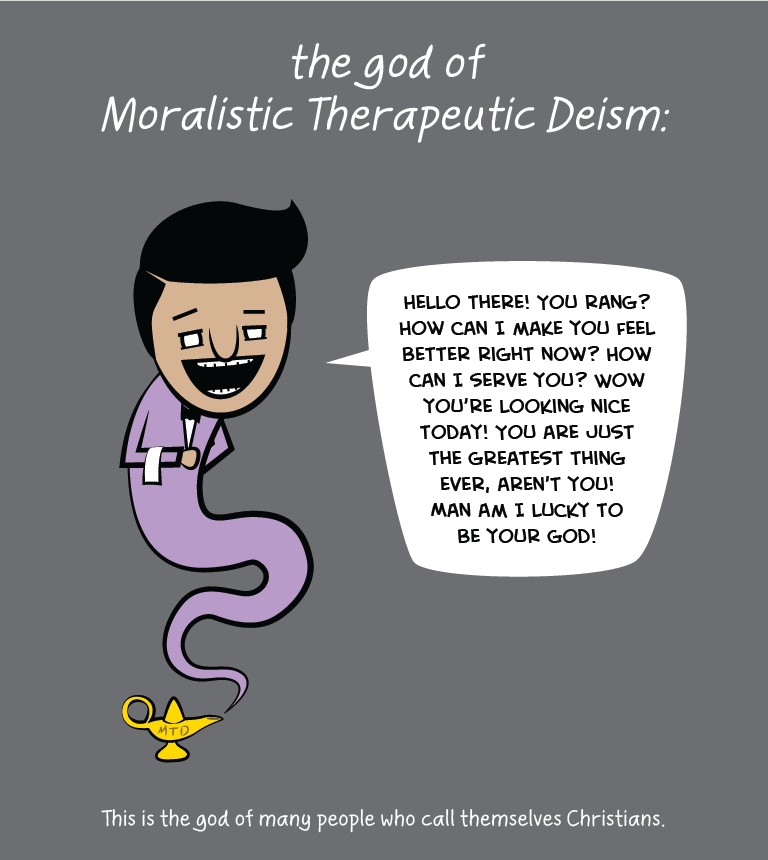
Moralistic Therapeutic Deism Genie by Adam Ford

What do Americans believe?  In my last post, I suggested that even though 65% of Americans say they are Christian, I and others believe that many (most?) of them are not. Many of them believe in the Moralistic Therapeutic Deism worldview and not the Christian worldview.  What is Moralistic Therapeutic Deism (MTD)?  Those with MTD beliefs tend to believe in 5 tenets.

  1. A God exists who created and ordered the world and watches over human life on earth.
  2. God wants people to be good, nice, and fair to each other, as taught in the Bible and by most world religions.
  3. The central goal of life is to be happy and to feel good about oneself.
  4. God does not need to be particularly involved in one’s life except when God is needed to resolve a problem.
  5. Good people go to heaven when they die.

This comes from a survey of teenagers (15+ years ago). The survey (Smith, Christian; Lundquist Denton, Melina (2005). Soul Searching: The Religious and Spiritual Lives of American Teenagers) also asked where the teens got their beliefs.  For most, their beliefs came from their parents, so these beliefs cover at least a few generations. 

Moralistic Therapeutic Deism is not an organized faith, however it is so pervasive in America that some call it the civil or civic religion of America.  Tenets 2 and 5 describe the moralistic beliefs while tenets 3 and 4 describe the therapeutic beliefs. They are considered deists because of the minimal interaction of their creator god with the world (tenets 1 and 4). One can see these beliefs in American culture over the past 50+ years.

Even though many MTD deists will say they are Christian, MTD is not at all like traditional Christianity.  First MTD is very “Me” oriented and is not focused on God and what he has done for us.  For MTD, god is not involved and there is no relationship with us except being ready to help when needed.  In Christianity God desires a relationship of love with him and is very involved in the world.  Life as a Christian is about serving him in love and thankfulness, not as MTD says about being happy and feeling good. In fact, the God in Christianity does not promise happiness, but he does promise being there in the tough times.  

The Christian Faith is about bad people going to heaven, not good people, because we all are bad and in need of God’s forgiveness and grace. We find our identity in the fact that we are loved by God, not in our own goodness.  We can be realistic about our shortcomings because we are loved by God.  

Tenet 2 says “God wants people to be good, nice, and fair to each other, as taught in the Bible and by most world religions.”   That is true in a broad general sense, but with Tenet 5 it makes MTD into what we do to get to God, not God reaching down to save us as the Christian Faith declares.  It also implies that all major world religions are effectively the same. That is far from the truth, but is a fairly common belief among Americans. 

So what do you say when you are talking about spiritual matters to an American?  First you can not assume they believe what you believe.  Americans tend to pick and choose what they believe.  MTD is a summary of what the common beliefs are.  You need to ask and listen carefully to what they say they believe.  Ask questions and nail down the best you can of what they believe.  And then respectfully share with them what you believe.

Check out this explanation of Moralistic Therapeutic Deism in comic form by Adam Ford.

Christian Worldview

What do you believe?  Though 65% of Americans say they are Christian (Pew Research, 2019; https://www.pewforum.org/2019/10/17/in-u-s-decline-of-christianity-continues-at-rapid-pace/), I believe that most of them view the world in a very different way from the traditional Christian view of the world.  Here is a short summary of what I believe. I believe this fits into that traditional Christian worldview.

When I look at myself, I see that I have a strong tendency to be selfish and self-centered. I look around and I see that I am not alone. Self centeredness is part of our human condition.  Because of it all kinds of evil and injustice exist. We are able to dream of utopia, where everyone is well behaved and loved and everyone works for the common good, but we are unable to achieve that. That is because we are messed up and broken.  Deep down inside of each of us we are selfish. This is the root of our problems, and this eventually corrupts every human institution and undertaking, no matter how noble.

I believe there is a solution. We can not fix ourselves but God can. God loves each and every one of us. Jesus came into the world to show us God and how much he loves us. He died for our selfish wrongdoing and wrong thinking.  And he rose from the dead to show us that he has a good life of love for us. Trusting in him, starts a process of changing us into loving people and removing that self centeredness. We, who believe, will one day be fully renewed, and will  be in a full and complete relationship with God. That is what I believe and what I have experienced.

For a much longer version, 22 years ago I wrote this “creed” of what I believe.  If I wrote it today, it might look slightly different but it is a good summary of what I believe.  Read it here: https://heinsite.blog/what-i-believe-the-creed-of-paul-f-hein/

My View, Your View, Worldviews

Have you ever been frustrated at someone because they can not seem to understand what you are saying?  Maybe that is why we seem so divisive today. People can view the world very differently than you do. The next several posts I will explore some different ways of viewing the world.  All the posts will give a very broad brushstroke of the worldviews. Note people do mix and match portions of worldviews, taking an idea you want from one worldview and leaving other ideas to grab from a different worldview.

This post will focus on the broad worldview of Postmodernism.  This seems to be where society is transitioning to. I believe we are in a transition period from Modernism to Postmodernism or whatever the new worldview will be.  

Modernism was all about reason.  One relied on reason to determine the facts, the reality.  The idea was that by reason through science we would progress as a society in improving ourselves. We progressed technologically but socially we did not.

Postmodern scholars about 60-70 years ago pointed out that there is always a bias in how the facts were presented, and about 40 years ago these ideas started to take hold in today’s culture.  Due to assumed bias, Postmodernism provides no objective verification of the facts. Because of that they said the truth can not be known. Most postmoderns will allow some truth to be known, but most say that absolute moral truth can not be known. They tend to distrust all authority.  They say we are shaped by outside cultural and societal forces. (For example, industry though advertising has influenced us to be consumers of their products.)

Language is a powerful tool, but the rules and framework of a language provide constraints to the thoughts and ideas.  A postmodern would see that as mind control. The postmodern will make use of metaphors in creative ways to provide conceptual liberation and new connections of thought. Since the postmodern sees interpretation as a key part of any information, they are willing to interpret the information as they decide, not necessarily by any objective manner.  They are also interested in deconstructing any text to show the bias in the text. Their positive focus instead is on the persuasive power of stories. Stories are important in a postmodern world.

A postmodern would point out that Heath White, the author of the book (Postmodernism 101: A First Course for the Curious Christian) I mostly used to write this, is giving his perspective on Postmodernism, and I in my note taking and writing this post has constrained it further with my own bias. 

I am a believer in objective truth. Postmoderns believe that there is no such thing as objective truth.   So how can we have a conversation with a postmodern? You need to realize that using reason will not convince a postmodern.  They can claim bias. Using a story to make your point will work better. You also need to be aware that they may interpret things differently than you.  I have seen a Facebook post where the Thanksgiving holiday was interpreted as a reminder of the oppression of Native Americans by the White settlers. That is not how I would interpret the Thanksgiving holiday, but postmodernism allows you the freedom to interpret as you desire.  Don’t be surprised at the different views postmodern people will promote. They feel free to do so. Again I have seen the same event in 2016 as being interpreted by members of both political parties as a reason to vote against the other presidential candidate. Objective truth would make that impossible.  So, as always, be wary of political party claims this election season. You need to be careful to discern the truth. Since postmodernism is a broad worldview that has entered our society many years ago, you need to take a look at yourself and ask “How has postmodernism affected the way I view the world?” I am asking myself that question.

Oh My!

Coronavirus (Fusion Medical)

Worry! Fear! Panic!  The coronavirus has produced a lot of worry, fear, and panic.  The quick spread of the coronavirus is concerning, but as Christian I need not worry or  be afraid. I still worry a little because the unknown is scary, but I need to remind myself that God has this and he is ultimately in control.  We trust him because he desires the best for each of us, and we can rest in the peace that he gives. There is no need for fear and worry.   

Most who get sick with the coronavirus will have mild symptoms.  That is the case for 80% of those who get it. About 20% get it bad and only about 1-2% of the cases will result in death. That 1-2% is about 10 times of what it is for the flu.  Those who are old or with fragile health are the ones at greater risk of serious complications.

As a child of God,  I should respond to the situation with love and concern for others.  It is those of old age or with fragile health that we need to be concerned about.  That is why taking the warnings and recommendations seriously is important. I don’t want to infect a vulnerable person.  I am doing a better job of washing my hands and doing it more often. I will do more disinfecting. I will go to less events, and I will be more careful at the events I do attend. The goal is to reduce the spread of the coronavirus.  I will be especially careful around those of fragile health or old age. The last thing I want to do is to infect them. That will mean more phone calls and less visits. I don’t want to isolate them either. And there may come a time when I could be of service delivering meals to those quarantined.  Those are my plans. What are yours? How calm are you? Don’t worry. Don’t panic. God is there for you with his love and peace.

Who am I?

hats

What defines me? Who am I?  What is my identity? Those questions get asked by a lot of people.  I have asked those questions of myself over the years. I can come up with many different answers.  I am a retired computer person, a retired research meteorologist, an American, a graduate of the University of Washington, a graduate of Camas High School, a Lutheran Christian, a husband, and a heterosexual white male.  None of these answers really matter. What matters is that I am forgiven and loved, a child of God. That is who I am. That is what matters, and it is all because of what Jesus did out of love for me and you.

We tend to make a big deal out of our identities, many times too big of a deal.  We get into “us versus them” tribalism. So we compare ourselves, our group identity, with others, and say something like this, “We are better than you because we are the great UW Huskies and you are only lowly WSU Cougars”, or vice versa. Rivalries can be fun, but they are not important and are not defining who we really are.  Deep down inside we are all the same. There is no “us versus them”. We all are broken, corrupt, self-centered people. We are sinful people in need of help. The strange thing is God still loves us despite our many faults. It is his unconditional agape love (talked about in the last post, What is love? – heinsite) that restores us to him.  We are loved and forgiven. We can be his, and that becomes our identity.  We become forgiven and loved children of God. Turn to God and receive his love.  That is what really matters.