Moralistic Therapeutic Deism

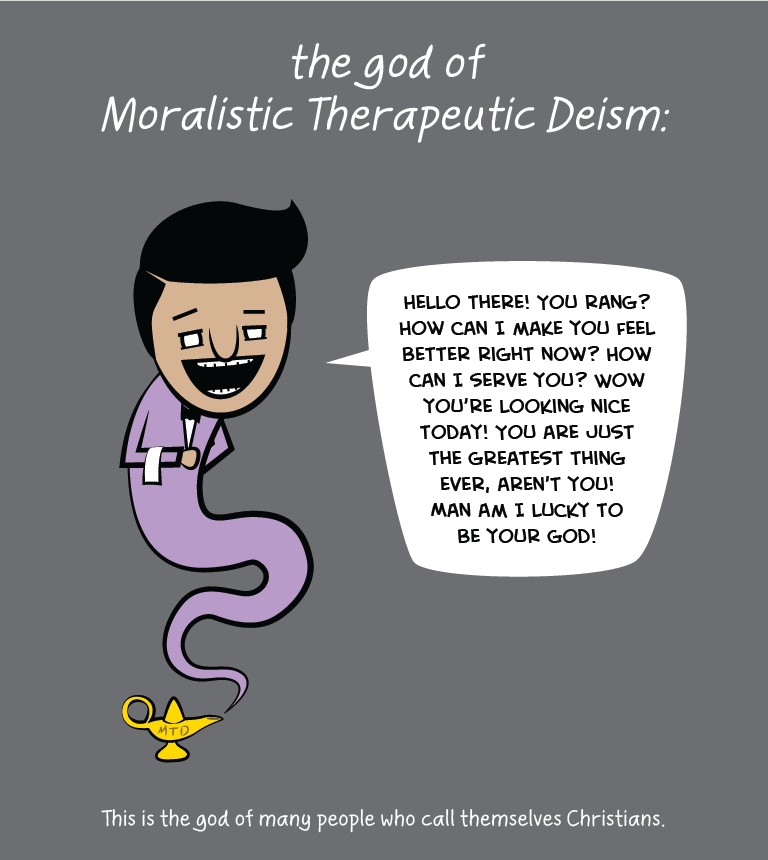
Moralistic Therapeutic Deism Genie by Adam Ford

What do Americans believe?  In my last post, I suggested that even though 65% of Americans say they are Christian, I and others believe that many (most?) of them are not. Many of them believe in the Moralistic Therapeutic Deism worldview and not the Christian worldview.  What is Moralistic Therapeutic Deism (MTD)?  Those with MTD beliefs tend to believe in 5 tenets.

  1. A God exists who created and ordered the world and watches over human life on earth.
  2. God wants people to be good, nice, and fair to each other, as taught in the Bible and by most world religions.
  3. The central goal of life is to be happy and to feel good about oneself.
  4. God does not need to be particularly involved in one’s life except when God is needed to resolve a problem.
  5. Good people go to heaven when they die.

This comes from a survey of teenagers (15+ years ago). The survey (Smith, Christian; Lundquist Denton, Melina (2005). Soul Searching: The Religious and Spiritual Lives of American Teenagers) also asked where the teens got their beliefs.  For most, their beliefs came from their parents, so these beliefs cover at least a few generations. 

Moralistic Therapeutic Deism is not an organized faith, however it is so pervasive in America that some call it the civil or civic religion of America.  Tenets 2 and 5 describe the moralistic beliefs while tenets 3 and 4 describe the therapeutic beliefs. They are considered deists because of the minimal interaction of their creator god with the world (tenets 1 and 4). One can see these beliefs in American culture over the past 50+ years.

Even though many MTD deists will say they are Christian, MTD is not at all like traditional Christianity.  First MTD is very “Me” oriented and is not focused on God and what he has done for us.  For MTD, god is not involved and there is no relationship with us except being ready to help when needed.  In Christianity God desires a relationship of love with him and is very involved in the world.  Life as a Christian is about serving him in love and thankfulness, not as MTD says about being happy and feeling good. In fact, the God in Christianity does not promise happiness, but he does promise being there in the tough times.  

The Christian Faith is about bad people going to heaven, not good people, because we all are bad and in need of God’s forgiveness and grace. We find our identity in the fact that we are loved by God, not in our own goodness.  We can be realistic about our shortcomings because we are loved by God.  

Tenet 2 says “God wants people to be good, nice, and fair to each other, as taught in the Bible and by most world religions.”   That is true in a broad general sense, but with Tenet 5 it makes MTD into what we do to get to God, not God reaching down to save us as the Christian Faith declares.  It also implies that all major world religions are effectively the same. That is far from the truth, but is a fairly common belief among Americans. 

So what do you say when you are talking about spiritual matters to an American?  First you can not assume they believe what you believe.  Americans tend to pick and choose what they believe.  MTD is a summary of what the common beliefs are.  You need to ask and listen carefully to what they say they believe.  Ask questions and nail down the best you can of what they believe.  And then respectfully share with them what you believe.

Check out this explanation of Moralistic Therapeutic Deism in comic form by Adam Ford.

Christian Worldview

What do you believe?  Though 65% of Americans say they are Christian (Pew Research, 2019; https://www.pewforum.org/2019/10/17/in-u-s-decline-of-christianity-continues-at-rapid-pace/), I believe that most of them view the world in a very different way from the traditional Christian view of the world.  Here is a short summary of what I believe. I believe this fits into that traditional Christian worldview.

When I look at myself, I see that I have a strong tendency to be selfish and self-centered. I look around and I see that I am not alone. Self centeredness is part of our human condition.  Because of it all kinds of evil and injustice exist. We are able to dream of utopia, where everyone is well behaved and loved and everyone works for the common good, but we are unable to achieve that. That is because we are messed up and broken.  Deep down inside of each of us we are selfish. This is the root of our problems, and this eventually corrupts every human institution and undertaking, no matter how noble.

I believe there is a solution. We can not fix ourselves but God can. God loves each and every one of us. Jesus came into the world to show us God and how much he loves us. He died for our selfish wrongdoing and wrong thinking.  And he rose from the dead to show us that he has a good life of love for us. Trusting in him, starts a process of changing us into loving people and removing that self centeredness. We, who believe, will one day be fully renewed, and will  be in a full and complete relationship with God. That is what I believe and what I have experienced.

For a much longer version, 22 years ago I wrote this “creed” of what I believe.  If I wrote it today, it might look slightly different but it is a good summary of what I believe.  Read it here: https://heinsite.blog/what-i-believe-the-creed-of-paul-f-hein/

My View, Your View, Worldviews

Have you ever been frustrated at someone because they can not seem to understand what you are saying?  Maybe that is why we seem so divisive today. People can view the world very differently than you do. The next several posts I will explore some different ways of viewing the world.  All the posts will give a very broad brushstroke of the worldviews. Note people do mix and match portions of worldviews, taking an idea you want from one worldview and leaving other ideas to grab from a different worldview.

This post will focus on the broad worldview of Postmodernism.  This seems to be where society is transitioning to. I believe we are in a transition period from Modernism to Postmodernism or whatever the new worldview will be.  

Modernism was all about reason.  One relied on reason to determine the facts, the reality.  The idea was that by reason through science we would progress as a society in improving ourselves. We progressed technologically but socially we did not.

Postmodern scholars about 60-70 years ago pointed out that there is always a bias in how the facts were presented, and about 40 years ago these ideas started to take hold in today’s culture.  Due to assumed bias, Postmodernism provides no objective verification of the facts. Because of that they said the truth can not be known. Most postmoderns will allow some truth to be known, but most say that absolute moral truth can not be known. They tend to distrust all authority.  They say we are shaped by outside cultural and societal forces. (For example, industry though advertising has influenced us to be consumers of their products.)

Language is a powerful tool, but the rules and framework of a language provide constraints to the thoughts and ideas.  A postmodern would see that as mind control. The postmodern will make use of metaphors in creative ways to provide conceptual liberation and new connections of thought. Since the postmodern sees interpretation as a key part of any information, they are willing to interpret the information as they decide, not necessarily by any objective manner.  They are also interested in deconstructing any text to show the bias in the text. Their positive focus instead is on the persuasive power of stories. Stories are important in a postmodern world.

A postmodern would point out that Heath White, the author of the book (Postmodernism 101: A First Course for the Curious Christian) I mostly used to write this, is giving his perspective on Postmodernism, and I in my note taking and writing this post has constrained it further with my own bias. 

I am a believer in objective truth. Postmoderns believe that there is no such thing as objective truth.   So how can we have a conversation with a postmodern? You need to realize that using reason will not convince a postmodern.  They can claim bias. Using a story to make your point will work better. You also need to be aware that they may interpret things differently than you.  I have seen a Facebook post where the Thanksgiving holiday was interpreted as a reminder of the oppression of Native Americans by the White settlers. That is not how I would interpret the Thanksgiving holiday, but postmodernism allows you the freedom to interpret as you desire.  Don’t be surprised at the different views postmodern people will promote. They feel free to do so. Again I have seen the same event in 2016 as being interpreted by members of both political parties as a reason to vote against the other presidential candidate. Objective truth would make that impossible.  So, as always, be wary of political party claims this election season. You need to be careful to discern the truth. Since postmodernism is a broad worldview that has entered our society many years ago, you need to take a look at yourself and ask “How has postmodernism affected the way I view the world?” I am asking myself that question.

Oh My!

Coronavirus (Fusion Medical)

Worry! Fear! Panic!  The coronavirus has produced a lot of worry, fear, and panic.  The quick spread of the coronavirus is concerning, but as Christian I need not worry or  be afraid. I still worry a little because the unknown is scary, but I need to remind myself that God has this and he is ultimately in control.  We trust him because he desires the best for each of us, and we can rest in the peace that he gives. There is no need for fear and worry.   

Most who get sick with the coronavirus will have mild symptoms.  That is the case for 80% of those who get it. About 20% get it bad and only about 1-2% of the cases will result in death. That 1-2% is about 10 times of what it is for the flu.  Those who are old or with fragile health are the ones at greater risk of serious complications.

As a child of God,  I should respond to the situation with love and concern for others.  It is those of old age or with fragile health that we need to be concerned about.  That is why taking the warnings and recommendations seriously is important. I don’t want to infect a vulnerable person.  I am doing a better job of washing my hands and doing it more often. I will do more disinfecting. I will go to less events, and I will be more careful at the events I do attend. The goal is to reduce the spread of the coronavirus.  I will be especially careful around those of fragile health or old age. The last thing I want to do is to infect them. That will mean more phone calls and less visits. I don’t want to isolate them either. And there may come a time when I could be of service delivering meals to those quarantined.  Those are my plans. What are yours? How calm are you? Don’t worry. Don’t panic. God is there for you with his love and peace.

Who am I?

hats

What defines me? Who am I?  What is my identity? Those questions get asked by a lot of people.  I have asked those questions of myself over the years. I can come up with many different answers.  I am a retired computer person, a retired research meteorologist, an American, a graduate of the University of Washington, a graduate of Camas High School, a Lutheran Christian, a husband, and a heterosexual white male.  None of these answers really matter. What matters is that I am forgiven and loved, a child of God. That is who I am. That is what matters, and it is all because of what Jesus did out of love for me and you.

We tend to make a big deal out of our identities, many times too big of a deal.  We get into “us versus them” tribalism. So we compare ourselves, our group identity, with others, and say something like this, “We are better than you because we are the great UW Huskies and you are only lowly WSU Cougars”, or vice versa. Rivalries can be fun, but they are not important and are not defining who we really are.  Deep down inside we are all the same. There is no “us versus them”. We all are broken, corrupt, self-centered people. We are sinful people in need of help. The strange thing is God still loves us despite our many faults. It is his unconditional agape love (talked about in the last post, What is love? – heinsite) that restores us to him.  We are loved and forgiven. We can be his, and that becomes our identity.  We become forgiven and loved children of God. Turn to God and receive his love.  That is what really matters.

What is love?

love you

February is the month, where we make a big deal out of love, especially here in Loveland, Colorado.  The English word love is not well defined. You can come up with several definitions of love depending on the context.  I have found one definition that I think does a fair job of covering what it means to love. I think it is a good definition.

“Love is a commitment you make to act in someone else’s best interest. True love can only be known by the actions that it prompts.” (“God Space”, by Doug Pollock, p. 92)

Many think that love is a feeling.  I would disagree. Love is not a feeling though feelings are many times connected with love.  Love is altruistic. It puts the other person needs first.

A great description of love is found in 1 Corinthians 13:4-8a: “Love is patient and kind; love does not envy or boast; it is not arrogant or rude. It does not insist on its own way; it is not irritable or resentful;  it does not rejoice at wrongdoing, but rejoices with the truth. Love bears all things, believes all things, hopes all things, endures all things.  Love never ends.” (https://www.biblegateway.com/passage/?search=1+Corinthians+13&version=ESV)

The Greek word for love in this passage is agape.  It is a selfless unconditional love. (Greek has many words that can be translated as love.)  It is the primary word for love in the Bible. It is the love that God has shown us. Romans 5:8 says, “but God shows his love for us in that while we were still sinners, Christ died for us.”  This passage shows that God’s love is tangible, an action that is directed toward each one of us. It is also unconditional. We did not have to get our act together. We were “still sinners”. And it is a sacrificial love that cost Jesus his life.  

Look back at 1 Corinthians 13:4-8a.  Replace the word love (and it) with Jesus or God, and read it again.  That describes Jesus. It is who he is. You can replace love with your name instead, and see how well you do.  I know that I fail many times at these things. I tend to be selfish and not selfless. Many times it has been my needs and my happiness that have driven my love actions.  My love has not been pure as it should be. Thank God that he is not like me. He loves us totally with that selfless unconditional agape love. Though you can not always count on me, you can count on God.  His love is there for you. He always desires the best for you.

Starting A Blog

I am starting a blog, https://heinsite.blog .  In the blog, there will be a variety of posts.  I am doing this because I want to share with you.  From the posts you can find out what I am interested in and what I consider to be important.  Many of the posts will be Christian or spiritual oriented, but not all posts will be on those topics.  Since this blog was originally setup many years ago by Gail she may also post on it too. My plan is to do about 2 posts a month.  I will announce them on Facebook and via email. Let me know if you want to be on the email list. My posts will always have the category of “Paul”.  The blog will allow comments but they will be moderated so it may take a little time before they are approved and show up on the site.